Boeing misses out on Fed cut rally as workers strike for first time in 16 years
- 33,000 Boeing workers walk off the job on Friday.
- Workers want a 40% increase in pay over four years.
- Wall Street trades higher as Bill Dudley calls for 50 bps cut.
- Inflation expectations fall to lowest level in eight months.

The market has reached euphoria on Friday, but Boeing (BA) is the Dow Jones stock most left out of the rally. A major strike, the first in a decade and a half, has brought further uncertainty to the aeronautics company beset by a slew of internal issues.
The Dow Jones Industrial Average (DJIA) has gained 0.9% on Friday, leading the other indices as Wall Street hopes grow for a 50 bps interest rate cut from the Federal Reserve (Fed) at the September 18 meeting next week. It was already helped along on Thursday by late-breaking Producer Price Index (PPI) data. Boeing stock is off 3.4% at the time of writing.
Boeing stock news
About 96% of Boeing’s unionized workforce voted in favor of a strike late Thursday night. There are 33,000 members of the International Association of Machinists & Aerospace Workers (IAM) at Boeing, and the union requires a two-thirds majority in order to effect a walkout.
The difference between the union and Boeing management is primarily the latter’s offer of a 25% salary raise that would be implemented over the course of four years. The union and vast majority of workers are asking for a 40% raise.
The work stoppage, the first since 2008, will affect production of the company’s 737 MAX line of airplanes and could cost the company as much as $1.5 billion if it lasts for 30 days, according to reports from CNBC.
The strike comes after years of worrying events at America’s largest exporter. Boeing has faced lawsuits and government investigations since 2018 following passenger airline crashes in Ethiopia and Indonesia.
Safety issues and the murder of an engineering whistleblower have also placed a dark cloud above the company’s prospects. Shares have shed 40% this year alone and 58% over the past five years.
Wall Street grows excited for 50 bps
Chances of a 50 bps interest rate cut next Wednesday have soared from 28% to 43% on Friday, according to data from the CME Group’s FedWatch Tool. A multitude of factors have surfaced overnight to make that the case.
In Friday’s University of Michigan Consumer Sentiment Index, the year-ahead inflation expectations fell for the fourth month in a row to 2.7%. That is the lowest level since December 2020.
Additionally, a report from the Labor Department on Friday found that import prices in August dropped by the most in eight months.
Articles in the Financial Times and The Wall Street Journal both emphasized that despite 25 bps being the mainstream expectation at next Wednesday’s Federal Open Market Committee (FOMC) meeting, it is really a tossup based on conversations among those in the know.
Former New York Fed President Bill Dudley, who is thought to be aware of current internal FOMC conversations, highlighted a “strong case” for a deeper cut. Goldman Sachs has been outspoken about the need for a 50 bps cut over the past week as well.
Boeing stock chart
Seen from a monthly chart perspective, Boeing's travails are really brought home. The best one can hope for is that the $120 level holds. That level supported price action back in 2020 and 2022.
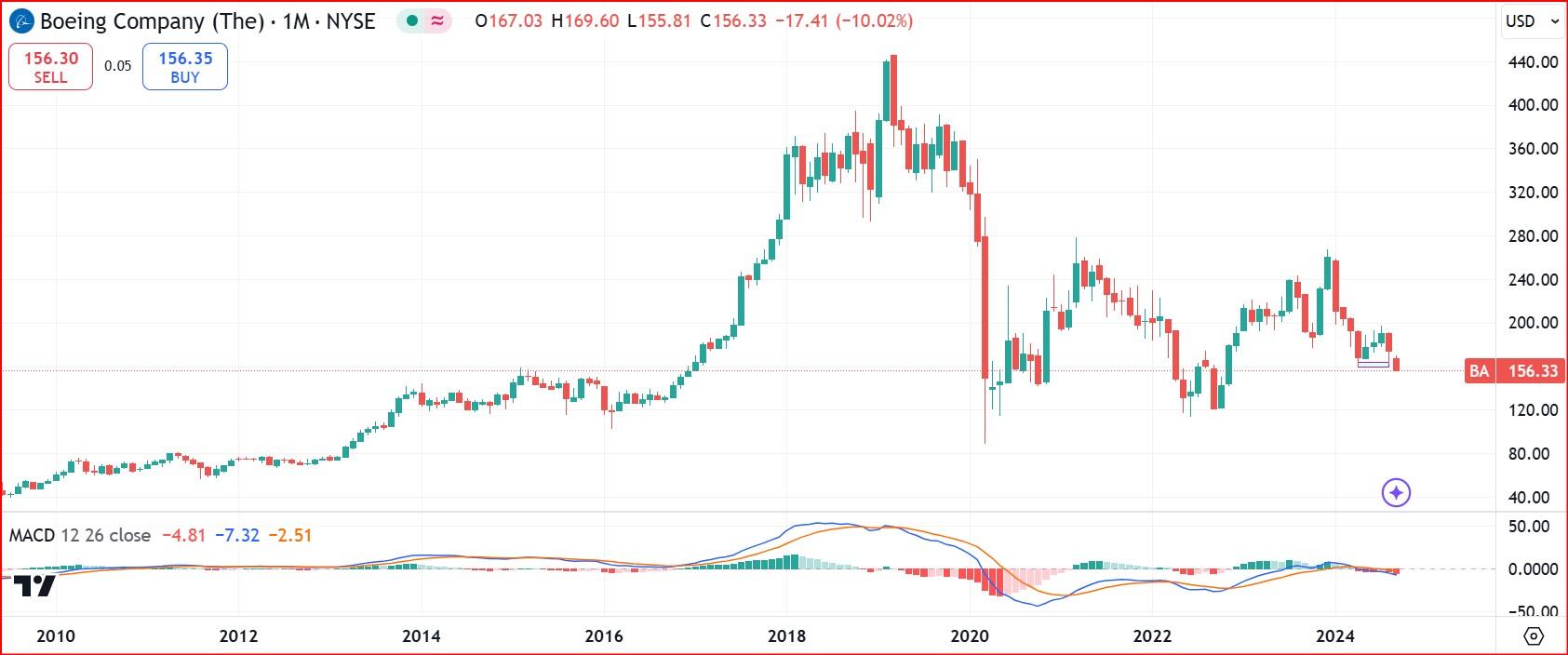
BA monthly stock chart
Author

Clay Webster
FXStreet
Clay Webster grew up in the US outside Buffalo, New York and Lancaster, Pennsylvania. He began investing after college following the 2008 financial crisis.