Australian Dollar remains resilient in risk-off mood ahead of Judo Bank PMIs
- AUD/USD slips as geopolitical tensions weigh on risk sentiment.
- US private hiring data improves, while Richmond Fed President Barkin warns that inflation remains a concern despite recent rate cuts.
- Traders focus on upcoming Australian PMI data with the RBA focused on high inflation.

The Australian Dollar (AUD) registers minimal losses against the Greenback late during Wednesday’s North American session after hitting a daily high of 0.6915. Risk aversion boosted the prospects of safe-haven currencies, due to the likelihood of Israel retaliating after Iran’s missile attack on Tuesday. The AUD/USD trades at 0.6882, virtually unchanged.
Antipodeans remained pressured due to geopolitical tensions. Hence, the Greenback was boosted as Israel’s envoy to the United Nations warned of a possible attack. At the same time, a senior official at the US State Department revealed that the US is also weighing the answer to Iran’s attack.
US data was positive, with private hiring improving in September. Richmond Fed President Thomas Barkin reiterated that despite lowering rates “aggressively” by 50 basis points (bps) in September, they had not won the battle against inflation.
On the Australian Dollar front, traders are eyeing the release of September’s Judo Bank Services and Composite PMIs, with the former expected to cool down sharply though still in expansionary territory. The Reserve Bank of Australia (RBA) has remained wary that inflation is too high, failing to provide hints of the beginning of its easing cycle.
Earlier, the Australian Bureau of Statistics (ABS) revealed that Retail Sales on Tuesday were better than expected, justifying the RBA’s stance to hold rates higher.
Daily digest market movers: Australian Dollar is on the back foot following US jobs data
- The ADP National Employment Change for September came in at 143K, up from the upwardly revised 103K in the previous month, surpassing the forecast of 120K.
- Market participants have placed the odds of a 25 bps Fed rate cut at 64%, while the chances for a more significant 50 bps cut have diminished to 36%, according to the CME FedWatch Tool.
- Australia’s Judo Bank Services PMI is expected to decrease from 52.5 to 50.6 in September. The latest reading of the Composite PMI was 51.7. A reading lower than expected would suggest a deterioration in business activity.
- The latest Aussie Retail Sales fared better than expected, crushed the 0.4% increase in July and rose 0.7% MoM in August.
- Retail Sales on Tuesday, the primary gauge of Australia’s consumer spending, rose 0.7% MoM in August. This exceeded the market expectations of a 0.4% increase.
- China’s business activity has deteriorated, which has led to increased stimulus from the People’s Bank of China (PBoC) and the Politburo.
- To stimulate the economy, the PBoC cut loan rates, reduced bank reserve capital requirements and even lowered property down payments. If China’s economy continues to print deflationary readings, it could miss its Gross Domestic Product (GDP) 5% goal for 2024.
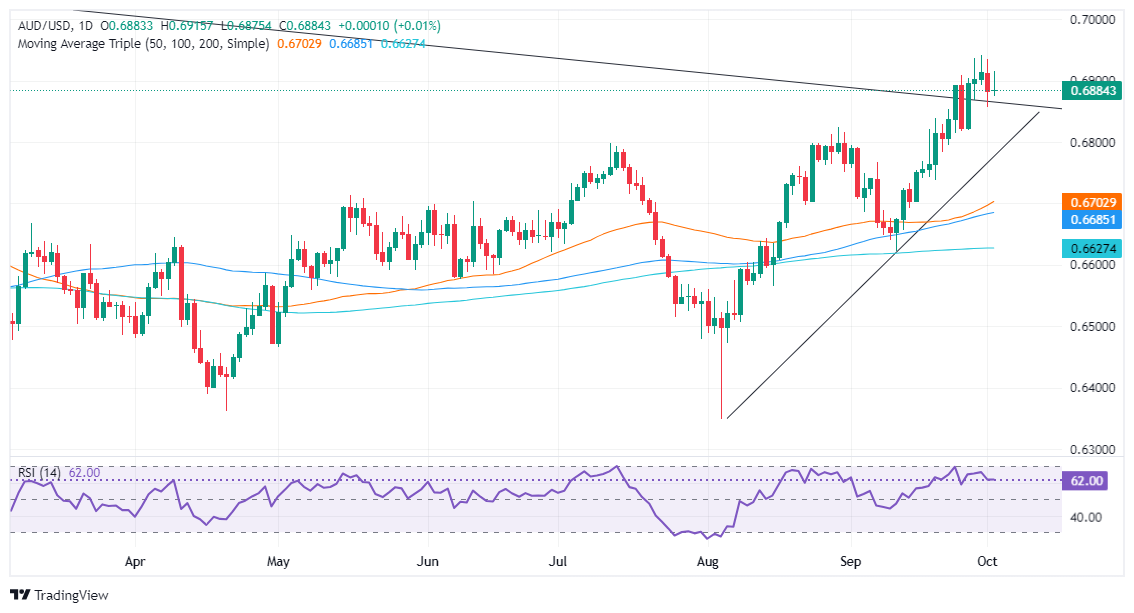
Technical outlook: Australian Dollar to retrace in the short-term before challenging 0.6900
The AUD/USD is set to extend its losses after failing to hold gains above the 0.6900 figure. Although momentum suggests that buyers are in charge, the Relative Strength Index (RSI) is aiming lower in the short term. Therefore, the AUD/USD is tilted to the downside before resuming its ongoing uptrend.
The AUD/USD could test the December 28, 2023 peak turned support at 0.6871 on further weakness. Once surrendered, the next stop would be the October 1, 2024 low of 0.6856, ahead of challenging 0.6800.
However, if AUD/USD aims higher and closes above 0.6900, look for a retest of the year-to-date high of 0.6934.
Australian Dollar FAQs
One of the most significant factors for the Australian Dollar (AUD) is the level of interest rates set by the Reserve Bank of Australia (RBA). Because Australia is a resource-rich country another key driver is the price of its biggest export, Iron Ore. The health of the Chinese economy, its largest trading partner, is a factor, as well as inflation in Australia, its growth rate and Trade Balance. Market sentiment – whether investors are taking on more risky assets (risk-on) or seeking safe-havens (risk-off) – is also a factor, with risk-on positive for AUD.
The Reserve Bank of Australia (RBA) influences the Australian Dollar (AUD) by setting the level of interest rates that Australian banks can lend to each other. This influences the level of interest rates in the economy as a whole. The main goal of the RBA is to maintain a stable inflation rate of 2-3% by adjusting interest rates up or down. Relatively high interest rates compared to other major central banks support the AUD, and the opposite for relatively low. The RBA can also use quantitative easing and tightening to influence credit conditions, with the former AUD-negative and the latter AUD-positive.
China is Australia’s largest trading partner so the health of the Chinese economy is a major influence on the value of the Australian Dollar (AUD). When the Chinese economy is doing well it purchases more raw materials, goods and services from Australia, lifting demand for the AUD, and pushing up its value. The opposite is the case when the Chinese economy is not growing as fast as expected. Positive or negative surprises in Chinese growth data, therefore, often have a direct impact on the Australian Dollar and its pairs.
Iron Ore is Australia’s largest export, accounting for $118 billion a year according to data from 2021, with China as its primary destination. The price of Iron Ore, therefore, can be a driver of the Australian Dollar. Generally, if the price of Iron Ore rises, AUD also goes up, as aggregate demand for the currency increases. The opposite is the case if the price of Iron Ore falls. Higher Iron Ore prices also tend to result in a greater likelihood of a positive Trade Balance for Australia, which is also positive of the AUD.
The Trade Balance, which is the difference between what a country earns from its exports versus what it pays for its imports, is another factor that can influence the value of the Australian Dollar. If Australia produces highly sought after exports, then its currency will gain in value purely from the surplus demand created from foreign buyers seeking to purchase its exports versus what it spends to purchase imports. Therefore, a positive net Trade Balance strengthens the AUD, with the opposite effect if the Trade Balance is negative.
Author

Christian Borjon Valencia
FXStreet
Markets analyst, news editor, and trading instructor with over 14 years of experience across FX, commodities, US equity indices, and global macro markets.















