Australian Dollar holds gains after China's Trade Surplus, awaits NFP
- The Australian Dollar gained ground as trade partner China's Trade Surplus widened to $82.62 billion in May.
- The Australian equity market appreciates with higher mining and energy stocks due to stronger commodity prices.
- The US Dollar struggles as the lower US labor data sparks hopes for two interest rate cuts by the Fed in 2024.

The Australian Dollar (AUD) edges higher following China's Trade Balance data release on Friday. The National Bureau of Statistics of China reported that Trade Surplus widened to $82.62 billion year-over-year in May, surpassing the expected balance of $73.00 billion and the previous balance of $65.55 billion. Any change in China's economy could impact the Australian market as both countries are close trade partners.
AUD traders are likely to await the speech by Andrew Hauser, Deputy Governor of the Reserve Bank of Australia (RBA), on Australia’s economic outlook later in the day. Attention will also turn toward US employment data releases, including Average Hourly Earnings and Nonfarm Payrolls.
The Australian Dollar received support following the widened Trade Surplus on Thursday. Additionally, the hawkish statement by RBA Governor Michele Bullock on Wednesday reinforced the AUD’s strength and underpinned the AUD/USD pair. Bullock indicated that the central bank is prepared to increase interest rates if the Consumer Price Index (CPI) does not return to the target range of 1%-3%, according to NCA NewsWire.
The US Dollar (USD) struggled as the lower employment data from the United States (US) fueled hopes for two interest rate cuts by the US Federal Reserve (Fed) in 2024. On Thursday, Initial Jobless Claims showed the number of people claiming unemployment benefits in the US increased by 8,000 to 229,000 for the week ending May 31, surpassing market expectations of 220,000. This marks the highest reading since the eight-month high of 232,000 recorded in early May.
Daily Digest Market Movers: Australian Dollar edges higher after China's Trade Surplus
- In May, China's exports surged 7.6% year-over-year to $302.35 billion, surpassing market expectations of a 6.0% growth and accelerating from a 1.5% rise in the previous month. Meanwhile, imports rose by 1.8% from the prior year to USD 219.73 billion in May, missing market estimates of 4.2% while experiencing a significant decrease from April's 8.4% rise.
- The ASX 200 Index advanced toward 7,850 on Friday, with mining and energy stocks driving the market higher due to stronger commodity prices. This upward movement was influenced by signs of a cooling US labor market, which increased the Fed's expectations for two interest rate cuts this year.
- A Reuters poll from May 31 to June 5 indicated that nearly two-thirds of economists now predict an interest rate cut in September. Additionally, the CME FedWatch Tool suggests the probability of a Fed rate cut in September by at least 25 basis points has increased to nearly 70.0%, up from 51.0% a week earlier.
- Australia's Trade Balance widened to A$6,548 ($4,321.68) million MoM in May, exceeding the expected A$5,500 million and April's balance of A$5,024 million. Imports plunged by 7.2% MoM in May, swinging from April’s 4.2% increase. Exports shrank 2.5% following the previous decline of 0.6%.
- On Wednesday, the ISM US Services PMI soared to 53.8 in May, marking its highest level in nine months and significantly surpassing the forecast of 50.8. In contrast, the ADP US Employment Change report showed that 152,000 new workers were added to payrolls in May, the lowest in four months and well below the forecast of 175,000 and the downwardly revised figure of 188,000 for April.
- Australia's Gross Domestic Product (GDP) was released on Wednesday, which grew 0.1% in the first quarter, against the expected 0.2% reading. On an annual basis, the economy grew 1.1%, slightly below the expected 1.2%.
Technical Analysis: Australian Dollar maintains its position above 0.6650
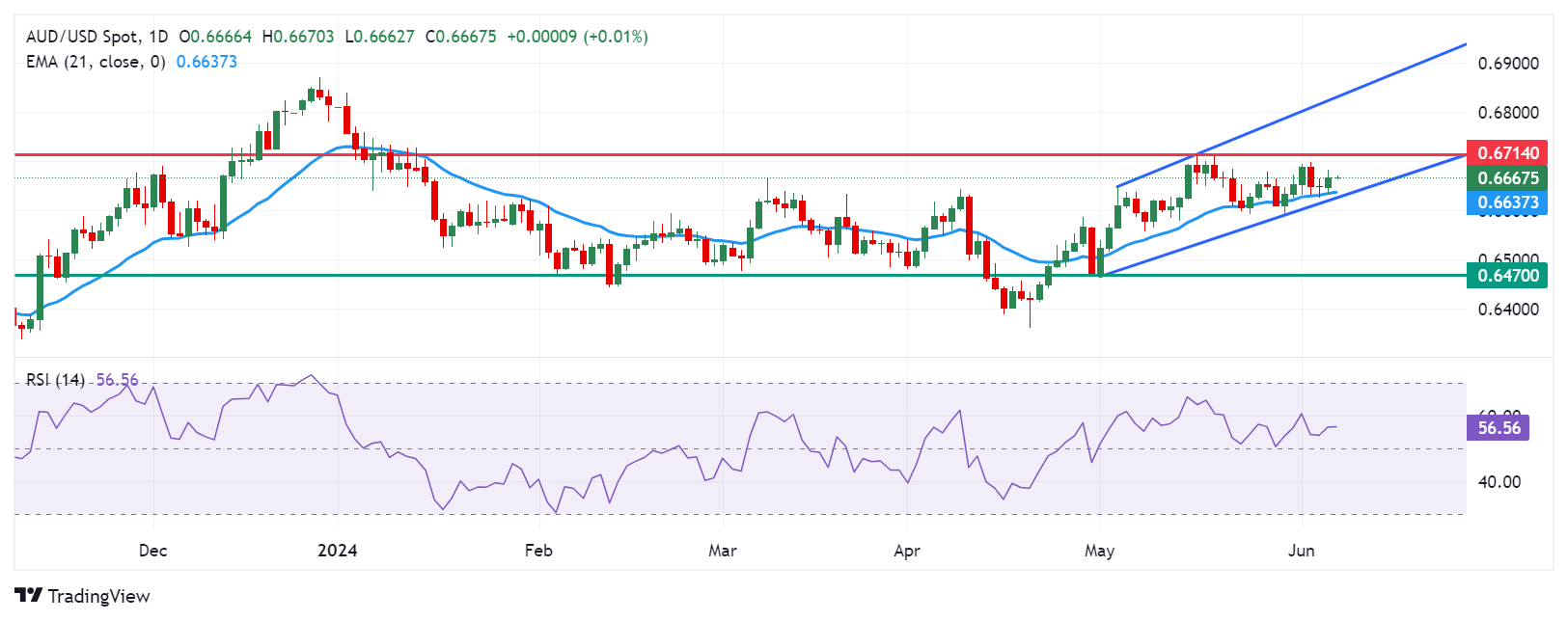
The Australian Dollar trades around 0.6660 on Friday. Analysis of the daily chart indicates a bullish bias for the AUD/USD pair as it consolidates within an ascending channel pattern. This bullish bias is further confirmed by the 14-day Relative Strength Index (RSI), which is above the 50 level.
The AUD/USD pair could target the psychological level of 0.6700, followed by May’s high of 0.6714. A breakthrough above this level could lead the pair to approach the upper boundary of the ascending channel around 0.6800.
On the downside, immediate support is at the 21-day Exponential Moving Average (EMA) at 0.6637, which aligns with the lower threshold of the ascending channel. Additional support is found at the psychological level of 0.6600. A further decline could pressure the AUD/USD pair toward the throwback support region at 0.6470.
AUD/USD: Daily Chart
Australian Dollar price today
The table below shows the percentage change of the Australian Dollar (AUD) against listed major currencies today. The Australian Dollar was the strongest against the Canadian Dollar.
| USD | EUR | GBP | CAD | AUD | JPY | NZD | CHF | |
| USD | -0.03% | -0.06% | 0.01% | -0.12% | -0.29% | -0.02% | -0.13% | |
| EUR | 0.04% | -0.03% | 0.06% | -0.08% | -0.26% | 0.01% | -0.09% | |
| GBP | 0.06% | 0.02% | 0.09% | -0.06% | -0.21% | 0.04% | -0.06% | |
| CAD | -0.02% | -0.05% | -0.08% | -0.13% | -0.29% | -0.04% | -0.14% | |
| AUD | 0.12% | 0.08% | 0.06% | 0.13% | -0.16% | 0.10% | -0.02% | |
| JPY | 0.29% | 0.25% | 0.20% | 0.27% | 0.16% | 0.24% | 0.13% | |
| NZD | 0.02% | -0.02% | -0.04% | 0.04% | -0.10% | -0.27% | -0.13% | |
| CHF | 0.13% | 0.09% | 0.06% | 0.14% | 0.02% | -0.15% | 0.10% |
The heat map shows percentage changes of major currencies against each other. The base currency is picked from the left column, while the quote currency is picked from the top row. For example, if you pick the Euro from the left column and move along the horizontal line to the Japanese Yen, the percentage change displayed in the box will represent EUR (base)/JPY (quote).
Australian Dollar FAQs
One of the most significant factors for the Australian Dollar (AUD) is the level of interest rates set by the Reserve Bank of Australia (RBA). Because Australia is a resource-rich country another key driver is the price of its biggest export, Iron Ore. The health of the Chinese economy, its largest trading partner, is a factor, as well as inflation in Australia, its growth rate and Trade Balance. Market sentiment – whether investors are taking on more risky assets (risk-on) or seeking safe-havens (risk-off) – is also a factor, with risk-on positive for AUD.
The Reserve Bank of Australia (RBA) influences the Australian Dollar (AUD) by setting the level of interest rates that Australian banks can lend to each other. This influences the level of interest rates in the economy as a whole. The main goal of the RBA is to maintain a stable inflation rate of 2-3% by adjusting interest rates up or down. Relatively high interest rates compared to other major central banks support the AUD, and the opposite for relatively low. The RBA can also use quantitative easing and tightening to influence credit conditions, with the former AUD-negative and the latter AUD-positive.
China is Australia’s largest trading partner so the health of the Chinese economy is a major influence on the value of the Australian Dollar (AUD). When the Chinese economy is doing well it purchases more raw materials, goods and services from Australia, lifting demand for the AUD, and pushing up its value. The opposite is the case when the Chinese economy is not growing as fast as expected. Positive or negative surprises in Chinese growth data, therefore, often have a direct impact on the Australian Dollar and its pairs.
Iron Ore is Australia’s largest export, accounting for $118 billion a year according to data from 2021, with China as its primary destination. The price of Iron Ore, therefore, can be a driver of the Australian Dollar. Generally, if the price of Iron Ore rises, AUD also goes up, as aggregate demand for the currency increases. The opposite is the case if the price of Iron Ore falls. Higher Iron Ore prices also tend to result in a greater likelihood of a positive Trade Balance for Australia, which is also positive of the AUD.
The Trade Balance, which is the difference between what a country earns from its exports versus what it pays for its imports, is another factor that can influence the value of the Australian Dollar. If Australia produces highly sought after exports, then its currency will gain in value purely from the surplus demand created from foreign buyers seeking to purchase its exports versus what it spends to purchase imports. Therefore, a positive net Trade Balance strengthens the AUD, with the opposite effect if the Trade Balance is negative.
Author

Akhtar Faruqui
FXStreet
Akhtar Faruqui is a Forex Analyst based in New Delhi, India. With a keen eye for market trends and a passion for dissecting complex financial dynamics, he is dedicated to delivering accurate and insightful Forex news and analysis.