Australian Dollar moves little due to thin trading before Christmas holiday
- The Australian Dollar depreciates as the RBA may begin rate cuts in February.
- The RBA’s Meeting Minutes suggested that the board had grown more confident about inflation; however, risks persisted.
- US Dollar appreciated as Fed policymakers signaled fewer rate cuts in 2025 due to a slowdown in the disinflation process.

The Australian Dollar (AUD) loses ground for the second successive day against the US Dollar (USD) on Tuesday following the release of the Reserve Bank of Australia’s (RBA) Meeting Minutes for its December monetary policy. Trading activity is expected to be subdued before the Christmas holiday.
The RBA’s Meeting Minutes indicated that the board had grown more confident about inflation since its previous meeting, though risks persisted. The board emphasized the need for monetary policy to remain "sufficiently restrictive" until there was greater certainty about inflation.
The RBA board also noted that if future data aligns with or falls below forecasts, it would bolster confidence in inflation and make it appropriate to start easing policy restrictions. However, stronger-than-expected data could require maintaining restrictive policy for a longer period.
Reserve Bank of Australia Governor Michele Bullock highlighted the continued strength of the labor market as a key reason the RBA has been slower than other nations to commence its monetary easing cycle.
Australian Dollar weakens as traders expect fewer Fed rate cuts next year
- The US Dollar rebounded following a sharp sell-off as Federal Reserve (Fed) policymakers signaled fewer interest rate cuts next year due to a slowdown in the disinflation process. However, soft US PCE data have tempered inflation concerns, presenting a mixed outlook for the economy.
- According to the CME FedWatch tool, markets now anticipate a nearly 93% probability that the Federal Reserve (Fed) will keep interest rates unchanged in January, maintaining the current range of 4.25%–4.50%.
- US Durable Goods Orders for November came in weaker than expected, with fresh orders declining by 1.1%, compared to the projected 0.4% drop. This follows an upwardly revised increase of 0.8% in October, up from the initially reported 0.2%.
- The US Consumer Confidence Index, published by the Conference Board, fell by 8.1 points in December, landing at 104.7. “The recent rebound in consumer confidence was not sustained in December as the Index dropped back to the middle of the range that has prevailed over the past two years,” noted Dana M. Peterson, Chief Economist at The Conference Board.
- US households expressed concerns about President-elect Trump’s economic policies, with nearly half of respondents fearing that tariffs could drive up the cost of living. These concerns were compounded by the Federal Open Market Committee’s (FOMC) recent projections, which indicated fewer rate cuts in 2025, reflecting caution amid persistent inflationary pressures.
- On Friday, Cleveland Fed President Beth Hammack said that she prefers to hold interest rates steady "until the Fed gets further evidence that inflation is resuming its path to its 2% objective,” per Reuters.
- Chicago Fed President Austan Goolsbee stated in an interview with CNBC that uncertainty surrounding Trump’s policies after taking office led him to revise his projection for 2025. While he had previously anticipated a 100-basis-point (bps) interest rate reduction, he now expects fewer cuts.
- US core PCE inflation year-over-year, the Fed’s preferred inflation measure, rose steadily by 2.8%, slower than estimates of 2.9%. The monthly core inflation grew moderately by 0.1%, against forecasts of 0.2% and the prior release of 0.3%.
Australian Dollar remains below 0.6250, with RSI reflecting risks to the upward correction
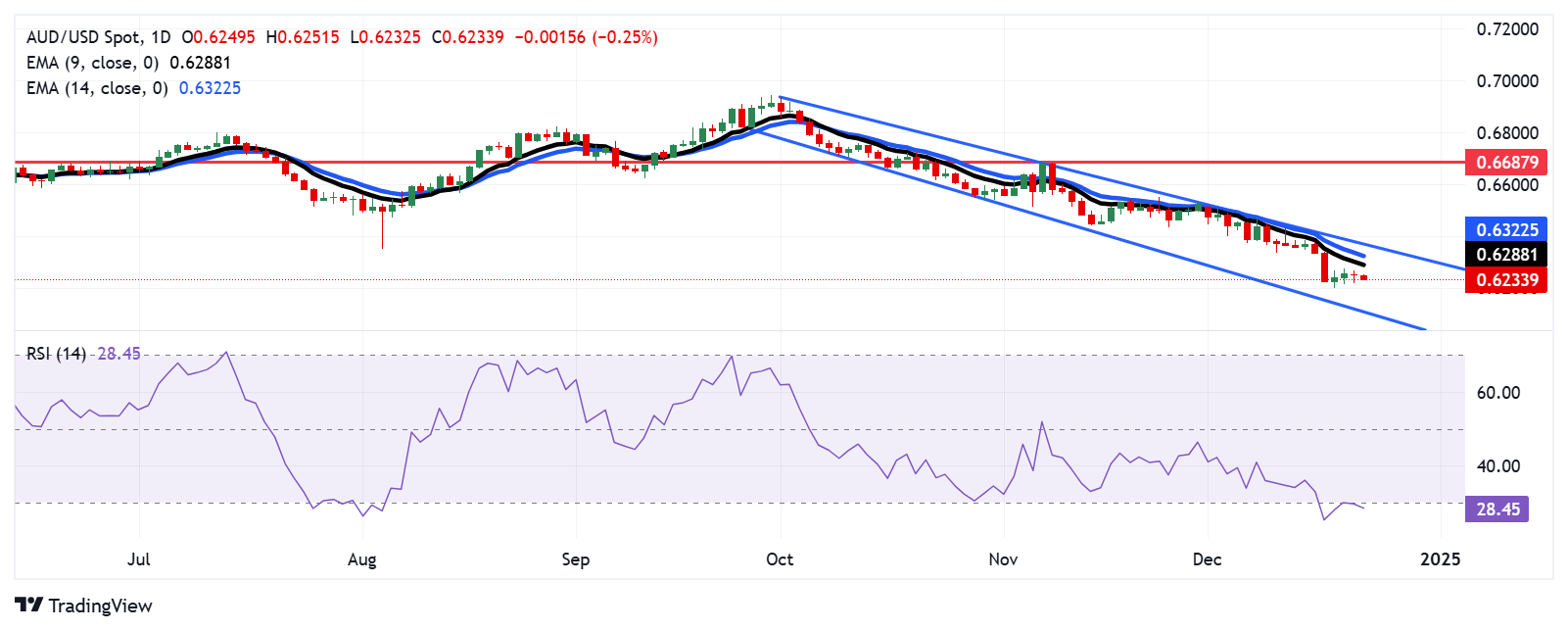
AUD/USD trades near 0.6230 on Tuesday, with the daily chart signaling a persistent bearish bias as the pair remains within a descending channel pattern. The 14-day Relative Strength Index (RSI) dips below the 30-level, suggesting the potential near-term upward correction to dissipate.
On the downside, the AUD/USD pair may test the lower boundary of the descending channel near the 0.6110 support level.
To the upside, the AUD/USD pair faces an initial barrier at the nine-day Exponential Moving Average (EMA) of 0.6288, followed by the 14-day EMA at 0.6322. A more significant hurdle is the descending channel’s upper boundary, around 0.6370. A decisive breakout above this channel could open the door for a rally toward the nine-week high of 0.6687.
AUD/USD: Daily Chart
Australian Dollar PRICE Today
The table below shows the percentage change of Australian Dollar (AUD) against listed major currencies today. Australian Dollar was the weakest against the Japanese Yen.
| USD | EUR | GBP | JPY | CAD | AUD | NZD | CHF | |
|---|---|---|---|---|---|---|---|---|
| USD | 0.09% | 0.00% | -0.09% | 0.10% | 0.17% | 0.07% | 0.02% | |
| EUR | -0.09% | -0.09% | -0.18% | 0.00% | 0.08% | -0.02% | -0.07% | |
| GBP | -0.00% | 0.09% | -0.10% | 0.10% | 0.17% | 0.07% | 0.01% | |
| JPY | 0.09% | 0.18% | 0.10% | 0.21% | 0.31% | 0.17% | 0.15% | |
| CAD | -0.10% | -0.01% | -0.10% | -0.21% | 0.07% | -0.03% | -0.08% | |
| AUD | -0.17% | -0.08% | -0.17% | -0.31% | -0.07% | -0.10% | -0.14% | |
| NZD | -0.07% | 0.02% | -0.07% | -0.17% | 0.03% | 0.10% | -0.05% | |
| CHF | -0.02% | 0.07% | -0.01% | -0.15% | 0.08% | 0.14% | 0.05% |
The heat map shows percentage changes of major currencies against each other. The base currency is picked from the left column, while the quote currency is picked from the top row. For example, if you pick the Australian Dollar from the left column and move along the horizontal line to the US Dollar, the percentage change displayed in the box will represent AUD (base)/USD (quote).
Australian Dollar FAQs
One of the most significant factors for the Australian Dollar (AUD) is the level of interest rates set by the Reserve Bank of Australia (RBA). Because Australia is a resource-rich country another key driver is the price of its biggest export, Iron Ore. The health of the Chinese economy, its largest trading partner, is a factor, as well as inflation in Australia, its growth rate and Trade Balance. Market sentiment – whether investors are taking on more risky assets (risk-on) or seeking safe-havens (risk-off) – is also a factor, with risk-on positive for AUD.
The Reserve Bank of Australia (RBA) influences the Australian Dollar (AUD) by setting the level of interest rates that Australian banks can lend to each other. This influences the level of interest rates in the economy as a whole. The main goal of the RBA is to maintain a stable inflation rate of 2-3% by adjusting interest rates up or down. Relatively high interest rates compared to other major central banks support the AUD, and the opposite for relatively low. The RBA can also use quantitative easing and tightening to influence credit conditions, with the former AUD-negative and the latter AUD-positive.
China is Australia’s largest trading partner so the health of the Chinese economy is a major influence on the value of the Australian Dollar (AUD). When the Chinese economy is doing well it purchases more raw materials, goods and services from Australia, lifting demand for the AUD, and pushing up its value. The opposite is the case when the Chinese economy is not growing as fast as expected. Positive or negative surprises in Chinese growth data, therefore, often have a direct impact on the Australian Dollar and its pairs.
Iron Ore is Australia’s largest export, accounting for $118 billion a year according to data from 2021, with China as its primary destination. The price of Iron Ore, therefore, can be a driver of the Australian Dollar. Generally, if the price of Iron Ore rises, AUD also goes up, as aggregate demand for the currency increases. The opposite is the case if the price of Iron Ore falls. Higher Iron Ore prices also tend to result in a greater likelihood of a positive Trade Balance for Australia, which is also positive of the AUD.
The Trade Balance, which is the difference between what a country earns from its exports versus what it pays for its imports, is another factor that can influence the value of the Australian Dollar. If Australia produces highly sought after exports, then its currency will gain in value purely from the surplus demand created from foreign buyers seeking to purchase its exports versus what it spends to purchase imports. Therefore, a positive net Trade Balance strengthens the AUD, with the opposite effect if the Trade Balance is negative.
Author

Akhtar Faruqui
FXStreet
Akhtar Faruqui is a Forex Analyst based in New Delhi, India. With a keen eye for market trends and a passion for dissecting complex financial dynamics, he is dedicated to delivering accurate and insightful Forex news and analysis.

















