Australian Dollar advances as US Dollar remains tepid ahead of GDP Annualized
- The Australian Dollar gains ground as the RBA and Fed adopt different policy outlooks.
- The RBA's Financial Stability Review suggests the Australian financial system remains resilient, with risks largely contained.
- China plans to inject CNY 1 trillion of capital into top banks.

The Australian Dollar (AUD) retraces its recent losses against the US Dollar (USD) on Thursday. The AUD/USD pair receives support from the divergent monetary policy outlooks between the two central banks. Additionally, the commodity-linked Aussie Dollar found support as China, its largest trading partner, announced a new round of stimulus measures to boost its economy.
The Reserve Bank of Australia (RBA) held the Official Cash Rate (OCR) steady at 4.35% on Tuesday, offering support to the Australian Dollar and bolstering the AUD/USD pair. Additionally, RBA Governor Michele Bullock confirmed that rates will remain on hold for now.
The Federal Open Market Committee (FOMC) lowered the federal funds rate to a range of 4.75% to 5.0% by delivering a bumper 50 basis point rate cut, marking the Fed’s first rate cut in over four years. According to the CME FedWatch Tool, markets are pricing in around a 50% chance of 75 basis points to be deducted by the Fed to a range of 4.0-4.25% by the end of this year.
Traders are now focused on the release of the final US Gross Domestic Product (GDP) Annualized for the second quarter (Q2) scheduled to be released later in the North American session.
Daily Digest Market Movers: Australian Dollar appreciates due to central banks' policy divergence
- China plans to inject over CNY 1 trillion in capital into its largest state banks, which are facing challenges such as shrinking margins, declining profits, and increasing bad loans. This substantial capital infusion would mark the first of its kind since the 2008 global financial crisis.
- According to the Reserve Bank of Australia's Financial Stability Review from September 2024, the Australian financial system remains resilient, with risks largely contained. However, notable concerns include stress in China's financial sector and the limited response from Beijing to address these issues. Domestically, a small but growing portion of Australian home borrowers are falling behind on their payments, though only about 2% of owner-occupier borrowers are at serious risk of default.
- The Commonwealth Bank of Australia (CBA) anticipates that the RBA will need to revise its consumption forecasts downward in November. The RBA has already acknowledged downside risks to its current outlook. This potential revision, combined with expectations of a further rise in unemployment and trimmed mean inflation aligning with CBA's forecasts, could position the RBA to implement rate cuts before the end of the year.
- Federal Reserve Governor Adriana Kugler said on Wednesday that she “strongly supported” the Fed’s decision to cut the interest rates by a half point last week. Kugler further stated that it will be appropriate to make additional rate cuts if inflation continues to ease as expected, per Bloomberg.
- Australian Treasurer Jim Chalmers is set to visit China this week to bolster economic ties between the two nations. "Given our vulnerability to fluctuations in the Chinese economy, it is essential to engage with key Chinese officials in Beijing over the next two days," Chalmers stated.
- In a recent note, JP Morgan advised investors to monitor commodities and bond yields in light of the positive market outlook following China's stimulus proposals on Tuesday. The bank emphasized that global growth has received a new boost from China, a factor that has been lacking in recent years. This development notably reduces the risk of a recession and is seen as favorable for the markets. However, JP Morgan also cautioned about the potential risk of reinflation.
- Australia’s Monthly Consumer Price Index rose 2.7% year-over-year in August, down from the previous 3.5% rise and expected 2.8% increase.
- On Tuesday, People's Bank of China (PBOC) Governor Pan Gongsheng announced that China will reduce the Reserve Requirement Ratio (RRR) by 50 basis points (bps). Gongsheng also noted that the central bank would lower the seven-day repo rate from 1.7% to 1.5%, and reduce the down payment for second homes from 25% to 15%. Additionally, the PBOC cut the one-year Medium-term Lending Facility (MLF) rate from 2.30% to 2.0% on Thursday, following the last reduction in July 2024, when the rate was lowered from 2.50%.
Technical Analysis: Australian Dollar remains below the lower ascending channel boundary near 0.6850
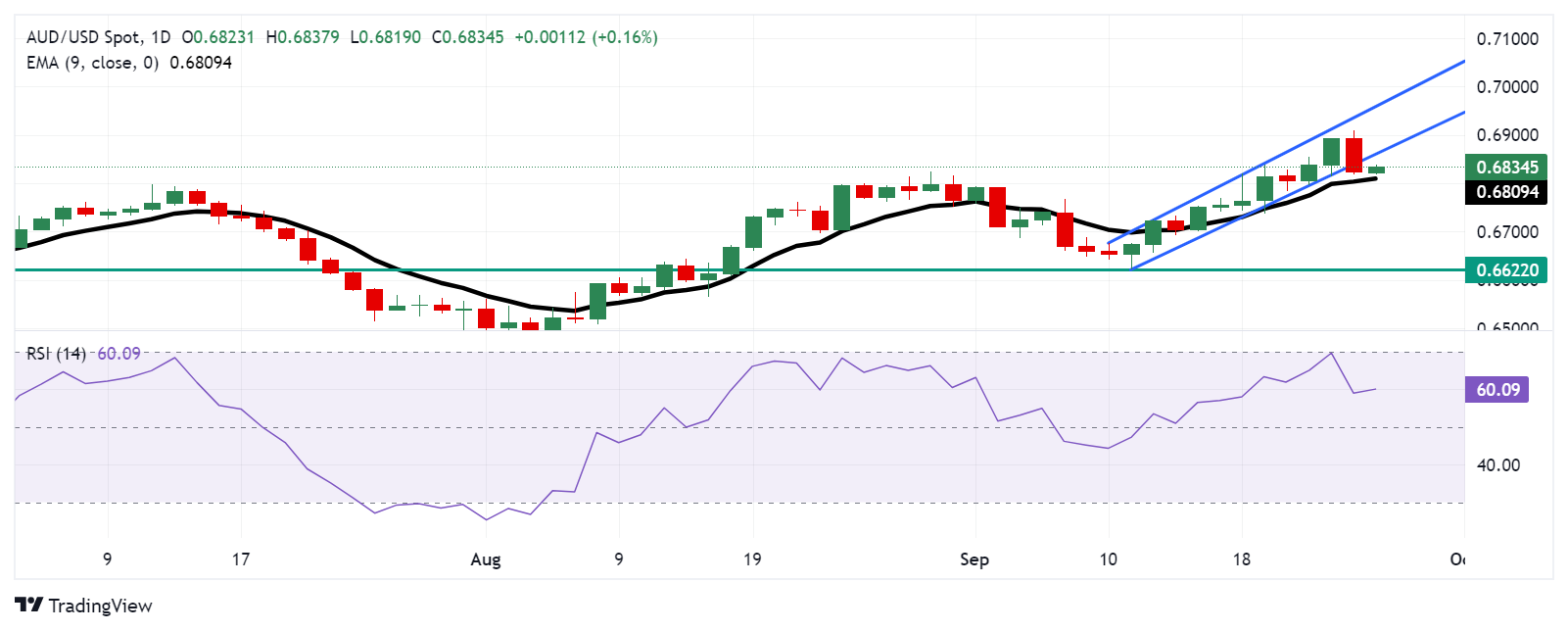
The AUD/USD pair trades near 0.6830 on Thursday. Technical analysis of the daily chart indicates that the pair has breached below the ascending channel pattern, suggesting a potential for weakening bullish bias. However, the 14-day Relative Strength Index (RSI) remains above the 50 level, suggesting that bullish sentiment is still intact.
In terms of resistance, the AUD/USD pair could test the lower boundary of the ascending channel at 0.6860 level. A return to the ascending channel would reinforce the bullish bias and lead the pair to approach the upper boundary of the ascending channel, around the 0.6960 level.
On the downside, the AUD/USD pair could find support at the nine-day Exponential Moving Average (EMA) at the 0.6809 level. The next significant support is at the psychological level of 0.6700. A break below this level could push the pair further down toward its six-week low of 0.6622.
AUD/USD: Daily Chart
Australian Dollar PRICE Today
The table below shows the percentage change of Australian Dollar (AUD) against listed major currencies today. Australian Dollar was the strongest against the US Dollar.
| USD | EUR | GBP | JPY | CAD | AUD | NZD | CHF | |
|---|---|---|---|---|---|---|---|---|
| USD | -0.14% | -0.15% | -0.03% | -0.10% | -0.54% | -0.27% | -0.01% | |
| EUR | 0.14% | -0.01% | 0.10% | 0.04% | -0.40% | -0.14% | 0.13% | |
| GBP | 0.15% | 0.01% | 0.10% | 0.06% | -0.38% | -0.14% | 0.15% | |
| JPY | 0.03% | -0.10% | -0.10% | -0.04% | -0.52% | -0.26% | 0.01% | |
| CAD | 0.10% | -0.04% | -0.06% | 0.04% | -0.43% | -0.18% | 0.10% | |
| AUD | 0.54% | 0.40% | 0.38% | 0.52% | 0.43% | 0.27% | 0.54% | |
| NZD | 0.27% | 0.14% | 0.14% | 0.26% | 0.18% | -0.27% | 0.27% | |
| CHF | 0.00% | -0.13% | -0.15% | -0.01% | -0.10% | -0.54% | -0.27% |
The heat map shows percentage changes of major currencies against each other. The base currency is picked from the left column, while the quote currency is picked from the top row. For example, if you pick the Australian Dollar from the left column and move along the horizontal line to the US Dollar, the percentage change displayed in the box will represent AUD (base)/USD (quote).
Australian Dollar FAQs
One of the most significant factors for the Australian Dollar (AUD) is the level of interest rates set by the Reserve Bank of Australia (RBA). Because Australia is a resource-rich country another key driver is the price of its biggest export, Iron Ore. The health of the Chinese economy, its largest trading partner, is a factor, as well as inflation in Australia, its growth rate and Trade Balance. Market sentiment – whether investors are taking on more risky assets (risk-on) or seeking safe-havens (risk-off) – is also a factor, with risk-on positive for AUD.
The Reserve Bank of Australia (RBA) influences the Australian Dollar (AUD) by setting the level of interest rates that Australian banks can lend to each other. This influences the level of interest rates in the economy as a whole. The main goal of the RBA is to maintain a stable inflation rate of 2-3% by adjusting interest rates up or down. Relatively high interest rates compared to other major central banks support the AUD, and the opposite for relatively low. The RBA can also use quantitative easing and tightening to influence credit conditions, with the former AUD-negative and the latter AUD-positive.
China is Australia’s largest trading partner so the health of the Chinese economy is a major influence on the value of the Australian Dollar (AUD). When the Chinese economy is doing well it purchases more raw materials, goods and services from Australia, lifting demand for the AUD, and pushing up its value. The opposite is the case when the Chinese economy is not growing as fast as expected. Positive or negative surprises in Chinese growth data, therefore, often have a direct impact on the Australian Dollar and its pairs.
Iron Ore is Australia’s largest export, accounting for $118 billion a year according to data from 2021, with China as its primary destination. The price of Iron Ore, therefore, can be a driver of the Australian Dollar. Generally, if the price of Iron Ore rises, AUD also goes up, as aggregate demand for the currency increases. The opposite is the case if the price of Iron Ore falls. Higher Iron Ore prices also tend to result in a greater likelihood of a positive Trade Balance for Australia, which is also positive of the AUD.
The Trade Balance, which is the difference between what a country earns from its exports versus what it pays for its imports, is another factor that can influence the value of the Australian Dollar. If Australia produces highly sought after exports, then its currency will gain in value purely from the surplus demand created from foreign buyers seeking to purchase its exports versus what it spends to purchase imports. Therefore, a positive net Trade Balance strengthens the AUD, with the opposite effect if the Trade Balance is negative.
Author

Akhtar Faruqui
FXStreet
Akhtar Faruqui is a Forex Analyst based in New Delhi, India. With a keen eye for market trends and a passion for dissecting complex financial dynamics, he is dedicated to delivering accurate and insightful Forex news and analysis.