Australian Dollar loses ground as GDP YoY expects to slowdown in Q1
- The Australian Dollar edges lower, possibly due to an unexpected current account deficit of A$ 4.9 billion in Q1.
- Australia's GDP (YoY) is expected to grow by 1.2% in the first quarter, against the previous growth rate of 1.5%.
- The US Dollar remains stable due to the upward correction in US Treasury yields.


The Australian Dollar (AUD) halted its three-day winning streak on Tuesday, likely due to Australia's unexpected current account deficit of A$ 4.9 billion (USD 3.2 billion) in the first quarter. This shift from a downwardly revised surplus of A$ 2.7 billion in the previous quarter missed market expectations of an A$ 5.9 billion surplus.
In a media release from the Australian Bureau of Statistics (ABS), Grace Kim, ABS head of International Statistics, stated: "The current account deficit reflects a smaller trade surplus, driven by a rise in the imports of goods, while the net primary income deficit increased." Imports of goods rose by 4.5% in Q1, driven by consumption goods, while exports of goods fell by 1.5%, reflecting reduced domestic coal and iron ore production.
The US Dollar (USD) edges higher as US Treasury yields improve, which can be attributed to a prevailing risk aversion. However, the Greenback may face challenges as Federal Reserve (Fed) officials indicated last week that the central bank could achieve its 2% annual inflation target without further interest rate hikes.
Investors are likely awaiting Australia's Gross Domestic Product (GDP) data for the first quarter and China's Caixin Services PMI for May, both set to be released on Wednesday. In the US, attention will be paid to the ADP Employment Change and ISM Services PMI reports.
Daily Digest Market Movers: Australian Dollar depreciates due to risk aversion
- The ISM Manufacturing PMI unexpectedly dropped to 48.7 in May, down from April's reading of 49.2 and below the forecast of 49.6. The US manufacturing sector experienced its second consecutive month of contraction, marking 18th in the last 19 months.
- Australia’s Judo Bank Manufacturing PMI was released on Monday, edging up slightly to 49.7 in May from 49.6 in April, marking the fourth consecutive month of declining conditions in the manufacturing sector.
- On Monday, the Caixin China Manufacturing PMI rose to 51.7 in May from 51.4 in April, marking the seventh consecutive month of expansion in factory activity and surpassing the estimates of 51.5. Friday’s NBS PMI data showed that manufacturing activity fell to 49.5 in May from 50.4 in April, missing the market consensus of an increase to 50.5. Meanwhile, the Non-Manufacturing PMI declined to 51.1 from the previous reading of 51.2, falling short of the estimated 51.5.
- Last week, Atlanta Fed President Raphael Bostic remarked in an interview with Fox Business that he doesn't believe further rate hikes should be required to reach the Fed's 2% annual inflation target. Additionally, New York Fed President John Williams stated that inflation is still too high but should moderate over the second half of 2024. Williams doesn't feel the urgency to act on monetary policy, per Reuters.
- As per a Bloomberg report, RBA Assistant Governor Sarah Hunter said at a conference in Sydney on Thursday that “inflationary pressures" are the key issue. “We’re very mindful of that." Hunter also stated that the RBA Board is concerned about inflation remaining above the target range of 1%-3%, suggesting persistent inflationary pressure. Wages growth appears to be near its peak.
Technical Analysis: Australian Dollar maintains its position above 0.6650
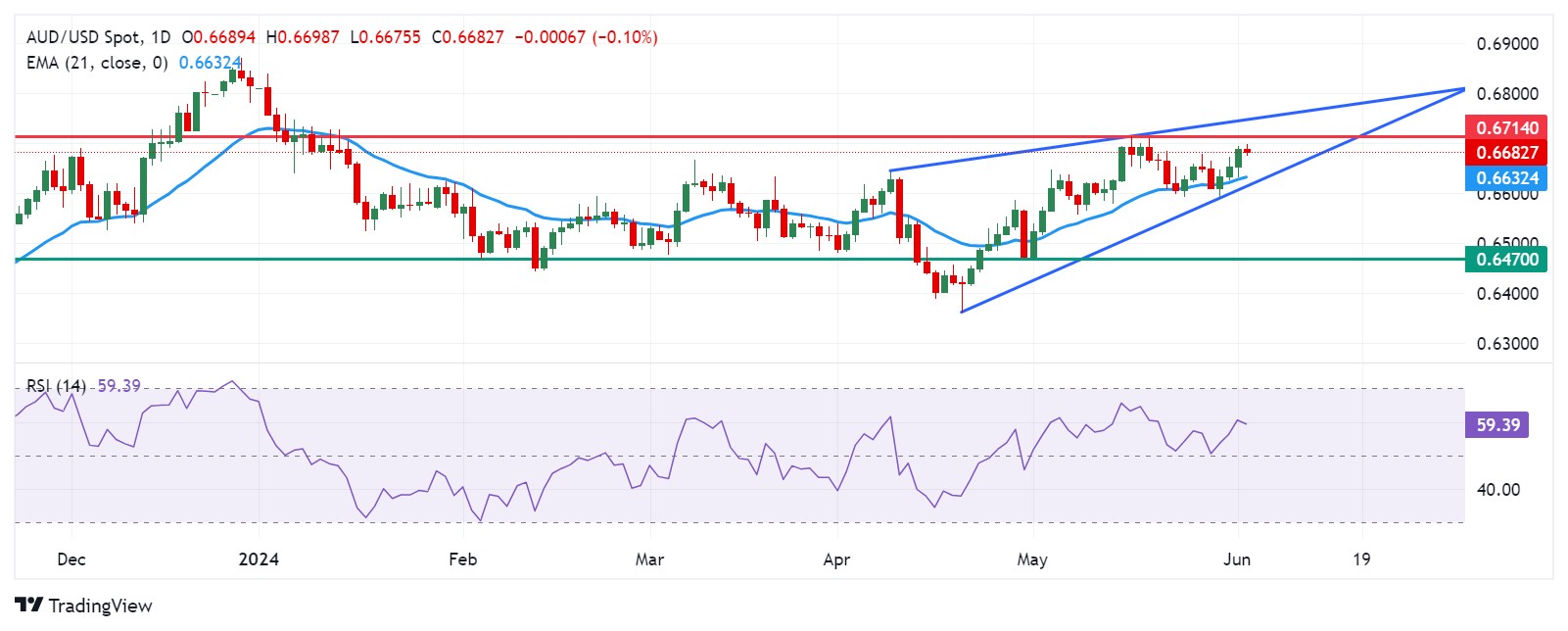
The Australian Dollar trades around 0.6680 on Tuesday. A daily chart analysis suggests a bullish bias for the AUD/USD pair, as it appears to be moving upward from the lower boundary of a rising wedge pattern. Additionally, the 14-day Relative Strength Index (RSI) is positioned above the 50 level, confirming this bullish bias.
The AUD/USD pair could target the psychological level of 0.6700, followed by the four-month high of 0.6714 and the upper limit of the rising wedge around 0.6750.
On the downside, immediate support is observed at the 21-day Exponential Moving Average (EMA) at 0.6632, followed by the lower boundary of the rising wedge and the psychological level of 0.6600. A further decline could exert downward pressure on the AUD/USD pair, potentially leading it toward the throwback support region at 0.6470.
AUD/USD: Daily Chart
Australian Dollar price today
The table below shows the percentage change of the Australian Dollar (AUD) against listed major currencies today. The Australian Dollar was the weakest against the Japanese Yen.
| USD | EUR | GBP | CAD | AUD | JPY | NZD | CHF | |
| USD | 0.15% | 0.16% | 0.28% | 0.43% | -0.23% | 0.21% | 0.02% | |
| EUR | -0.15% | 0.01% | 0.12% | 0.30% | -0.38% | 0.05% | -0.13% | |
| GBP | -0.18% | -0.01% | 0.11% | 0.28% | -0.40% | 0.05% | -0.15% | |
| CAD | -0.28% | -0.12% | -0.11% | 0.17% | -0.51% | -0.07% | -0.25% | |
| AUD | -0.43% | -0.29% | -0.28% | -0.16% | -0.68% | -0.22% | -0.46% | |
| JPY | 0.23% | 0.39% | 0.42% | 0.51% | 0.69% | 0.47% | 0.27% | |
| NZD | -0.22% | -0.07% | -0.06% | 0.05% | 0.23% | -0.45% | -0.20% | |
| CHF | -0.02% | 0.12% | 0.12% | 0.25% | 0.41% | -0.26% | 0.18% |
The heat map shows percentage changes of major currencies against each other. The base currency is picked from the left column, while the quote currency is picked from the top row. For example, if you pick the Euro from the left column and move along the horizontal line to the Japanese Yen, the percentage change displayed in the box will represent EUR (base)/JPY (quote).
Economic Indicator
Gross Domestic Product (QoQ)
The Gross Domestic Product (GDP), released by the Australian Bureau of Statistics on a quarterly basis, is a measure of the total value of all goods and services produced in Australia during a given period. The GDP is considered as the main measure of Australian economic activity. The QoQ reading compares economic activity in the reference quarter to the previous quarter. Generally, a rise in this indicator is bullish for the Australian Dollar (AUD), while a low reading is seen as bearish.
Read more.Next release: Wed Jun 05, 2024 01:30
Frequency: Quarterly
Consensus: 0.2%
Previous: 0.2%
Source: Australian Bureau of Statistics
The Australian Bureau of Statistics (ABS) releases the Gross Domestic Product (GDP) on a quarterly basis. It is published about 65 days after the quarter ends. The indicator is closely watched, as it paints an important picture for the economy. A strong labor market, rising wages and rising private capital expenditure data are critical for the country’s improved economic performance, which in turn impacts the Reserve Bank of Australia’s (RBA) monetary policy decision and the Australian dollar. Actual figures beating estimates is considered AUD bullish, as it could prompt the RBA to tighten its monetary policy.
Author
Akhtar Faruqui
FXStreet
Akhtar Faruqui is a Forex Analyst based in New Delhi, India. With a keen eye for market trends and a passion for dissecting complex financial dynamics, he is dedicated to delivering accurate and insightful Forex news and analysis.
















