Australian Dollar maintains position as traders expect RBA to remain hawkish
- The AUD may depreciate due to potential concerns over Trump’s tariffs on Chinese goods.
- The Aussie Dollar faced challenges as China's latest stimulus measures fell short of investors’ expectations.
- Donald Trump’s fiscal policies could heighten inflation risks, prompting the Fed to maintain restrictive policy.

The Australian Dollar (AUD) edged higher against the US Dollar (USD) on Monday despite a generally negative outlook driven by concerns over Donald Trump’s proposed tariff increases on Chinese goods, which could impact Australian markets, one of China's largest trading partners. US markets will be closed for the Veteran’s Day Bank Holiday.
The Aussie Dollar struggles due to lower-than-expected Chinese Consumer Price Index (CPI) data released on Saturday. Additionally, China's latest stimulus measures fell short of investor expectations, further dampening demand prospects for Australia’s largest trading partner and weighing on the Australian Dollar.
China announced a 10 trillion Yuan debt package on Friday designed to alleviate local government financing pressures and support struggling economic growth. However, the package stopped short of implementing direct economic stimulus measures.
Australia's 10-year government bond yield dropped to around 4.6%, reflecting a decline in US bond yields following the Federal Reserve's widely anticipated 25 basis point interest rate cut. Last week, the Reserve Bank of Australia (RBA) kept its interest rate unchanged at 4.35%. The central bank emphasized that underlying inflation remains too high and is not expected to return to its target until 2026.
Daily Digest Market Movers: Australian Dollar receives downward pressure from Trump’s tariff fear
- Minneapolis Fed President Neel Kashkari stated on Sunday that the US economy has shown remarkable resilience as the Fed continues its efforts to curb inflation. However, Kashkari noted that the Fed is still “not all the way home.” He also mentioned that the Fed aims to be confident that inflation will fully return to the 2% target and needs additional evidence before considering another rate cut.
- Morgan Stanley divides the Trump administration's macroeconomic policies into three key areas: tariffs, immigration, and fiscal measures. The report predicts that tariff policies will be prioritized, with an anticipated immediate imposition of 10% tariffs globally and 60% tariffs specifically on China.
- Analysts suggest that if Trump’s fiscal policies are implemented, they could lead to higher investment, spending, and labor demand, elevating inflation risks. This could prompt the Fed to adopt a more restrictive monetary policy, potentially strengthening the US Dollar and putting additional pressure on the AUD/USD pair.
- However, Fed Chair Jerome Powell stated on Thursday that he doesn’t anticipate Trump’s potential return to the White House impacting the Fed’s near-term policy decisions. “We don’t guess, speculate, and we don’t assume what future government policy choices will be,” Powell noted after the bank decided to lower interest rates by 25 basis points to a range of 4.50%-4.75%, as expected.
- Federal Reserve Chair Jerome Powell also emphasized that the Fed will continue to assess economic data to decide on the "pace and destination" of future rate changes, highlighting that inflation has been gradually slowing toward the Fed's 2% target.
- China’s Consumer Price Index (CPI) rose 0.3% year-over-year in October, slightly below market expectations and down from September’s 0.4%. This marks the ninth consecutive month of consumer price inflation but represents the lowest rate since June. Month-over-month, the CPI dropped by 0.3%, a sharper decline than the expected 0.1% decrease, following a flat reading in September.
- On Friday, the preliminary University of Michigan Consumer Sentiment Index rose to 73.0 in November, up from 70.5 in October and exceeding the market’s expectation of 71.0.
- US Initial Jobless Claims rose to 221,000 for the week ending November 1, according to a Thursday report from the US Department of Labor (DoL). This figure aligned with initial estimates and was up from the previous week’s revised total of 218,000 (originally reported as 216,000).
Technical Analysis: Australian Dollar trades below 0.6600, nine-day EMA
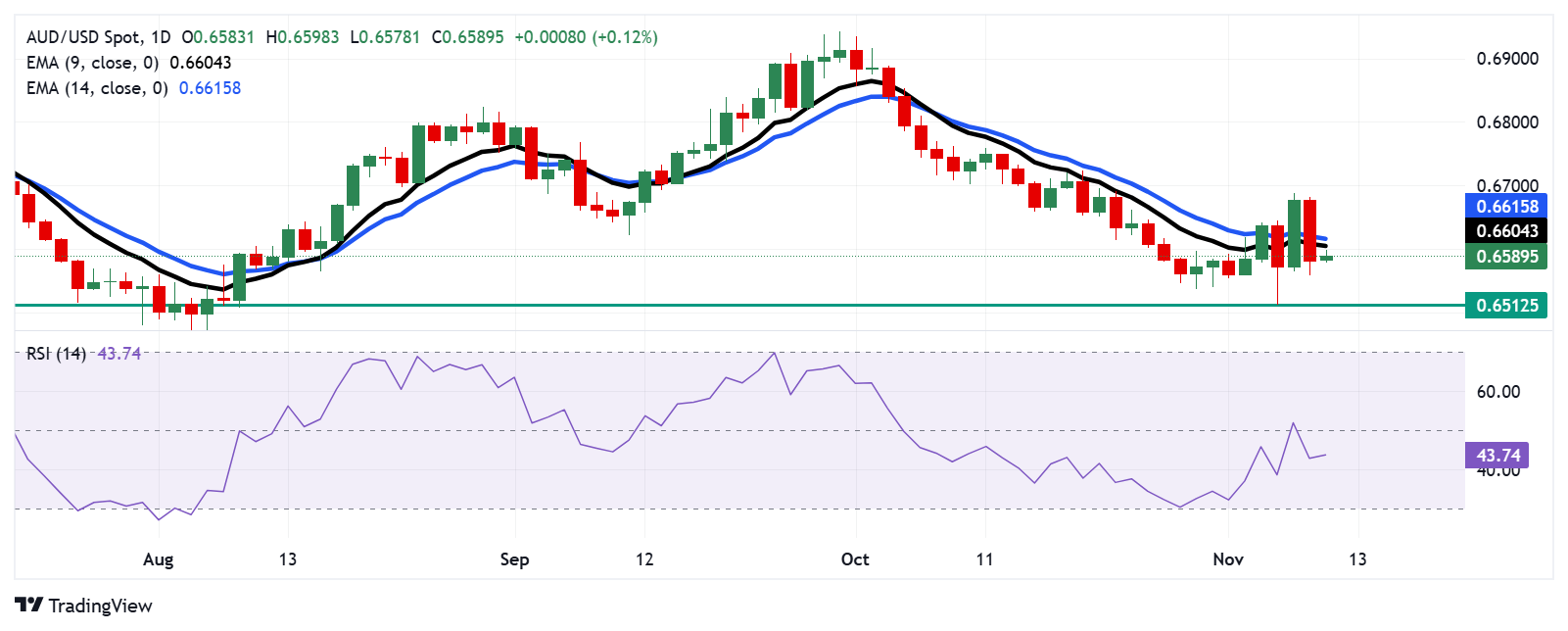
The AUD/USD pair trades around 0.6590 on Monday. Daily chart analysis indicated short-term downward pressure as the pair is positioned below the nine-day Exponential Moving Average (EMA). Additionally, the 14-day Relative Strength Index (RSI) has broken below the 50 mark, further suggesting that a bearish sentiment is prevailing.
In terms of support, the AUD/USD pair may approach its three-month low at 0.6512, which was recorded on November 6, followed by key psychological support at 0.6500.
On the upside, the immediate resistance appears at the nine-day EMA at 0.6604, followed by the 14-day EMA at 0.6616. A breakthrough above these EMAs could lead the AUD/USD pair to revisit its recent high at 0.6687 level, followed by the psychological level of 0.6700.
AUD/USD: Daily Chart
Australian Dollar PRICE Today
The table below shows the percentage change of Australian Dollar (AUD) against listed major currencies today. Australian Dollar was the strongest against the Japanese Yen.
| USD | EUR | GBP | JPY | CAD | AUD | NZD | CHF | |
|---|---|---|---|---|---|---|---|---|
| USD | 0.01% | 0.04% | 0.54% | 0.09% | -0.15% | -0.20% | 0.08% | |
| EUR | -0.01% | -0.00% | 0.63% | 0.19% | -0.07% | -0.12% | 0.15% | |
| GBP | -0.04% | 0.00% | 0.54% | 0.19% | -0.07% | -0.12% | 0.15% | |
| JPY | -0.54% | -0.63% | -0.54% | -0.44% | -0.77% | -0.64% | -0.45% | |
| CAD | -0.09% | -0.19% | -0.19% | 0.44% | -0.20% | -0.31% | -0.04% | |
| AUD | 0.15% | 0.07% | 0.07% | 0.77% | 0.20% | -0.07% | 0.24% | |
| NZD | 0.20% | 0.12% | 0.12% | 0.64% | 0.31% | 0.07% | 0.27% | |
| CHF | -0.08% | -0.15% | -0.15% | 0.45% | 0.04% | -0.24% | -0.27% |
The heat map shows percentage changes of major currencies against each other. The base currency is picked from the left column, while the quote currency is picked from the top row. For example, if you pick the Australian Dollar from the left column and move along the horizontal line to the US Dollar, the percentage change displayed in the box will represent AUD (base)/USD (quote).
Interest rates FAQs
Interest rates are charged by financial institutions on loans to borrowers and are paid as interest to savers and depositors. They are influenced by base lending rates, which are set by central banks in response to changes in the economy. Central banks normally have a mandate to ensure price stability, which in most cases means targeting a core inflation rate of around 2%. If inflation falls below target the central bank may cut base lending rates, with a view to stimulating lending and boosting the economy. If inflation rises substantially above 2% it normally results in the central bank raising base lending rates in an attempt to lower inflation.
Higher interest rates generally help strengthen a country’s currency as they make it a more attractive place for global investors to park their money.
Higher interest rates overall weigh on the price of Gold because they increase the opportunity cost of holding Gold instead of investing in an interest-bearing asset or placing cash in the bank. If interest rates are high that usually pushes up the price of the US Dollar (USD), and since Gold is priced in Dollars, this has the effect of lowering the price of Gold.
The Fed funds rate is the overnight rate at which US banks lend to each other. It is the oft-quoted headline rate set by the Federal Reserve at its FOMC meetings. It is set as a range, for example 4.75%-5.00%, though the upper limit (in that case 5.00%) is the quoted figure. Market expectations for future Fed funds rate are tracked by the CME FedWatch tool, which shapes how many financial markets behave in anticipation of future Federal Reserve monetary policy decisions.
Author

Akhtar Faruqui
FXStreet
Akhtar Faruqui is a Forex Analyst based in New Delhi, India. With a keen eye for market trends and a passion for dissecting complex financial dynamics, he is dedicated to delivering accurate and insightful Forex news and analysis.