|

AUD/NZD sees slight uptick ahead of RBNZ decision, hawkish RBA

  • AUD/NZD saw a mild increase in Tuesday's session but cleared most of its gains.
  • RBNZ decision comes up later in the Asian session with a hold priced in.
  • The RBA maintains its hawkish tone, promoting a more favorable outlook for the Aussie.

After a climb to the highest level since early May, the AUD/NZD buyers have cleared some gains and the pair faces some consolidation. The market awaits the Reserve Bank of New Zealand (RBNZ) decision later on Tuesday where the Official Cash Rate (OCR) is expected to be maintained at 5.50%.

Despite markets betting on a 60% probability of a rate hike by the end of the year, as suggested in the RBNZ’s May rate path projection, the disinflationary process brought on by New Zealand’s sluggish growth outlook leans the market towards an early rate cut in October, with a November cut fully priced in. In that sense, the Monetary Policy Statement for any possible insights will be closely looked at.

On the other hand, in Australia, the latest hot inflation data has increased market expectations, suggesting high chances of a 25 bps rate hike at the Reserve Bank of Australia (RBA)'s September 24 meeting, which rises to nearly 50% by November 5. Other than the RBNZ decision there won’t be any significant highlight the bank’s decision will dictate the pace of the pair for the rest of the week.

AUD/NZD technical analysis

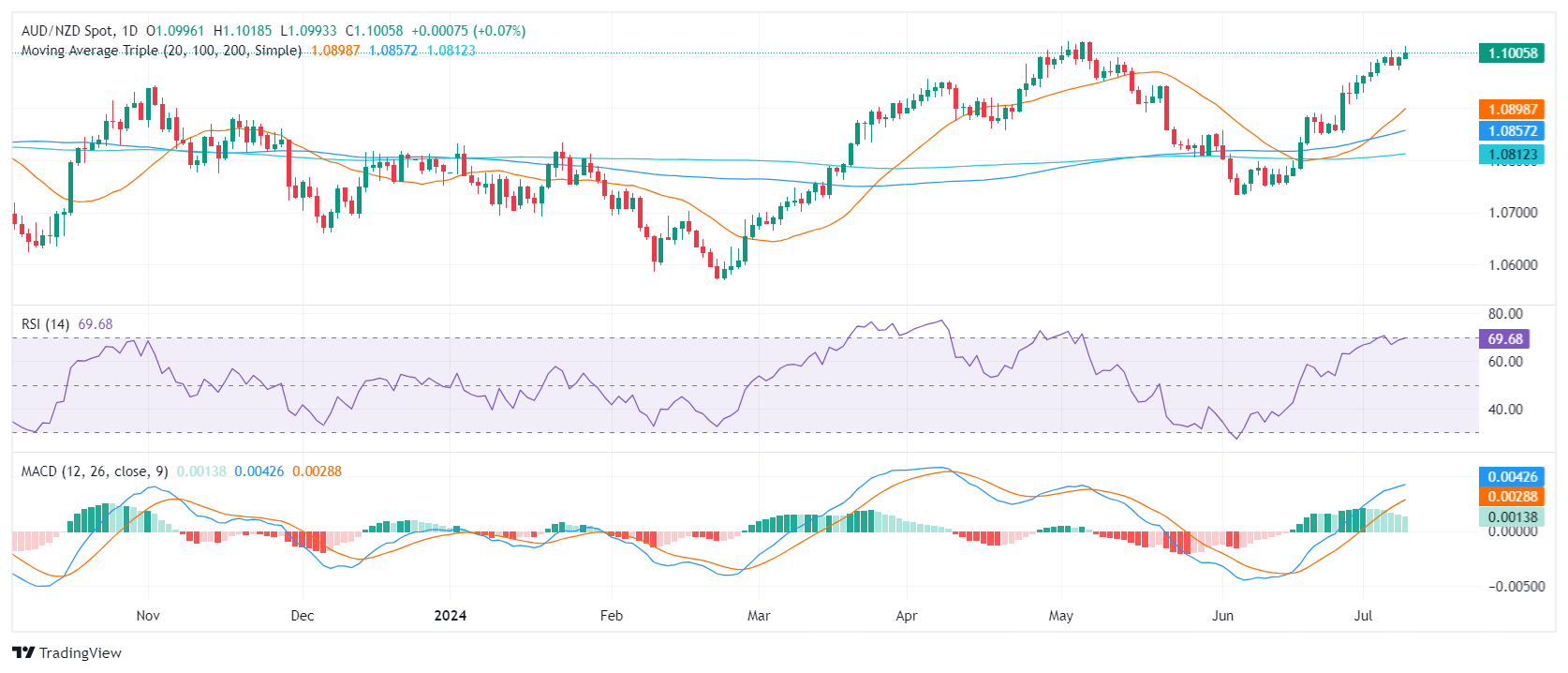
Short-term, the AUD/NZD maintains a bullish stance clarified by the recent gains. However, nearing overbought conditions suggests the potential for a correction. The Relative Strength Index (RSI) and the Moving Average Convergence Divergence (MACD) both indicate that a correction may be looming as buyers lose steam.

Support levels continue to lie at 1.1000, 1.0950, and 1.0930. The 1.1000 target remains the next task for the buyers to retain.

AUD/NZD daily chart
Author

Patricio Martín

Patricio is an economist from Argentina passionate about global finance and understanding the daily movements of the markets.


More from Patricio Martín
Share:

Editor's Picks

EUR/USD clings to gains around 1.1800

EUR/USD manages to regain composure and retests the 1.1800 region in quite a positive start to the week. The pair’s bounce follows the US Dollar’s offered stance post-SCOTUS ruling ahead of important US data and Fedspeak on Tuesday.

GBP/USD treads water near 1.3500 as BoE-Fed divergence debate stalls

GBP/USD spent Monday spinning in place as market participants await a fresh catalyst to break the pair out of its recent range. The BoE's February hold came with a surprisingly dovish 5-4 split, and UK Consumer Price Index data last week showed inflation easing to 3.0%, reinforcing the case for earlier rate cuts, with most economists now looking to April or March for the next move. 

Gold climbs above $5,200 on geopolitical tensions, trade uncertainty

Gold price jumps to around $5,230 during the early Asian session on Tuesday. The rally of the precious metal is bolstered by heightened geopolitical tensions and global trade uncertainty following US tariff decisions. Traders brace for the US January Producer Price Index report on Friday for fresh impetus. 

Solana DeFi platform Step Finance to close operations following treasury hack

The Solana based decentralized finance platform Step Finance announced it will end all operations effective immediately following a breach that drained its treasury.

Supreme Court nixes tariffs, Trump teases 15% global tariff

On February 20th, the Supreme Court ruled that Trump’s global tariffs under IEEPA authority were unconstitutional, effectively nullifying the framework. However, the relief was short-lived. Within hours, Trump floated a 15% blanket tariff under an alternative legal authority.

XRP recovers slightly as bearish sentiment dominates crypto market

Ripple is rising above $1.40 at the time of writing on Monday amid fresh tariff-triggered headwinds in the broader cryptocurrency market. The sell-off to $1.33, the token’s intraday low, can be attributed to macroeconomic uncertainty, geopolitical tensions and risk-averse sentiment among other factors.