Alphabet Stock Forecast: Google hawks new AI chip during Cloud Next conference
- Alphabet unviels new Arm-based Axion TPU to compete with Nvidia, Intel, AMD.
- The v5p chip will only be accessibly via Google Cloud.
- GOOGL stock rises on the news despite market sell-off ahead of March CPI.
- Technicals show that Alphabet stock is likely to experience a near-term reversal.
Alphabet (GOOGL), the parent of Google, announced its answer to Nvidia (NVDA) on Tuesday with the release of an Arm-based central processing unit (CPU) meant to speed up artificial intelligence (AI) workloads in data centers. GOOGL stock ended Tuesday up 1.1% at $156.60 before adding slightly more gains afterhours.
Google is hosting its Cloud Next conference speaker series from Tuesday through Thursday this week. The announcement positions Alphabet as a competitor to Nvidia, whose various chips, mostly GPUs, currently dominate the AI training market for large language models (LLMs).
US markets fell in the middle of the day but rose in the session's final hour. Traders are nervous about Wednesday's Consumer Price Index (CPI) for March. The NASDAQ and S&P 500 saw moderate gains, while the Dow Jones index nosed down by a hair. Nvidia and Arm Holdings (ARM) stocks lost around 2% each.
Alphabet stock news
Specifically, Alphabet unveiled its tensor processing unit (TPU) called the Axion via Google Cloud or TPU v5p. The name stems from the fact that customers will only have access to the chip via Google’s cloud platform.
Officials say that operating in clusters of 8,960 chips allows the technology to render AI workloads at twice the performance of earlier TPU versions.
"We're making it easy for customers to bring their existing workloads to Arm," said Mark Lohmeyer, Google Cloud's vice president and general manager of compute & machine learning infrastructure. "Axion is built on open foundations, but customers using Arm anywhere can easily adopt Axion without re-architecting or re-writing their apps."
The company did not mention whether Broadcom (AVGO) had helped them design the new chip as the latter company did with earlier TPU versions. Both Amazon (AMZN) and Microsoft (MSFT) have previously designed their own CPUs in order to differentiate each of their cloud platforms.
Additionally, Google said that the TPU v5p chips perform 30% better than standard Arm chips and 50% better than x86 architectures produced by Advanced Micro Devices (AMD) and Intel (INTC).
Social media company Snap (SNAP) is expected to be first in line to begin testing out the new technology in Google Cloud.
Semiconductor stocks FAQs
A semiconductor is a term for various types of computer chips. Officially called semiconductor devices, these computer chips rely on semiconductor materials like silicon and gallium arsenide to process the electrical current that produces the modern world of computing. They come in many shapes, sizes, enhancements and configurations such as diodes, transistors and integrated circuits to more complicated applications like DRAM memory, simple processors and even GPUs.
First, there are the pure chip designers, such as Nvidia, AMD, Broadcom and Qualcomm. These companies use sophisticated software to design and test chips. Second, there are the equipment manufacturers that provide the machines necessary to build computer chips. These include ASML and Lam Research. Then, there are foundries that manufacture the chips. These include Taiwan Semiconductor and GlobalFoundries. Last of all are the integrated device manufacturers who design their own chips and additionally manufacture themselves. These include Samsung and Intel.
It is the observation that the number of transistors in an integrated circuit doubles every two years. The “law” is named after Gordon Moore, who founded Fairchild Semiconductor and later Intel. The doubling is possible due to the shrinking size of process nodes or parts in the computer chip. In 1971 the advanced commercial manufacturing had reached 10 microns in width. In 1987 semiconductor technology had advanced to 800 nanometers in width. By 1999, this process had moved to 180 nanometers. By 2007, the size had dropped to 32 nanometers, and this fell all the way to 3 nanometers in 2022, which is close to the size of human DNA.
In 2022, the global semiconductor industry had revenues just under $600 billion. In total, the industry shipped 1.15 trillion semiconductor units in 2021. The leading nations involved in the semiconductor supply chain are Taiwan, the United States, China, the Netherlands, South Korea, Japan and Israel.
Alphabet stock forecast: technicals are bearish
GOOGL stock saw its light dim since the morning session on Tuesday when the stock shot up about 2.4% to $158.56, an all-time high. With prospects for the market dimming until the CPI data comes in for March on Wednesday, traders are standing pat. If the CPI data comes in hot, then expect GOOGL stock to return to support at $153, which was an area of resistance in January.
Somewhat more importantly, the technicals for Alphabet stock are bearish. First, Tuesday's candlestick looks like a textbook Shooting Star. Rendered like an upside down hammer, the chart pattern at the top of a staircase rally often signals that a bearish reversal is in order.
Secondly, the ascending top trendline of the higher highs (orange line) on the daily chart is inverse to the descending trendline (also orange) on the Relative Strength Index (RSI) over the same period from late January to early April. This RSI Divergence pattern is also a sign of a bearish countertrend. The chart says to sell despite the day's news on the chip front.
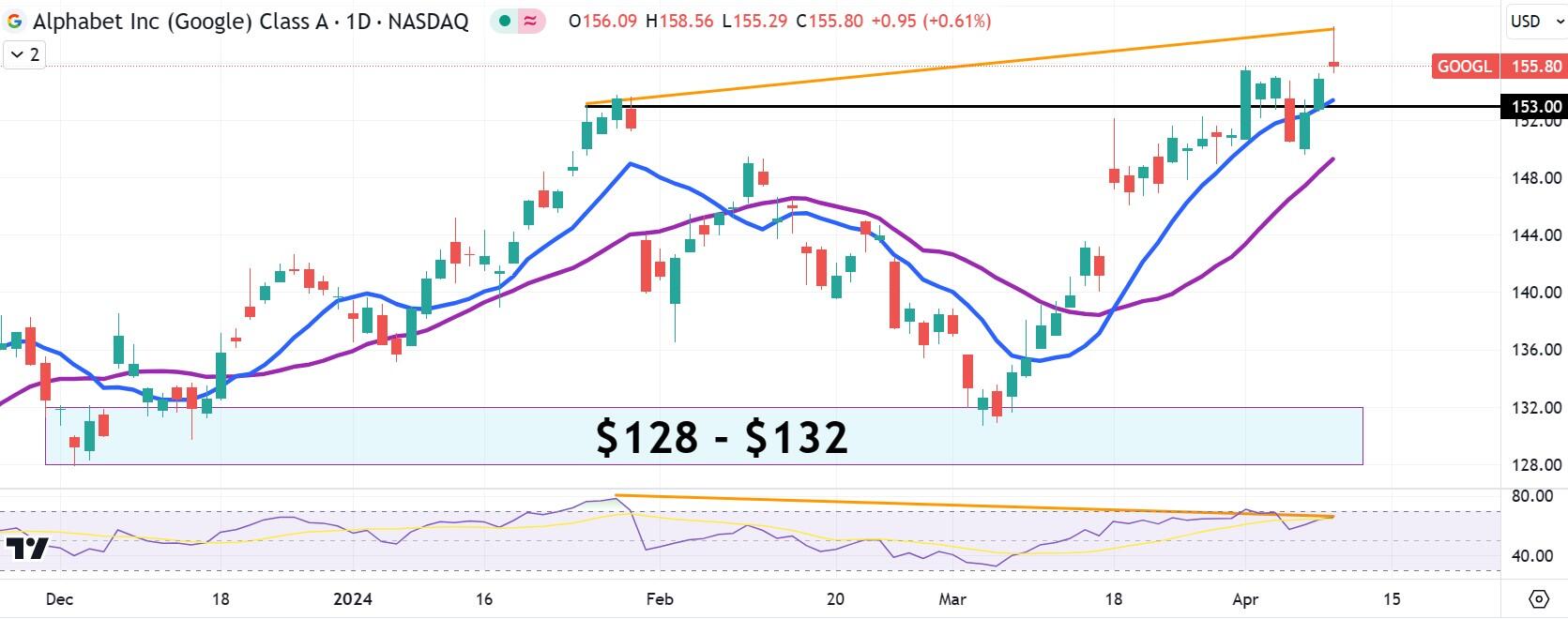
GOOGL daily stock chart
Author

Clay Webster
FXStreet
Clay Webster grew up in the US outside Buffalo, New York and Lancaster, Pennsylvania. He began investing after college following the 2008 financial crisis.














