Alibaba Stock News and Forecast: BABA, Tencent stock start week down after Beijing issues fines
- Alibaba, Tencent and others were fined by for monopolistic practices.
- BABA stock is down 3.6% in Monday's premarket.
- The fines are rather small, but they worry the market after 18 months of scrutiny.

Alibaba (BABA) stock is off 3.6% ahead of Monday's open after fines were handed down to the ecommerce giant and other Chinese internet companies for engaging in alleged monopolistic behaviour. Having closed last Friday at $120.90, BABA looks to open on Monday somewhere close to $116.57.
Also read: Meta Platforms (META) Stock Deep Dive: Facebook parent price target at $200 despite macro headwinds
Alibaba Stock News: New round of fines unsettles Chinese equities
On Sunday, China's State Administration for Market Regulation (SAMR) doled out fines for 28 transactions that it said violated anti-monopoly laws. Alibaba received five of the 28 violations, while Tencent (TCEHY) received an unexpected 12. Companies like SoftBank from Japan and Ping An Healthcare & Technology Company (PANHF) also were hit with fines.
The fines themselves are nothing major. Reuters reported that each violation has a maximum value of 500,000 yuan, which is close to $75,000. Although the details of each of Alibaba's violations are somewhat unclear, the biggest focus has been on the company's investment in the Youku Tudou streaming platform.
These fines are inconsequential in absolute terms for any of these billion-dollar behemoths, but the focus remains on whether the government will stick to its plan to reduce scrutiny of its many internet giants, a policy that began with the halt to Alibaba subsidiary Ant Group's attempt to IPO in late 2020.
On June 17 the People's Bank of China said it was now allowing Ant Group to restart its IPO bid. Alibaba owns about a third of Ant Group.
During the first week of March, Alibaba announced its creation of a brand new data subsidiary focused on the enterprise market. Lingyang Intelligent Service sells data as a service through 11 different products focused on manufacturing, marketing and customer management.
Alibaba Stock Forecast: Bulls focused on $124, $128, but reversal may be in order
For those of you who have watched BABA shares flounder for the better part of 18 months, the last 30 trading sessions have been a delight for the most part. BABA continues making one short-term higher high after another. The actual rally began on May 16, but the 15-day crossed over the 50-day only on June 9.
I am using the 15-day moving average here, because BABA stock has been using it as ascending support since May 26. Last week Alibaba stock was able to climb above the stubborn resistance level of $120, which has been an indefatigable obstacle for months now. As FXStreet wrote last week, above $120 are two other clean resistance levels in short order: $124 and $128. These price levels showed their cards in February and March. A move through this zone might take some time before bulls can make a run at the year's high point – January 12's $138.70.
Besides $124 and $128 guarding the door, however, divergence on the Relative Strength Index (RSI) forecasts a turn for the worse. As can be seen by the orange lines on the price chart and RSI chart, BABA share price saw a higher high between June 8 and July 8, while the RSI over the same period failed to make a new high. Typically, this a leading indicator that a reversal is about to commence. Be warned!
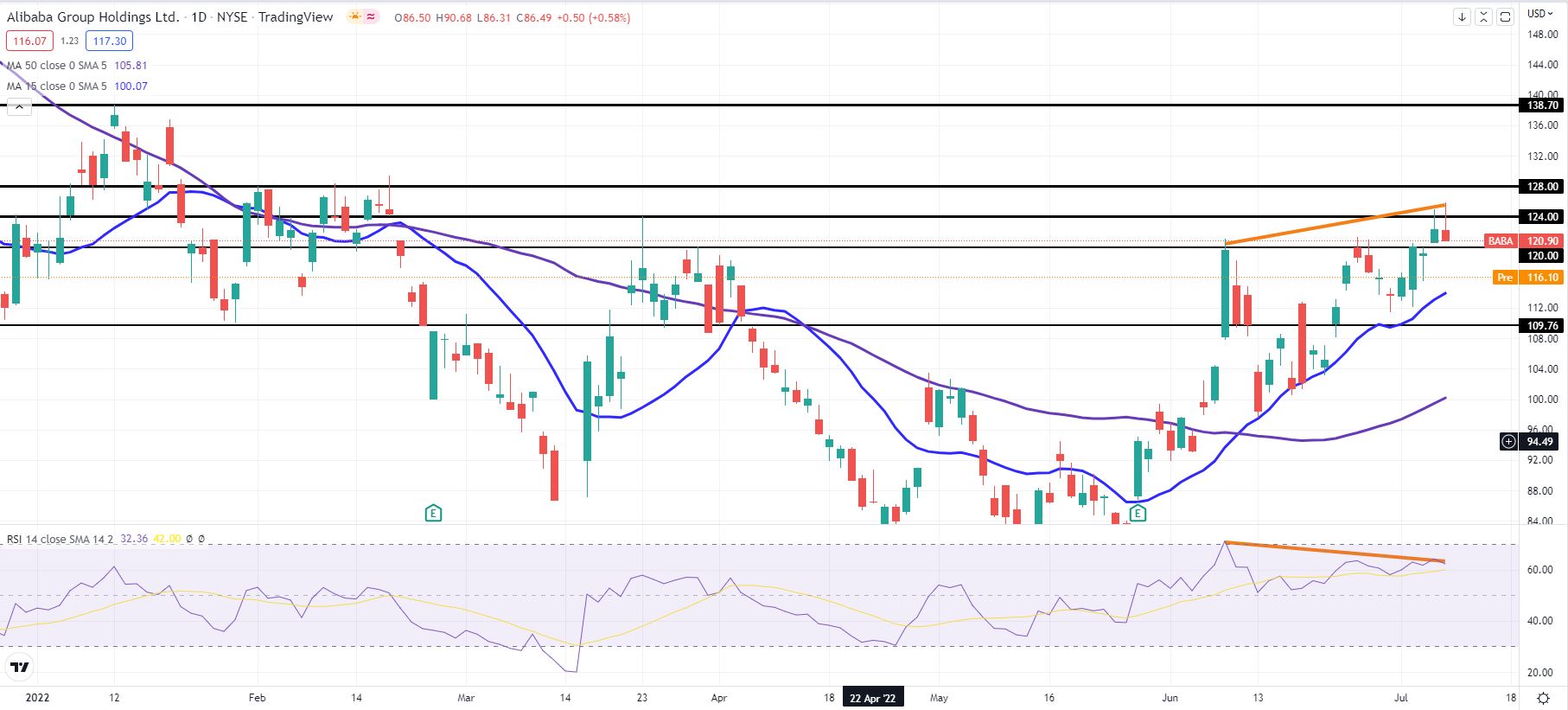
BABA daily chart
Like this article? Help us with some feedback by answering this survey:
Author

Clay Webster
FXStreet
Clay Webster grew up in the US outside Buffalo, New York and Lancaster, Pennsylvania. He began investing after college following the 2008 financial crisis.