Alibaba Stock News and Forecast: BABA edges higher after Jack Ma returns to China for AI talk
- Alibaba founder Jack Ma returns after year abroad.
- Pundits think it may signal warming relations between Alibabab and Beijing.
- BABA stock advances cautiously on news.
- Ma visited a school where he gave a talk on the future of artificial intelligence in education.
Alibaba (BABA) shareholders begin the week with a glimmer of hope after founder Jack Ma was seen visiting China after spending more than one year abroad – a sojourn that had led many investors to believe the enmity between the ecommerce giant and Beijing had yet to dissolve. The report originally led to Alibaba's shares in Hong Kong rising 4% before subsiding.
BABA stock is ahead 0.2% at $87.06 in Monday's premarket, in line with NASDAQ futures, while Dow and S&P 500 futures have advanced 0.4% at the time of writing.
Alibaba stock news: Jack Ma talks artificial intelligence
Jack Ma has been conspicuously absent from China since late 2021, a year in which he was already seen rarely and thought to be negotiating with Chinese officials. Jack Ma originally criticized financial reguation in China in late 2020, which precipitated the government backlash against Alibaba that led to it share price losing more than two-thirds of its value.
Since then payments partner Ant Group, which was originally a subsidiary of Alibaba known for its popular Alipay app, has reduced Alibaba and Jack Ma's control over itself. This move came about in January and was thought to be forced via government pressure. Ant Group's original IPO for $37 billion was shelved in late 2020 due to regulators' anger with Ma's remarks. Last year it was reported that Ma had been living in Tokyo and had made trips to the US and Israel.
Ma visited the Hangzhou Yungu School, which he and other Alibaba founders funded back in 2017. Ma spoke with school leaders about advances in artificial intelligence and how that might affect the future of education, according to the South China Morning Post, which Alibaba owns.
"We must use AI to solve problems, not to be controlled by AI," Ma said, according to the newspaper.
The timing is fascinating as just last week one of Alibaba's top AI executives left to join an AI startup. That executive, Jia Yangqing, was helping Alibaba build a chatbot similar to OpenAI's ChatGPT version that has forced every major tech company to buckle down on introducing their own AI products. Both Baidu (BIDU) and Tencent (TCEHY) have entered the fray, as well as Alphabet (GOOGL) with its own version named Bard..
Alibaba stock forecast
To make a move higher, traders will watch whether Alibaba stock can close above the 8-week moving average, which is currently near $92.50. Even before that BABA needs to hold itself above the 30-week average at $88.70. With those moving averages in the rearview mirror, bulls would make a run at the supply zone between $103 and $105.30. That resistance zone saw plenty of action in August 2022 when the 8-week moving average broke harshly below its 30-week counterpart.
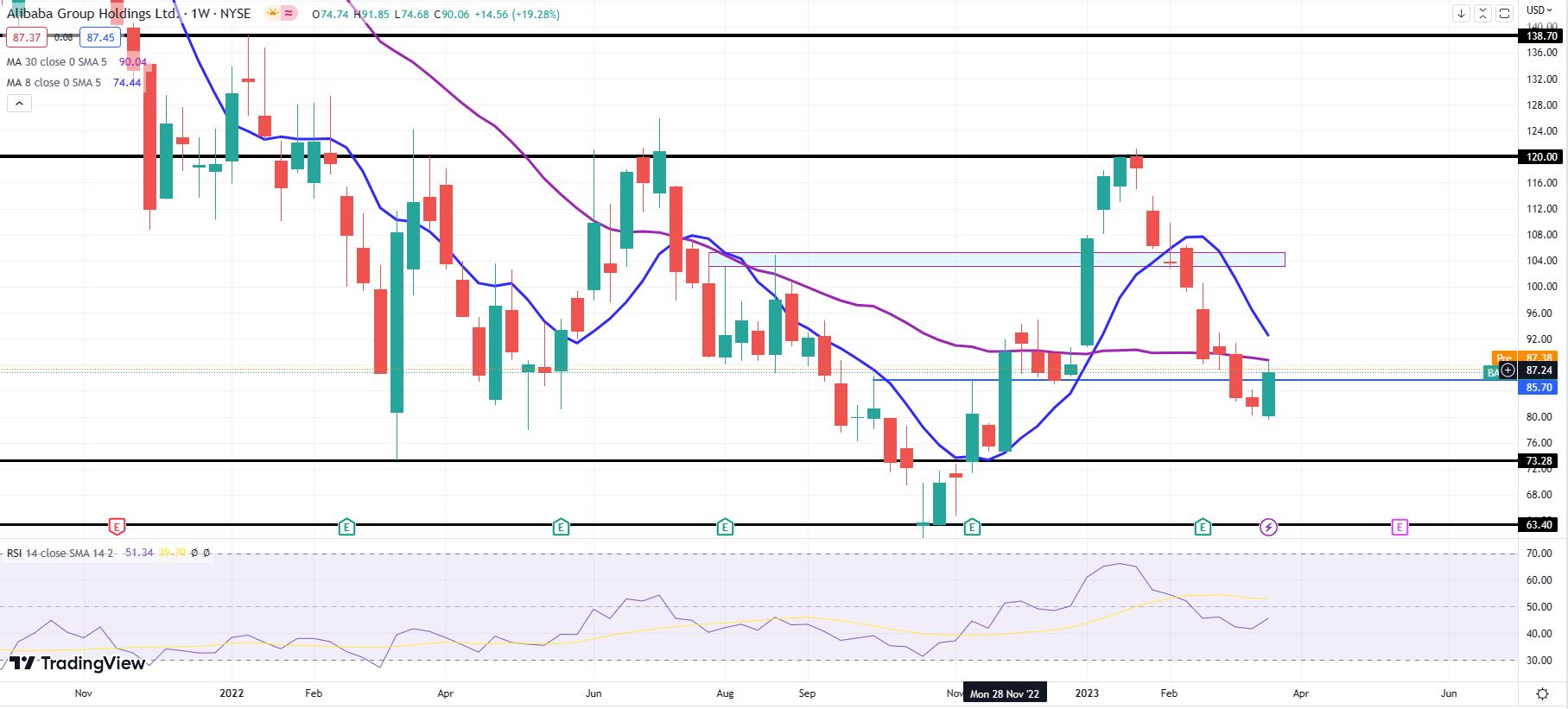
BABA weekly chart
Author

Clay Webster
FXStreet
Clay Webster grew up in the US outside Buffalo, New York and Lancaster, Pennsylvania. He began investing after college following the 2008 financial crisis.

















