Advanced Micro Devices Stock Forecast: AMD closes fourth consecutive week higher
- AMD price action scored its fourth straight week of gains.
- S&P Global PMIs show Services overperforming, while Manufacturing underperforms.
- AMD gains at Friday open, while NASDAQ Composite fades.
- The $127 to $133 supply zone from May and June becomes primary bull target.
Advanced Micro Devices (AMD) stock ended its fourth week in a row higher. AMD ended Friday's session down 0.16% at $122.31 but gained 1.29% for the full week.
The Dow Jones Industrial Index gained 0.33% on the last day of the week, while the NASDAQ Composite lost 0.11% and the S&P 500 gained 0.06%.
The S&P Global Purchasing Managers Index (PMI) for November, out on Friday, showed that Services reported at 50.8, above the 50.4 reading that was expected. The Manufacturing PMI is exactly opposite – printing at 49.4 rather than the consensus of 49.8.
AMD stock news
News on the AMD front is lacking this week. The semiconductor stock has been rallying for its fourth straight week following Q3 earnings that demonstrated the stock was performing well despite a cyclical downturn among chipmakers.
On October 31, AMD reported normalized funds from operations of $0.70, a slight beat of 2 cents above consensus. Revenue of $5.8 billion arrived more than $106 million ahead of consensus.
Nvidia (NVDA), AMD’s primary competitor, is discouraging shareholders after a wildly optimistic earnings report on Tuesday. Nvidia beat its revenue consensus for the most recently completed quarter by more than $2 billion and likewise raised its sales outlook for the current quarter by more than $2 billion above consensus to near $20 billion.
Nvidia stock has sold off on Friday after the company said its artificial-intelligence-focused (AI) HGX H20 chip, which was created in order to circumvent US government chip sanctions on China, would be delayed until the first quarter of next year. The L20 PCIe and L2 PCIe chips, however, are largely thought to be on schedule to launch in China. Huawei Technologies is expected to reap the reward of Nvidia AI chips being either sanctioned or delayed in the Chinese domestic market.
In the meantime, this may also create a path toward greater sales of AMD’s MI300A and MI300X AI-geared chips. CEO Lisa Su has said that the MI300 chip is on course to be the fastest product in the company’s history to ramp up to $1 billion in sales.
Semiconductor stocks FAQs
What is a semiconductor?
A semiconductor is a term for various types of computer chips. Officially called semiconductor devices, these computer chips rely on semiconductor materials like silicon and gallium arsenide to process the electrical current that produces the modern world of computing. They come in many shapes, sizes, enhancements and configurations such as diodes, transistors and integrated circuits to more complicated applications like DRAM memory, simple processors and even GPUs.
What types of semiconductor companies are there?
First, there are the pure chip designers, such as Nvidia, AMD, Broadcom and Qualcomm. These companies use sophisticated software to design and test chips. Second, there are the equipment manufacturers that provide the machines necessary to build computer chips. These include ASML and Lam Research. Then, there are foundries that manufacture the chips. These include Taiwan Semiconductor and GlobalFoundries. Last of all are the integrated device manufacturers who design their own chips and additionally manufacture themselves. These include Samsung and Intel.
What is Moore’s Law?
It is the observation that the number of transistors in an integrated circuit doubles every two years. The “law” is named after Gordon Moore, who founded Fairchild Semiconductor and later Intel. The doubling is possible due to the shrinking size of process nodes or parts in the computer chip. In 1971 the advanced commercial manufacturing had reached 10 microns in width. In 1987 semiconductor technology had advanced to 800 nanometers in width. By 1999, this process had moved to 180 nanometers. By 2007, the size had dropped to 32 nanometers, and this fell all the way to 3 nanometers in 2022, which is close to the size of human DNA.
How large is the semiconductor industry?
In 2022, the global semiconductor industry had revenues just under $600 billion. In total, the industry shipped 1.15 trillion semiconductor units in 2021. The leading nations involved in the semiconductor supply chain are Taiwan, the United States, China, the Netherlands, South Korea, Japan and Israel.
AMD stock forecast
AMD stock is steadily conquering territory after beating earnings expectations at the end of October. After bottoming just above $93 in late October, AMD stock is now on pace to enter the $127 to $133 resistance zone that shunted bulls back in May and June of this year.
The 9-day Simple Moving Average (SMA) has created distance with its 21-day counterpart, and the fast pace of the current rally makes its quite likely that the semiconductor stock could produce a new annual high before the year is out.
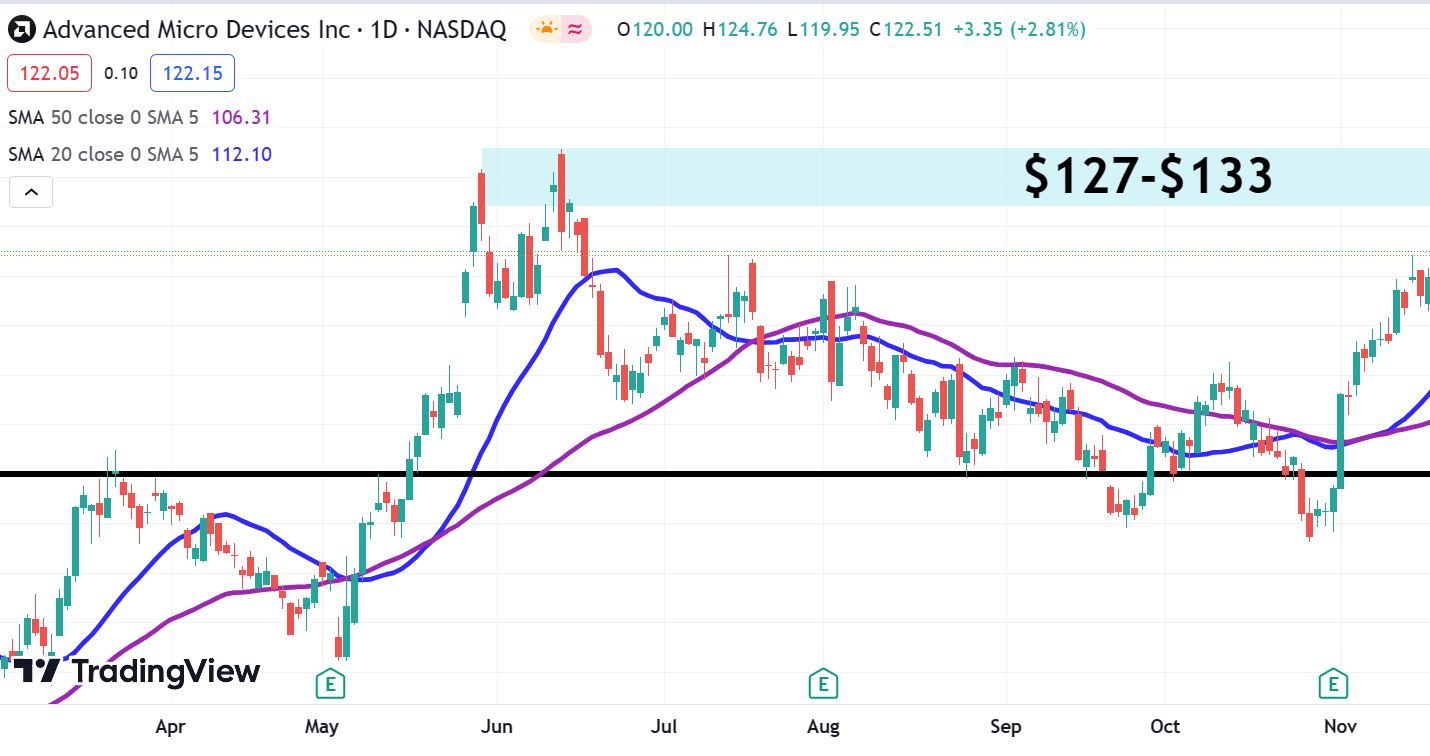
AMD daily stock chart
A glance at the weekly chart shows us that overcoming the year’s high near $133 could give ambitious traders the idea that the resistance point from November 2021 around $160 is possible.
Traders should expect some type of pullback before then however. The weekly Relative Strength Index (RSI) gives a reading of 61, which is not yet at overbought levels, while the daily RSI gets closer at 66. 70 is normally the threshold for an overbought reading.
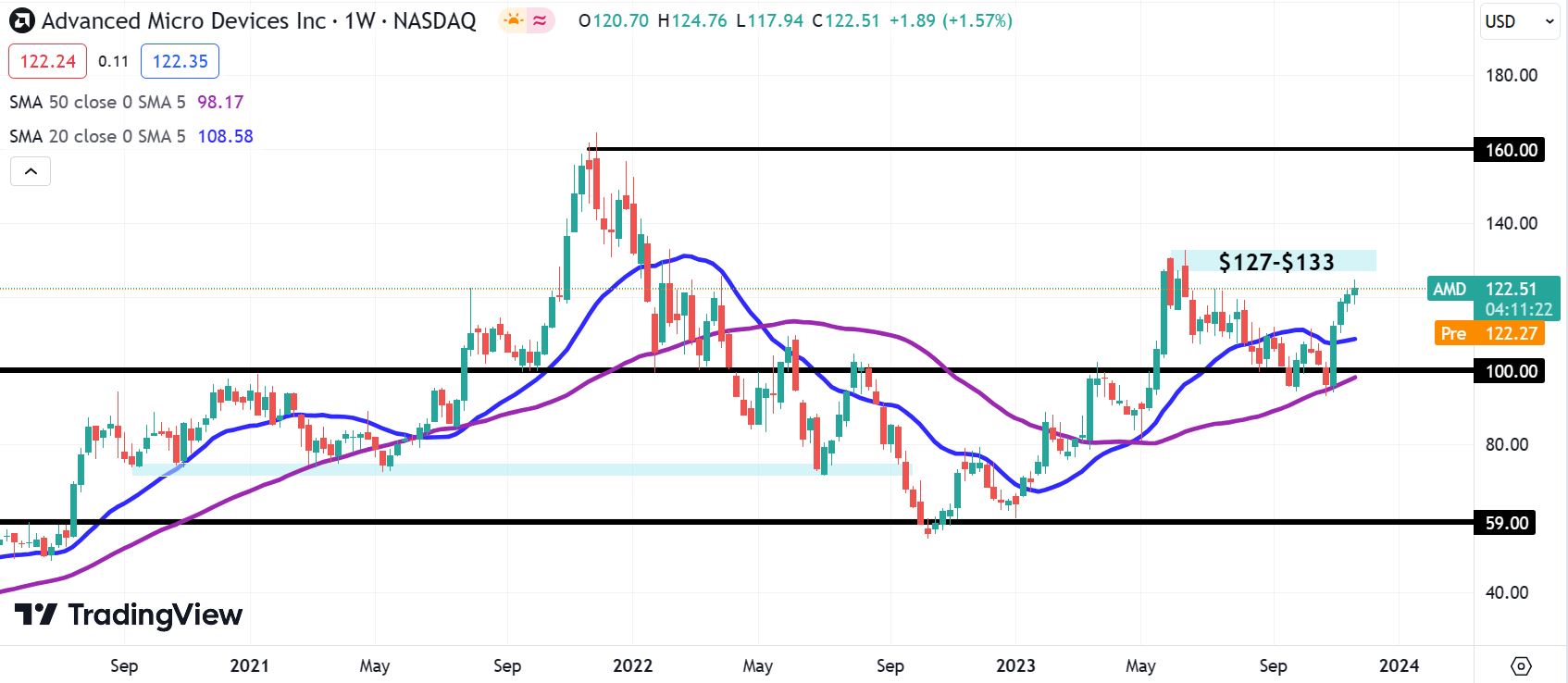
AMD weekly stock chart
Author

Clay Webster
FXStreet
Clay Webster grew up in the US outside Buffalo, New York and Lancaster, Pennsylvania. He began investing after college following the 2008 financial crisis.