Advanced Micro Devices Stock Forecast: AMD closes nearly 11% higher as semiconductors surge on Nvidia
- AMD stock rises 10.7% on Nvidia earnings excitement.
- Nvidia raised its Q1 revenue guidance by $2 billion to $24 billion.
- Market loves AI stocks, and AMD should benefit.
- NASDAQ surges 3% on Nvidia rally.

Advanced Micro Devices (AMD) stock surged 10.7% on Thursday on the heels of big brother Nvidia’s (NVDA) masterful Q4 release on Wednesday. AMD is seen as the runner-up to Nvidia’s success at becoming the go-to shop for artificial intelligence chips.
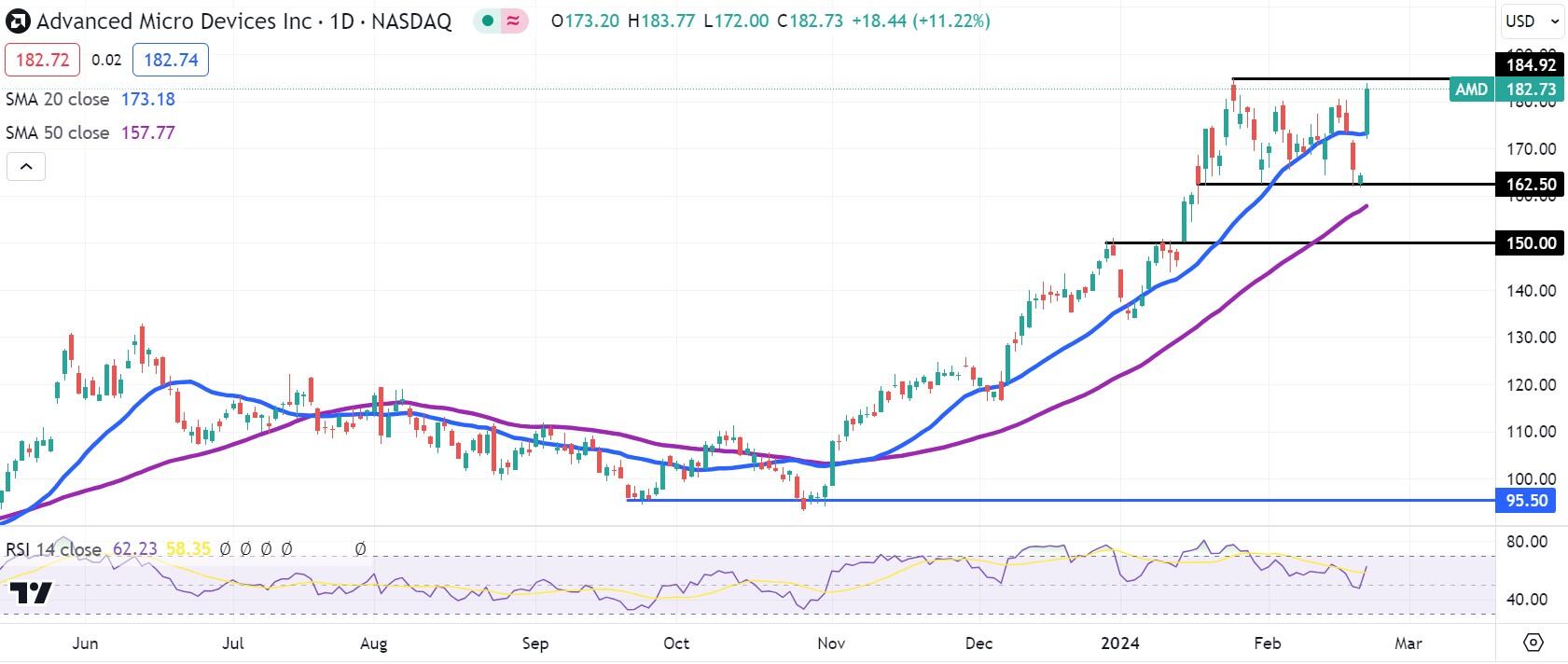
AMD stock closed at $181.86, though shares frequently moved above $183 in the bullish session. The S&P 500 and NASDAQ Composite have also seen extreme rallies on Thursday and gained 2.2% and 3%, respectively, as a consequence of Nvidia’s rally.
AMD stock news
Sometimes, it’s okay when your primary competitor wins so stridently. Nvidia’s fourth-quarter consensus beat and guidance raise on Wednesday has led to a rally among most semiconductor stocks. Super Micro Computer (SMCI) has spiked almost 33%, while Nvidia’s primary fab, Taiwan Semiconductor (TSM), has gained 3% on Thursday.
Nvidia itself gained 16.4% on Thursday after beating Wall Street consensus on Wednesday by 11% on adjusted earnings and nearly 8% on revenue. What’s more, management raised its guidance for the present first quarter of 2024 from $22 billion in sales to $24 billion in sales. Additionally, gross margins are expected to arrive between 76% and 77%.
“[W]e believe 60%-70% of enterprises will ultimately head down the AI use case path as we estimate $1 trillion of incremental AI spend over the next decade,” wrote Dan Ives of Wedbush Securities in his glowing response.
Cantor Fitzgerald raised its price target on Nvidia from $775 to $900, while Benchmark raised theirs from $625 to $1,000.
One good sign for AMD is that Cantor Fitzgerald noted that demand is so strong for Nvidia’s newest AI products that there will most likely be shortages. This could help AMD sell more MI300X AI GPUs, which the company is already using in Microsoft’s Azure data centers.
Nvidia FAQs
What is Nvidia known for?
Nvidia is the leading fabless designer of graphics processing units or GPUs. These sophisticated devices allow computers to better process graphics for display interfaces by accelerating computer memory and RAM. This is especially true in the world of video games, where Nvidia graphics cards became a mainstay of the industry. Additionally, Nvidia is well-known as the creator of its CUDA API that allows developers to create software for a number of industries using its parallel computing platform. Nvidia chips are leading products in the data center, supercomputing and artificial intelligence industries. The company is also viewed as one of the inventors of the system-on-a-chip design.
What is the history of Nvidia?
Current CEO Jensen Huang founded Nvidia with Chris Malachowsky and Curtis Priem in 1993. All three founders were semiconductor engineers, who had previously worked at AMD, Sun Microsystems, IBM and Hewlett-Packard. The team set out to build more proficient GPUs than currently existed in the market and largely succeeded by late 1990s. The company was founded with $40,000 but secured $20 million in funding from Sequoia Capital venture fund early on. Nvidia went public in 1999 under the ticker NVDA. Nvidia became a leading designer of chips to the data center, PC, automotive and mobile markets through its close relationship with Taiwan Semiconductor.
What is Nvidia’s relationship to artificial intelligence?
In 2022, Nvidia released its ninth-generation data center GPU called the H100. This GPU is specifically designed with the needs of artificial intelligence applications in mind. For instance, OpenAI’s ChatGPT and GPT-4 large language models (LLMs) rely on the H100’s high efficiency in parallel processing to execute a high number of commands quickly. The chip is said to speed up networks by six times Nvidia’s previous A100 chip and is based on the new Hopper architecture. The H100 chip contains 80 billion transistors. Nvidia’s market cap reached $1 trillion in May 2023 largely on the promise of its H100 chip becoming the “picks and shovels” of the coming AI revolution.
Why does Jensen Huang have a cult following?
Long-time CEO Jense Huang has a cult following in Silicon Valley and on Wall Street due to his strict loyalty and determination to build Nvidia into one of the world’s leading companies. Nvidia neary fell apart on several occasions, but each time Huang bet everything on a new technology that turned out to be the ticket to the company’s success. Huang is seen as a visionary in Silicon Valley, and his company is at the forefront of most major breakthroughs in computer processing. Huang is known for his enthusiastic keynote addresses at annual Nvidia GTC conferences, as well as his love of black leather jackets and Denny’s, the fast food chain where the company was founded.
AMD stock forecast
Thursday’s rally has placed AMD stock in contention with the all-time high of $184.92 from January 25 just a month ago. Nvidia’s success in the AI sector has placed a premium on all stocks related to AI, so AMD could continue to tread higher on the market’s euphoria.
Support is provide by the 20-day Simple Moving Average (SMA) at $173 and the $162.50 level that has worked as support since January 18. That latter level helped AMD hold up just on Wednesday this week.
Importantly for bulls, AMD stock is not overbought yet despite Thursday’s spike. The Relative Strength Index (RSI) sits at 62 and gives the stock room to continue running until traders take profits off the table.
AMD stock forecast
Author

Clay Webster
FXStreet
Clay Webster grew up in the US outside Buffalo, New York and Lancaster, Pennsylvania. He began investing after college following the 2008 financial crisis.