
Does it get your goat?
Being told, "It's your psychology," that's holding back your trading. It should!
Because it's advice from someone who hasn't solved the real cause.
Your psychology isn't the root cause—it's a side effect of something deeper.
The real culprit?
A lack of confidence. But where does confidence come from? Doing more of what feels like...
Let me share how it feels through yesterday's trading.
First, do you see the trades below from Wednesday's session?
Buying, adding, taking profits and then exiting completely...To flip to the sell side for a quick scalp...
Before re-engaging the long side...cautiously at first—increasing size as the market confirms its hand—to capitalise on the move, including exiting entirely at the high.
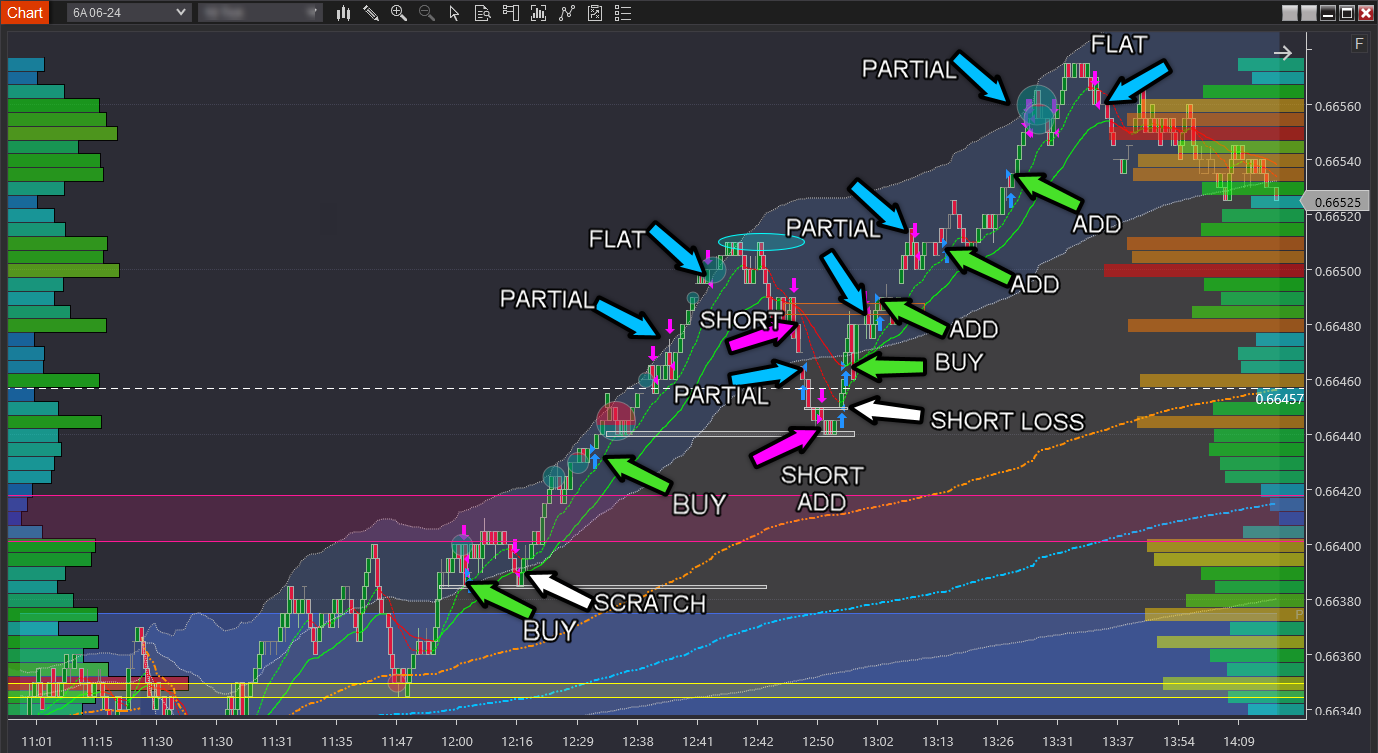
Now imagine feeling calm and self-assured as you made the above buying and selling decisions—a heightened sense of clarity and decisiveness as your executions aligned almost perfectly with the market's real-time movements.
Emotionally, it manifests as controlled excitement because, on the one hand, trading is business. But on the other...
Isn't the reason you got into this for fulfilment and life satisfaction? Not just financial reasons?
Fulfilment and life satisfaction occur when you're confident. So if trading feels stressful and emotionally exhausting, it is either not for you, or you lack confidence. And my guess is—if you've been at this for some time, the latter is the case. Agree?
Trading is challenging and competitive, so you'd better feel confident. Otherwise, why put yourself through it when you don't experience the satisfaction of being self-assured in your trading?
How you build confidence
It's surprisingly more straightforward than people are aware.
And to bust some myths, you don't need 'nerves of steel' or 'an affinity for taking risks'. Fun fact: the best traders are very risk-averse.
Consider this
While the trading above is from yesterday, I can show you the same trading sequence from many previous trading days spanning years. I know this trading scenario deeply.
I hear some of you say, "I know a particular setup, but I'm not confident taking it."
And to be blunt, you have no right to be.
That's because if you're using some technical analysis setup at best, it's giving you random results—just one of the many ways the majority trade plays into the hands of the minority.
By contrast
The easiest way to win again at trading is one where you've won many times before—because you excel at what you do more of. Correct?
Referred to as a playbook (of strategies), it sorts out where and when you have a legitimate competitive advantage to trade. It is built from understanding the trading game's deceptive tactics—how real opportunities are initially disguised to catch out the unsuspecting majority.
An armoury of playbook trades is trades you internalise. They become easier to trade in real time because there's less to think about—just spot them and act.
Is the following counter-intuitive?
The heavy lifting isn't in buying and selling. It's in internalising playbook trades. Let's ponder that point for a moment.
If the heavy lifting is already done, buying and selling doesn't feel threatening, uncomfortable or dangerous. Make sense?
You gain confidence because you've internalised trades you WANT to take. Trades you ENJOY taking. Trades, YOU KNOW, take profits out of the market.
Putting on my mentoring hat for a moment: Once you've learned how the game is played and how the money is made, your next step is to see playbook trades play out in the real-time market. You'll hear and see an explanation of what's happening to assist your comprehension.
At this point, take your notes and observations and start internalising by trading that sequence using recorded playback—a historical simulation of what occurred. Slow it down, pause to note key observations, etc.
It's easily the quickest way of internalising trades to develop confidence. So, it's no surprise that it plays a significant role in the curriculum at professional trading firms.
And for fun—because trading can be fun...
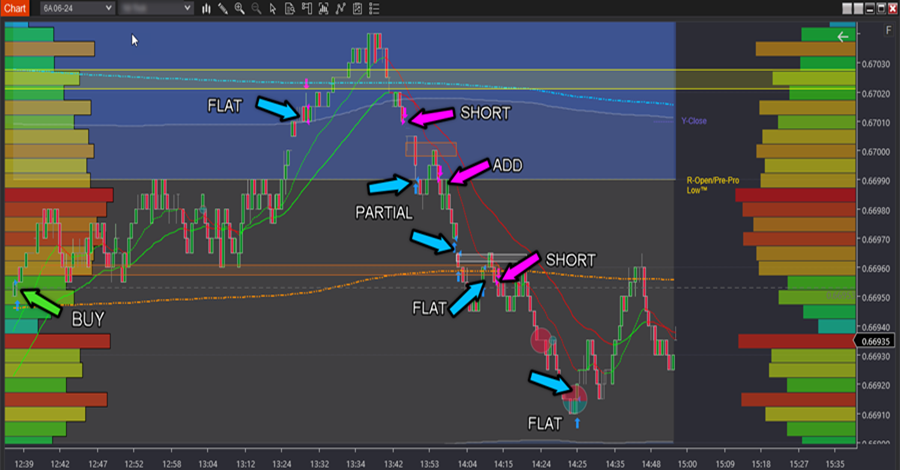
Here is a sequence of trades from yesterday.
Same MO... playbook trading.
Forex and derivatives trading is a highly competitive and often extremely fast-paced environment. It only rewards individuals who attain the required level of skill and expertise to compete. Past performance is not indicative of future results. There is a substantial risk of loss to unskilled and inexperienced players. The high degree of leverage can work against you as well as for you. Before deciding to trade any such leveraged products you should carefully consider your investment objectives, level of experience, and risk appetite. The possibility exists that you could sustain a loss of some or all of your initial investment and therefore you should not invest money that you cannot afford to lose. You should be aware of all the risks associated with trading on margin, and seek advice from an independent
Editors’ Picks

EUR/USD climbs to daily highs near 1.1820
EUR/USD now picks up pace and advances to the area of daily peaks north of the 1.1800 barrier at the end of the week. The pair’s decent move higher comes against the backdrop of a generalised lack of direction in the FX galaxy and the mild offered stance in the US Dollar.

GBP/USD trims losses, retests 1.3460
After briefly challenging its key 200-day SMA near 1.3440, GBP/USD now manages to regain some balance and revisit the 1.3460 zone on Friday. Cable’s pullback comes as the selling pressure on the Greenback gathers traction, reigniting some recovery in the risk-linked space.

Japanese Yen gives back half of early gains against USD ahead of US PPI data
The Japanese Yen (JPY) surrenders half of its early gains against the US Dollar (USD) during the European trading session on Friday. The USD/JPY pair rebounds to near 155.90 as the JPY falls back, but is still 0.15% down.
Editors’ Picks

EUR/USD: Fed calm, ECB steady, but the Dollar still leads Premium
EUR/USD is still struggling to find real traction. The pair has tried to stabilise, but momentum keeps fading, leaving the door open to further weakness.

Gold: Falling US yields, geopolitics help XAU/USD hold ground Premium
Gold (XAU/USD) gained traction and climbed above $5,200, ending the fourth consecutive week in positive territory. The next round of US-Iran talks and crucial macroeconomic data releases from the US will be watched closely by market participants in the short term.

GBP/USD: Will Pound Sterling defend key 1.3450 support ahead of US jobs data? Premium
The Pound Sterling (GBP) entered a bearish consolidation phase against the US Dollar (USD), after having tested critical support near the 1.3450 level on several occasions.

Bitcoin: Another month of losses, and it’s been five
Bitcoin (BTC) price is stabilizing around $68,000 at the time of writing on Friday, but the Crypto King is poised to close February on a fragile footing, marking its fifth consecutive month of losses since October and a rare start to the year with back-to-back monthly corrections.
US Dollar: At a crossroads; Fed steady, tariffs in flux Premium
The US Dollar’s (USD) upward momentum from the previous week seems to have encountered a tough nut to crack in the 98.00 region, as measured by the US Dollar Index (DXY).
RECOMMENDED LESSONS
Making money in forex is easy if you know how the bankers trade!

I’m often mystified in my educational forex articles why so many traders struggle to make consistent money out of forex trading. The answer has more to do with what they don’t know than what they do know. After working in investment banks for 20 years many of which were as a Chief trader its second knowledge how to extract cash out of the market.
5 Forex News Events You Need To Know

In the fast moving world of currency markets where huge moves can seemingly come from nowhere, it is extremely important for new traders to learn about the various economic indicators and forex news events and releases that shape the markets. Indeed, quickly getting a handle on which data to look out for, what it means, and how to trade it can see new traders quickly become far more profitable and sets up the road to long term success.
Top 10 Chart Patterns Every Trader Should Know

Chart patterns are one of the most effective trading tools for a trader. They are pure price-action, and form on the basis of underlying buying and selling pressure. Chart patterns have a proven track-record, and traders use them to identify continuation or reversal signals, to open positions and identify price targets.
7 Ways to Avoid Forex Scams

The forex industry is recently seeing more and more scams. Here are 7 ways to avoid losing your money in such scams: Forex scams are becoming frequent. Michael Greenberg reports on luxurious expenses, including a submarine bought from the money taken from forex traders. Here’s another report of a forex fraud. So, how can we avoid falling in such forex scams?
What Are the 10 Fatal Mistakes Traders Make
Trading is exciting. Trading is hard. Trading is extremely hard. Some say that it takes more than 10,000 hours to master. Others believe that trading is the way to quick riches. They might be both wrong. What is important to know that no matter how experienced you are, mistakes will be part of the trading process.
The challenge: Timing the market and trader psychology

Successful trading often comes down to timing – entering and exiting trades at the right moments. Yet timing the market is notoriously difficult, largely because human psychology can derail even the best plans. Two powerful emotions in particular – fear and greed – tend to drive trading decisions off course.