XRP price makes comeback above $0.50 as pro-XRP lawyer urges former SEC officials’ testimony
- XRP price recovered from its decline below the key psychological level of $0.50 early on Saturday.
- Pro-XRP attorney John Deaton said that former SEC officials’ testimony in SEC vs Ripple lawsuit could have classified XRP as non-security early on.
- Deaton concurred that it is key for Bill Hinman and Jay Clayton to provide testimony in the courtroom.

XRP price started its recovery early on Saturday. The recent consolidation in XRP was a result of the developments in the Securities and Exchange Commission (SEC) vs. Ripple lawsuit. Following pro-XRP attorney John Deaton’s comments urging former SEC officials’ testimony, the altcoin’s price made a comeback above $0.50.
At the time of writing, XRP price is $0.52 on Binance.
Also read: Top 3 undervalued cryptocurrencies in their opportunity zones during Bitcoin season
XRP price needs to overcome hurdles before rally to $0.70
XRP’s August high is $0.70. The altcoin made a comeback above the key psychological level of $0.50 and is trading at $0.52, at the time of writing. On its path to make a comeback to the August high, XRP price faces hurdles at the 10 and 50-day Exponential Moving Averages (EMAs) at $0.53 and $0.59.
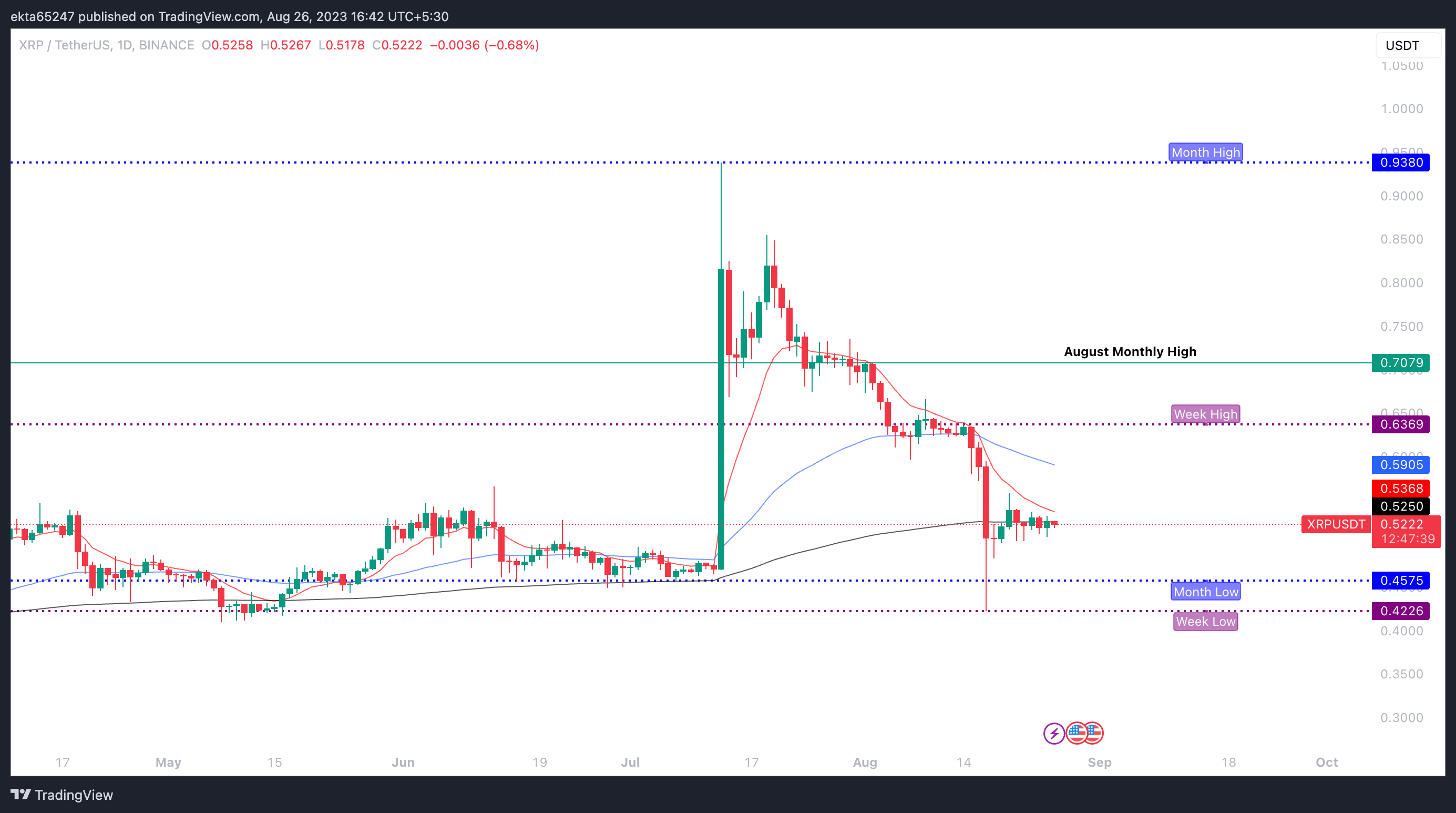
XRP/USDT one-day price chart on Binance
Developments in the SEC vs. Ripple lawsuit have acted as catalysts for the altcoin’s price since the July ruling, where Judge Analisa Torres declared a partial victory for the payment remittance firm. A pro-XRP attorney, John Deaton, recently commented on how former SEC officials, Bill Hinman and Jay Clayton could provide their testimony in the lawsuit and help prove XRP is not a security, early on in the legal battle.
Deaton tweeted:
Hinman definitely gets to testify. Normally, you’d have no chance at being able
— John E Deaton (@JohnEDeaton1) August 25, 2023
to subpoena a former Chairman for a trial. But here, the SEC stupidly chose to bring aiding and abetting charges against the CEO @bgarlinghouse. Ironically, it was Clayton who wanted to sue the…
According to Deaton, obtaining testimony from Clayton and Hinman could have saved legal expenses and time spent on the lawsuit. XRP’s adoption would likely have been unaffected during the course of the litigation and an outcome would have been reached faster.
As the XRP holder community awaits the next step in the SEC vs. Ripple lawsuit, the altcoin makes headway in its price recovery.
Ripple FAQs
What is Ripple?
Ripple is a payments company that specializes in cross-border remittance. The company does this by leveraging blockchain technology. RippleNet is a network used for payments transfer created by Ripple Labs Inc. and is open to financial institutions worldwide. The company also leverages the XRP token.
What is XRP?
XRP is the native token of the decentralized blockchain XRPLedger. The token is used by Ripple Labs to facilitate transactions on the XRPLedger, helping financial institutions transfer value in a borderless manner. XRP therefore facilitates trustless and instant payments on the XRPLedger chain, helping financial firms save on the cost of transacting worldwide.
What is XRPL?
XRPLedger is based on a distributed ledger technology and the blockchain using XRP to power transactions. The ledger is different from other blockchains as it has a built-in inflammatory protocol that helps fight spam and distributed denial-of-service (DDOS) attacks. The XRPL is maintained by a peer-to-peer network known as the global XRP Ledger community.
What blockchain technology does XRP use?
XRP uses the interledger standard. This is a blockchain protocol that aids payments across different networks. For instance, XRP’s blockchain can connect the ledgers of two or more banks. This effectively removes intermediaries and the need for centralization in the system. XRP acts as the native token of the XRPLedger blockchain engineered by Jed McCaleb, Arthur Britto and David Schwartz.
Like this article? Help us with some feedback by answering this survey:
Author

Ekta Mourya
FXStreet
Ekta Mourya has extensive experience in fundamental and on-chain analysis, particularly focused on impact of macroeconomics and central bank policies on cryptocurrencies.