What to expect from Bitcoin after the big BTC price drop and massive spike in social dominance
- Bitcoin price nosedived 5.2% within an hour, dropping from $23,435 to $22,259, but traders didn’t show serious concern until 12 hours later.
- Bitcoin’s social dominance hit a two-week high, as BTC price discussions started skyrocketing when the asset failed to rebound.
- Arthur Hayes, former head of BitMEX exchange believes there are only two scenarios for BTC price, either a massive decline or a smooth recovery.

Bitcoin witnessed a massive price drop on March 3, dropping from $23,435 to $22,259 within an hour. Experts at Santiment note that traders didn’t take note of the price drop until 12 hours later when BTC failed to rebound.
Also read: Why analysts believe Bitcoin is going to zero, will BTC price nosedive?
Bitcoin price plummets and BTC witnesses a spike in social dominance
Bitcoin price nosedived from $23,435 to $22,259 within an hour on March 3 at 1 AM UTC. Experts at Santiment, the crypto intelligence tracker noted that traders didn’t show serious concern until 12 hours later when the asset’s price failed to rebound.
Interestingly, Bitcoin’s social dominance hit a two-week high when discussions surrounding BTC’s likely recovery started taking over social media platforms. According to experts, social dominance needs to climb higher for the largest asset by market capitalization to turnaround.
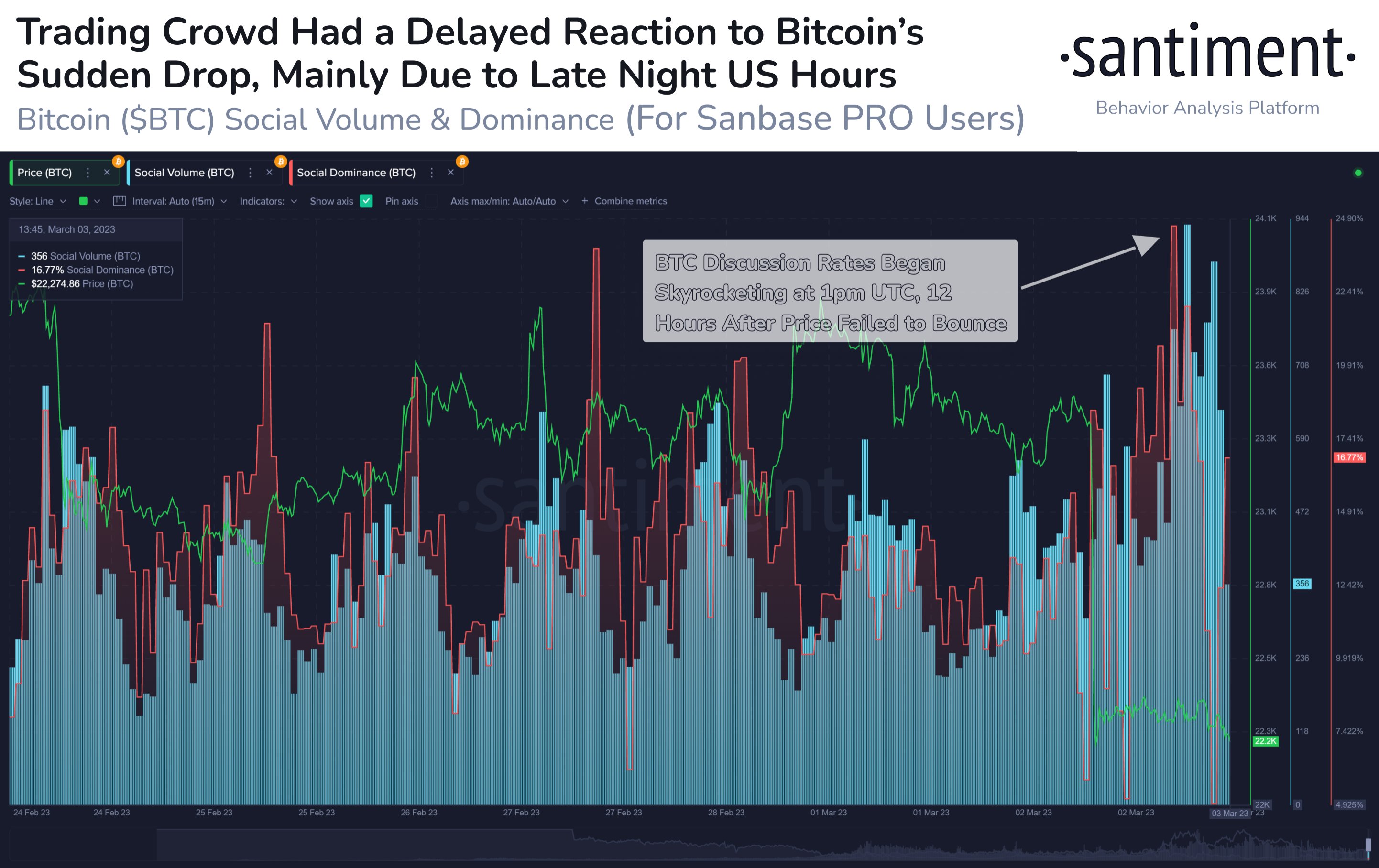
Bitcoin social dominance rises
What to expect from Bitcoin price?
Arthur Hayes, the former head of BitMEX exchange believes there are only two scenarios for Bitcoin price. In the first scenario the price of risk assets continues rising smoothly, and BTC could witness a gradual price increase.
Hayes believes Bitcoin has already passed the bottom, “because almost all the irresponsible persons who could go bankrupt — have gone bankrupt.” In this scenario, crypto winter is finally over and BTC could rally to the $40,000 price level in late 2023.
According to Hayes, in scenario two, risky assets would plummet, and 2023 would be just as bad as 2022. Bitcoin price could continue bleeding and risk assets would witness a steep correction similar to 2022.
Author

Ekta Mourya
FXStreet
Ekta Mourya has extensive experience in fundamental and on-chain analysis, particularly focused on impact of macroeconomics and central bank policies on cryptocurrencies.