Vitalik Buterin moves 400 Ethereum, ETH hovers around $2,600
- Vitalik Buterin moved 400 Ether from his wallet to a new address early on Monday.
- Ethereum founder transferred 1 ETH to crypto mixer Railgun, Buterin is likely to mix the remaining Ether for privacy protection.
- Ethereum spot ETFs had a new outflow of $14.16 million last week, signaling lack of institutional demand for the asset.
- ETH hovers around $2,600 on August 19.

Vitalik Buterin, co-creator of Ethereum, the largest altcoin in the crypto ecosystem, moved ETH to a crypto mixer, early on Monday. The mixer is known to effectively prevent malicious actors and protect user privacy.
Buterin mover over $1.06 million in Ether to a new wallet address per data from an on-chain tracker. The transfer comes at a time when ETH is reeling from the crypto crash of early August.
Ethereum trades at $2,632 at the time of writing.
Ethereum updates: Co-founder moves ETH to new wallet, institutional demand dips
Data from Arkham Intelligence, an on-chain crypto tracker shows that Vitalik Buterin transferred 400 Ether, worth about $1.06 million to a new wallet address, 0x18…F10E. Buterin moved 1 ETH to Railgun, a crypto mixer for professional traders and DeFi users.
The smart contract protocol adds privacy protection to crypto transactions.
Buterin’s transfer comes at a time when Ethereum is struggling to recover from the crypto market correction. ETH hovers under key support at $2,750 as institutional capital leaves Spot Ethereum ETFs.
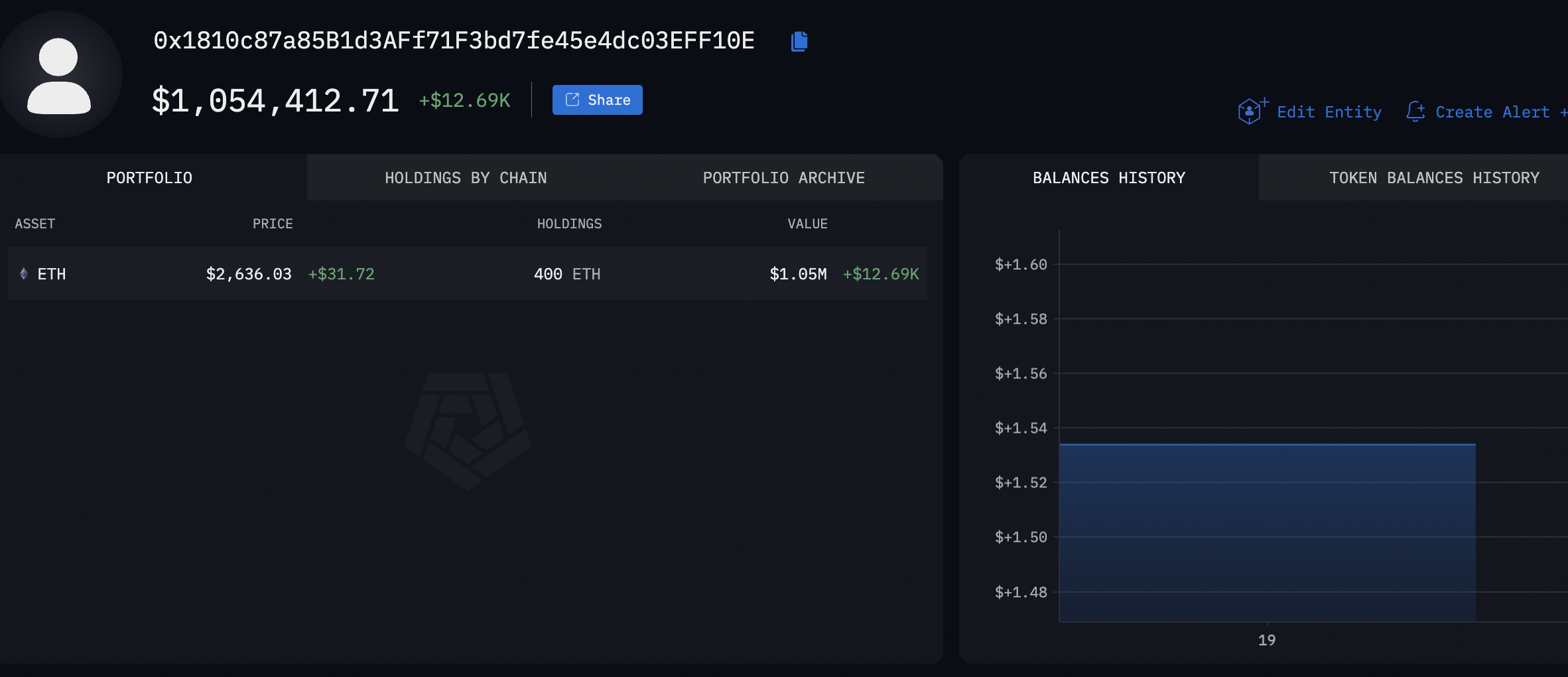
Vitalik Buterin’s new wallet
Data from Sosovalue shows that Spot Ethereum ETFs had a net outflow in the week of August 12 to 16, with $14.16 million leaving the investment product. Grayscale ETF’s ETHE had a new outflow of $118 million, while BlackRock and Fidelity’s Spot Ethereum ETFs garnered $76.35 million and $25.79 million in inflows respectively.
As institutional capital inflow to the investment product dwindles, it is likely that demand for Ether is drying up among institutions.
Ethereum trades at $2,632 at the time of writing.
Ethereum FAQs
Ethereum is a decentralized open-source blockchain with smart contracts functionality. Serving as the basal network for the Ether (ETH) cryptocurrency, it is the second largest crypto and largest altcoin by market capitalization. The Ethereum network is tailored for scalability, programmability, security, and decentralization, attributes that make it popular among developers.
Ethereum uses decentralized blockchain technology, where developers can build and deploy applications that are independent of the central authority. To make this easier, the network has a programming language in place, which helps users create self-executing smart contracts. A smart contract is basically a code that can be verified and allows inter-user transactions.
Staking is a process where investors grow their portfolios by locking their assets for a specified duration instead of selling them. It is used by most blockchains, especially the ones that employ Proof-of-Stake (PoS) mechanism, with users earning rewards as an incentive for committing their tokens. For most long-term cryptocurrency holders, staking is a strategy to make passive income from your assets, putting them to work in exchange for reward generation.
Ethereum transitioned from a Proof-of-Work (PoW) to a Proof-of-Stake (PoS) mechanism in an event christened “The Merge.” The transformation came as the network wanted to achieve more security, cut down on energy consumption by 99.95%, and execute new scaling solutions with a possible threshold of 100,000 transactions per second. With PoS, there are less entry barriers for miners considering the reduced energy demands.
Author

Ekta Mourya
FXStreet
Ekta Mourya has extensive experience in fundamental and on-chain analysis, particularly focused on impact of macroeconomics and central bank policies on cryptocurrencies.