USDC depegged, but it's not going to default

USD Coin is going to survive Silicon Valley Bank’s collapse. But it should inspire advocates of cryptocurrency to prepare for future systemic shocks.
Over the past week, investors understandably became concerned over the news that billions of dollars backing USD Coin — the second-largest stablecoin — were locked up in the distressed Silicon Valley Bank (SVB). The market reacted violently, causing USDC to lose its dollar peg. But while the concern was understandable, it has become clear that USDC creator Circle will regain full access to its funds. The crypto community can breathe easily.
It started as a tremor
Hundreds of sensors are buried on the ocean floor off the coast of Japan. Trained to detect the slightest hints of a tremor, they wire data at light speed to laboratories on the main island. In the event of the fault lines that bifurcate the ocean trenches hitting violently together, the seismic activity will be detected, giving islanders precious minutes in which to retreat to high ground before a tsunami hits.
Last week, the seismograph that records the financial health of the United States banking system began plotting jagged lines. Something had broken deep beneath the surface, and it was clear that trouble was on its way. On Friday, reports emerged that Silicon Valley Bank, relied on by thousands of tech startups including crypto companies, had run out of cash. Wires sent in the night before for processing were not being fulfilled.
The seismograph, which had already detected an uptick in activity with the collapse of Silvergate Bank days earlier, had begun to shake. It was clear that a tsunami was brewing. Over the weekend, with U.S. banks closed and SVB customers anxiously waiting for news of a bailout to protect their deposits, pressure has mounted on high-profile businesses to disclose their holdings.
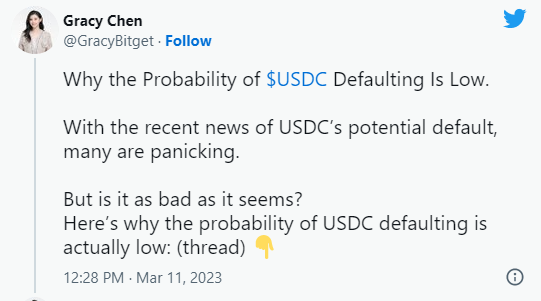
Circle, the issuer of the 100% fiat collateralized USDC stablecoin, is one of them. On Saturday, it released a statement confirming that $3.3 billion of the $40 billion used to back USDC is held with Silicon Valley Bank. Rather than reassuring investors that the bulk of Circle’s funds is safe, the revelation had the reverse effect: Confidence in USDC wobbled, and the stablecoin, which had clung closely to its $1 peg throughout its four-year lifespan, began to fall.
Related: Kraken staking ban is another nail in crypto’s coffin — And that’s a good thing
People clamored to short USDC, with major derivatives trading platforms even opening a dedicated market for the purpose. Arbitrageurs began profiting from price inefficiencies as panicked USDC holders sought sanctuary in other stablecoins at any cost, and other stablecoins, in turn, such as the USDC-collateralized Frax and Dai, also lost their peg. It’s clear there’s a wave heading for the shore.
Rumors of USDC’s demise have been exaggerated
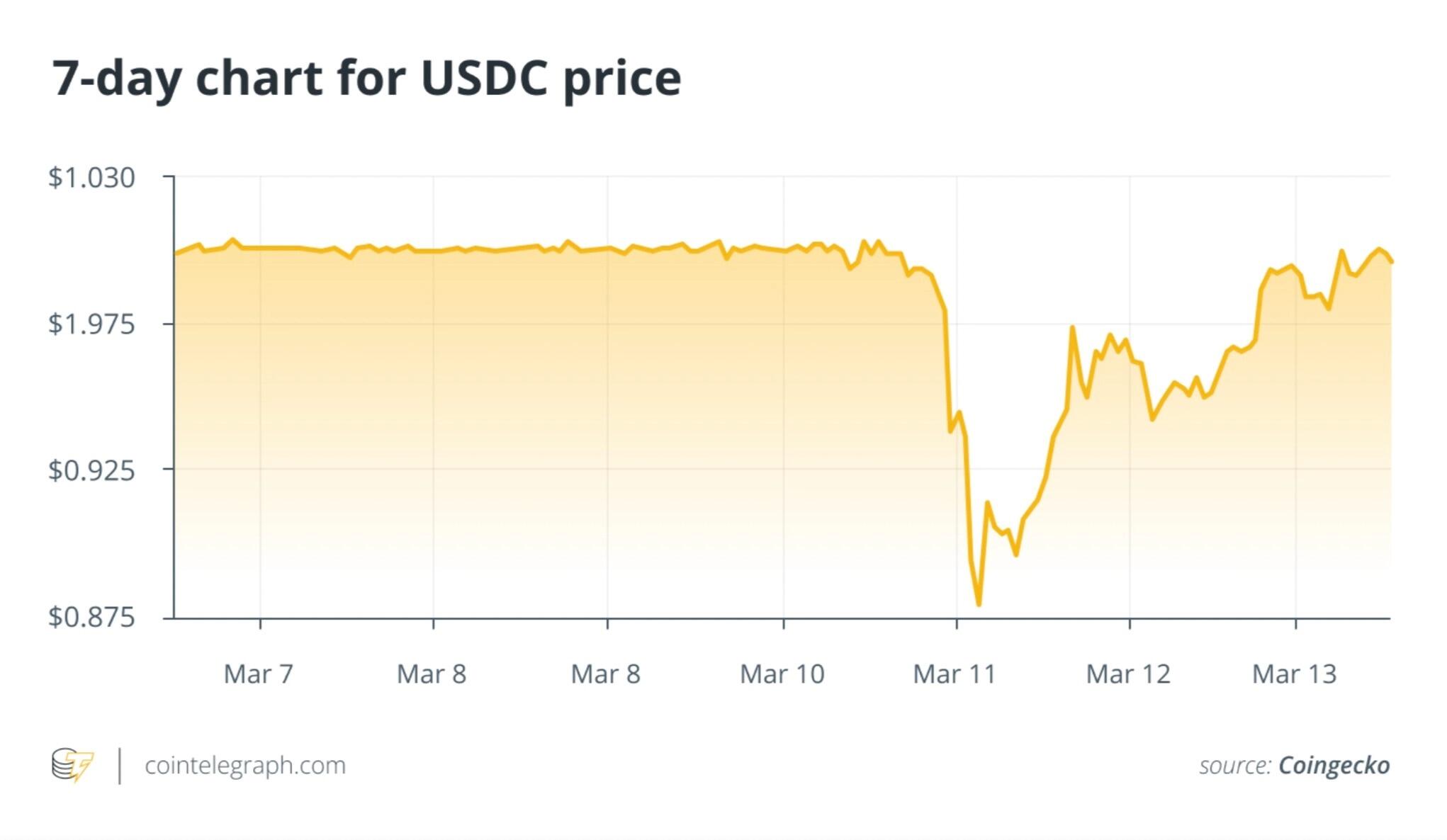
While SVB shareholders are not slated for a bailout, the U.S. federal government announced it would cover the bank’s uninsured depositors. Circle will be fine. But what about USDC? Over the weekend, the once-stable token plunged to a low of $0.88 as traders tried to price in USDC being under-collateralized. As of March 13, USDC has recovered to a range between $0.99 and $1.01.
As the dust settles, however, questions hang over not just USDC but all stablecoins and their ability to maintain their pegs through thick and thin. The panic over Silicon Valley Bank is almost over. Now, the onus is on the crypto industry to regain trust in the stablecoins that are the bedrock of the business. “Don’t trust, verify” is crypto’s core mantra. And yet, for all the cryptographic proof, it remains a business, like TradFi, that runs on faith.
It may not have developed into a Richter-shattering earthquake, but the tremors caused by Circle’s exposure to SVB have reverberated through the crypto sphere. Achieving stability in an unstable world is a challenge that’s bigger than crypto. Preventing future systemic shocks calls for a rethink of the tenets we once held to be infallible.
Author

Cointelegraph Team
Cointelegraph
We are privileged enough to work with the best and brightest in Bitcoin.