UNI price fills up a triangle as Uniswap fee switch proposal starts
- Uniswap price action has consolidated within a triangle in the days leading to March 1, when the fee switch proposal starts
- UNI next directional bias will manifest once the price breaks out.
- Uniswap’s move could kickstart the next big narrative for ETH-based DeFi, DEXes, and LSDs.

The Uniswap fee switch proposal officially starts on March 1, to upgrade the protocol such that its fee mechanism rewards UNI token holders that have delegated and staked their tokens.
Notably, Uniswap is [arguably] US compliant. This is deduced from an article published in December 2022, which cited possible legal issues in approving the fee switch proposal. The compliance argument is also supported by the fact that in 2023, the founder mulled fee switch option, but did not make a decision citing "legal concerns".
With that in mind, the latest move is a bold one. It could therefore mean something has changed fundamentally, in which case, it could encourage other platforms to do the same.
As the UNI fee switch proposal starts, the Uniswap price is filing up a triangle with the next directional bias due to manifest soon.
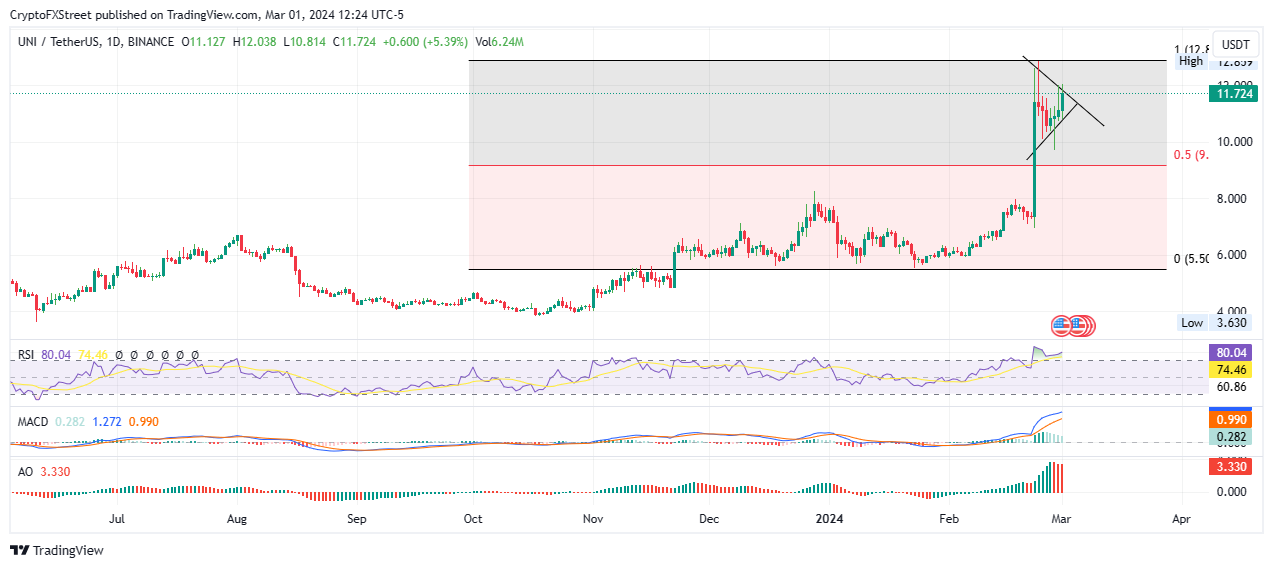
UNI/USDT 1-day chart
Bitcoin, altcoins, stablecoins FAQs
What is Bitcoin?
Bitcoin is the largest cryptocurrency by market capitalization, a virtual currency designed to serve as money. This form of payment cannot be controlled by any one person, group, or entity, which eliminates the need for third-party participation during financial transactions.
What are altcoins?
Altcoins are any cryptocurrency apart from Bitcoin, but some also regard Ethereum as a non-altcoin because it is from these two cryptocurrencies that forking happens. If this is true, then Litecoin is the first altcoin, forked from the Bitcoin protocol and, therefore, an “improved” version of it.
What are stablecoins?
Stablecoins are cryptocurrencies designed to have a stable price, with their value backed by a reserve of the asset it represents. To achieve this, the value of any one stablecoin is pegged to a commodity or financial instrument, such as the US Dollar (USD), with its supply regulated by an algorithm or demand. The main goal of stablecoins is to provide an on/off-ramp for investors willing to trade and invest in cryptocurrencies. Stablecoins also allow investors to store value since cryptocurrencies, in general, are subject to volatility.
What is Bitcoin Dominance?
Bitcoin dominance is the ratio of Bitcoin's market capitalization to the total market capitalization of all cryptocurrencies combined. It provides a clear picture of Bitcoin’s interest among investors. A high BTC dominance typically happens before and during a bull run, in which investors resort to investing in relatively stable and high market capitalization cryptocurrency like Bitcoin. A drop in BTC dominance usually means that investors are moving their capital and/or profits to altcoins in a quest for higher returns, which usually triggers an explosion of altcoin rallies.
This section below was published on February 27 detailing how Uniswap fee distribution incentive could bode well for Ethereum-based tokens
Uniswap (UNI), a decentralized protocol, recently passed the fee switch proposal, proposing that UNI token holders who have delegated and staked their tokens will be rewarded or rather, incentivized. The proposal was conceived in the Summer of 2022.
Also Read: UNI price drops over 10% as Uniswap DEX switches on their fee distribution incentive
Possible implications of Uniswap fee distribution incentive
After around 14 months since the Uniswap Foundation posted an article playing the devil's advocate with legal issues in approving its fee switch proposal, the protocol finally followed through this past weekend. Despite articulating in the article that it did not want trouble, having acknowledged the “regulatory and private litigation climate for DeFi in the US,” the proposal passed in the end.
Among the key aspects of the implementation of the proposal include the following, citing the official blog.
- Upgrade Uniswap Protocol Governance to enable the permissionless and programmatic collection of protocol fees
- Distribute any protocol fees pro-rata to UNI token holders who have staked and delegated their votes
- Allow for governance to continue to control core parameters: which pools are charged a fee, and the magnitude of the fee
Staking UNI and getting protocol fees as a reward is almost tantamount to being a real shareholder of Uniswap DEX. Nevertheless, it marks an inadvertent move to poked fingers at the US Securities and Exchange Commission (SEC).
Uniswap just declared war on the SEC on behalf of all DeFi .
— TonyBet.MVC (@TonyBet_) February 24, 2024
Uniswap is to make token holders the receivers of all fees generated on the platform.
Dex tokens are about to run if the vote passes.
TLDR;
Uniswap is a US company offering revenue share. pic.twitter.com/zMGLp6dCLv
Nevertheless, the bold move has inspired many, with Frax Finance CEO Sam Kazemian saying, “We are going to follow Uniswap's lead in proposing it. It will be up to the community to pass it.” Uniswap is a potential forerunner as the decision is likely to influence other protocols to do the same. Such an outcome could kickstart the next big narrative with Ethereum-based decentralized finance (DeFi)-based DeFi, decentralized exchanges (DEXes), and Liquid Staking Derivatives (LSDs) likely to take the spotlight next.
Specifically, other networks could start distributing part of their protocol fees to stakers of their respective native tokens, allowing them to keep their utility and governance rights. Leading the chain, Ethereum protocol could reward ETH holders for staking their holdings following the chain’s migration from Proof-of-Work (PoW) to Proof-of-Stake (PoS).
Such a move could elevate stakers so that like validators, who receive a variable amount of ETH after their proposed blocks are approved, the stakers are also rewarded.
By encouraging staking through incentivization, it would bolster price increases by reducing the amount of tokens in circulation. For projects such as Ethereum, where the markets anticipate prospects of an ETH ETF, investors looking to make the most from their holdings without selling can put them to work by staking and restaking, amplifying scarcity. This could see Ethereum price extend its gains now that it has breached the $3,000 milestone.
Ethereum FOMO reaches new heights! Staking and restaking narratives fuel investor interest, with over 31 million ETH staked. A spot ETH ETF approval could amplify supply scarcity, propelling ETH to new highs. #ETH #FOMORising
— митяй (@shoybis) February 26, 2024
For the layperson, staking entails depositing and locking up tokens to help validate and secure the consensus layer (the Beacon Chain for the case of Ethereum) and receive rewards for doing so.
On platforms such as liquid staking derivatives (LSDs) like Lido Finance (LDO), users can stake their ETH and receive stETH. For now, there are no fee distribution mechanisms, but if the network were to emulate the Uniswap then there would be rewards beyond the gains made when your stETH is traded or used for other DeFi applications such as lending.
Also Read: Ethereum price teases with a breakout, eyes $3,200 milestone as ETH bulls show resolve
Author

Lockridge Okoth
FXStreet
Lockridge is a believer in the transformative power of crypto and the blockchain industry.