Tornado Cash mixer blacklisted, Ethereum co-founder Vitalik Buterin proposes Privacy Pools
- Tornado Cash mixer blacklisted, Ethereum co-founder Vitalik Buterin proposes Privacy Pools
- After the clampdown on Tornado Cash developers, the US Treasury Department’s Office of Foreign Assets Control blacklisted the mixer.
- As a possible replacement, Ethereum’s Vitalik Buterin has co-structured Privacy Pools, a “regulation-friendly” privacy tool dissociating from illicit funds.
- Buterin and team envision a space where financial privacy and regulation can coexist provided unlawful actors are kept away.

Tornado Cash, the Ethereum-based non-custodial privacy mixer was blacklisted recently after the Department of the Treasury’s Office in collaboration with the US Department of Justice (DOJ) and the IRS accused its developers Roman Storm and Roman Semenov of laundering over $1 billion for the infamous Lazarus Group. Now, Ethereum co-founder Vitalik Buterin is collaborating for a replacement touted as being “regulation-friendly.”
Also Read: Tornado Cash developers arrested and charged with laundering more than $1 billion
Tornado Cash could be replaced with regulation-friendly software
Ethereum co-founder Vitalik Buterin is working with a team to develop an alternative, expected to be compliant with industry regulations. Citing an excerpt from the announcement, “We explored new compliance opportunities where users can provably dissociate from illicit funds.”
1/ New privacy paper with @VitalikButerin, Jacob Illum (@chainalysis), @mat_nadler, @fschaer!https://t.co/ovH1iYXXY6
— Ameen Soleimani (@ameensol) September 6, 2023
We explored new compliance opportunities made possible by https://t.co/Nt4b2Tgx1D, where users can provably dissociate from illicit funds.
story below pic.twitter.com/Tq0zYfbwlL
Other than Buterin, the rest of the team comprises Ameen Soleimani, Jacob Illum, Matthias Nadler and Fabian Schar. The first is a developer, the second a Chainalysis researcher, while the last two are scholars.
Touted as “a novel smart contract-based privacy-enhancing protocol” Privacy Pools will do the same job as Tornado Cash, to enhance transactional privacy on blockchains, only better. Specifically, while they will not reveal the complete transaction history, Privacy Pools will be able to determine the source of the funds using zero-knowledge proofs. This means they will be able to tell whether the funds come from illicit sources.
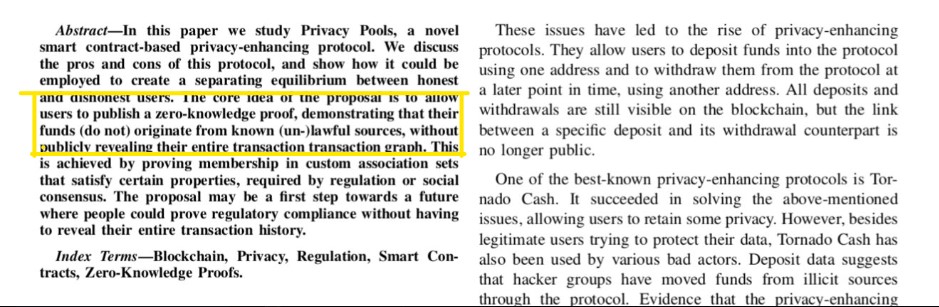
Privacy Pools Abstract
A space where financial privacy and regulation can coexist
Using Tornado Cash as a reference point, the authors explain that it is possible for financial privacy and regulation to co-exist as long as you can prevent it from being misused by unlawful actors.
When the DOJ clamped down against Tornado Cash, there was the expectation that the move would have wide-reaching and longstanding effects on the crypto ecosystem.Ethereum smart contracts for example share similarities with Tornado Cash, as both are made up of just code running on the blockchain.
As such, Buterin seems to be attempting to distance his network from possible negative sentiment connected with Tornado Cash even as the justice department turns its gaze toward mixing services and how they play enabling roles for criminals looking to conceal their activities after stealing funds from unsuspecting victims.
Ethereum FAQs
What is Ethereum?
Ethereum is a decentralized open-source blockchain with smart contracts functionality. Serving as the basal network for the Ether (ETH) cryptocurrency, it is the second largest crypto and largest altcoin by market capitalization. The Ethereum network is tailored for scalability, programmability, security, and decentralization, attributes that make it popular among developers.
What blockchain technology does Ethereum use?
Ethereum uses decentralized blockchain technology, where developers can build and deploy applications that are independent of the central authority. To make this easier, the network has a programming language in place, which helps users create self-executing smart contracts. A smart contract is basically a code that can be verified and allows inter-user transactions.
What is staking?
Staking is a process where investors grow their portfolios by locking their assets for a specified duration instead of selling them. It is used by most blockchains, especially the ones that employ Proof-of-Stake (PoS) mechanism, with users earning rewards as an incentive for committing their tokens. For most long-term cryptocurrency holders, staking is a strategy to make passive income from your assets, putting them to work in exchange for reward generation.
Why did Ethereum shift from Proof-of-Work to Proof-of-Stake?
Ethereum transitioned from a Proof-of-Work (PoW) to a Proof-of-Stake (PoS) mechanism in an event christened “The Merge.” The transformation came as the network wanted to achieve more security, cut down on energy consumption by 99.95%, and execute new scaling solutions with a possible threshold of 100,000 transactions per second. With PoS, there are less entry barriers for miners considering the reduced energy demands.
Author

Lockridge Okoth
FXStreet
Lockridge is a believer in the transformative power of crypto and the blockchain industry.