This is how Solana plans to cut costs for its on-chain storage solution
- Solana has revealed a cost-cutting solution for the network's on-chain storage.
- The technology, dubbed 'state compression,' promises to reduce the cost of on-chain storage by a significant margin.
- Twitter users classify the development as a game changer poised to increase Solana's viability and expand its enterprise applications.

Solana, a layer 1 blockchain, has introduced a new solution that will help reduce the cost of on-chain storage by a significant margin. The technology, christened 'state compression,' commits to lowering the cost of minting 1 million non-fungible tokens (NFTs) on the network to $110.
1/ Solana's low fees have made it an industry leader. But thanks to a recent innovation from teams across the ecosystem, it's about to cost even less.
— Solana (@solana) April 6, 2023
Introducing state compression, a new way to store data on Solana that lowers cost significantly. https://t.co/0baMJ0vOn1
Solana Foundation on state compression
In an April 6 blog post, the tech lead at the Solana Foundation, Jon Wong, said, "After numerous phases of development, adoption, and rollout, compressed NFTs are live on Solana's mainnet-beta and powering the next wave of novel on-chain product experiences."
From the blog, compressed NFTs are between 2,400 and 24,000 times cheaper than uncompressed peers with similar structures. Wong also explained that state compression hinges on Merkle trees. This is a "data structure famous for its ability to compress the verifiability of a tree of data into a 'hash,' or 'fingerprint' of the current state of the tree."
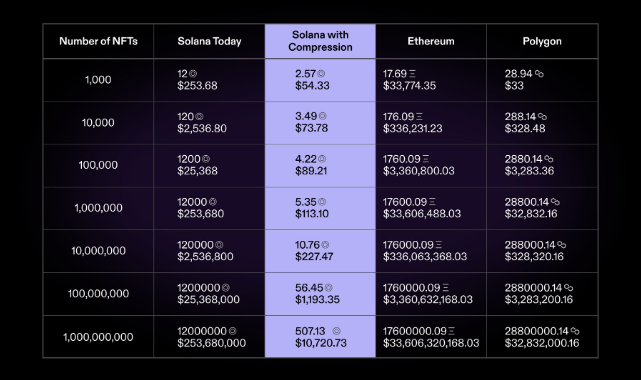
A breakdown of NFT costs with Solana compression. Source: Solana Foundation
The Merkle roots are stored on-chain, with updates recorded directly in the Solana ledger. Doing this reduces the cost of storing data without compromising decentralization. Notably, the approach can store any data type on-chain. Citing Wong,
This compression-friendly data structure allows developers to store a small bit of data on-chain and updates directly in the Solana ledger, cutting the data storage cost down dramatically while still using the security and decentralization of Solana's base layer.
State compression technology is a true cross-ecosystem effort
Further, the tech lead explained that the development was a "true cross-ecosystem effort," jointly developed by Solana Labs and Metaplex developers with support from Phantom, Solflare, and powered by RPC node providers, as well as indexers Helius, Triton, and SimpleHash.
6/ State compression is a true cross-ecosystem effort — with support from @Metaplex, @heliuslabs, @Triton_one, @SimpleHashInc, @phantom, @solflare_wallet, @SolanaLabs, and @SolanaFndn.
— Solana (@solana) April 6, 2023
The Solana community on Twitter has described the state compression solution as a "game changer" and a gateway "to make Solana a much more viable option for enterprise applications."
Some of the projects on the Solana ecosystem that have already adopted the state compression technology include Dialect, Crossmint, Helium, and Wordcel, with more to come. These projects use solutions link minting NFTs, integrations for business loyalty programs, and user experience (UX) improvement.
Watch this video to understand how state compression can help unlock Web3 experiences at a massive scale.
Author

Lockridge Okoth
FXStreet
Lockridge is a believer in the transformative power of crypto and the blockchain industry.