Terra Virtua migrates from Ethereum to Polygon to reduce energy consumption by over 99%
- Terra Virtua has made the decision to move from the Ethereum blockchain to Polygon, citing sustainability as the main factor.
- The switch to Polygon may reduce the energy consumption of producing one NFT by 99%.
- MATIC appears to be ready for a 20% move following its consolidation.

Non-fungible token (NFT) platform Terra Virtua has decided to move from the Ethereum blockchain to the Polygon network to become more environmentally friendly.
Terra Virtua to become more sustainable
Terra Virtua claims that the network would allow the ecosystem to reduce energy consumption used to create an NFT by more than 99%.
Any digital collectibles that were not sold on the Ethereum blockchain would also be reminted and moved to Polygon. Terra Virtua believes that sustainability “should not have to pay the price” for the technology, and it hopes to limit its impact on the environment.
This move will take the NFT platform out of beta testing, and the project aims to form licensing partnerships with global entities in the future.
Currently, the platform is offline due to a site-wide upgrade, and users will have until August 22 to purchase NFTs that were minted on the Ethereum blockchain.
Polygon price sets sights on 20% move
Polygon price has recovered by over 133% since its low on July 20 at $0.61. On the 12-hour chart, MATIC has formed an inverse head-and-shoulders pattern, suggesting that the altcoin has potential for a rally.
Having sliced above the neckline of the governing technical pattern at $1.18, coinciding with the 27.2% Fibonacci extension level, Polygon opened up the possibility of a 47% surge given by the prevailing chart pattern.
Currently, MATIC appears to have lost a bit of steam, but it continues to tread above $1.18, which indicates that the bullish target remains on the radar.
Should Polygon price climb above the next level of resistance at the 50% Fibonacci extension level at $1.65, corresponding to the breakout line from the Momentum Reversal Indicator (MRI), this would serve as a foothold for MATIC to reach its inverse head-and-shoulders target at $1.73.
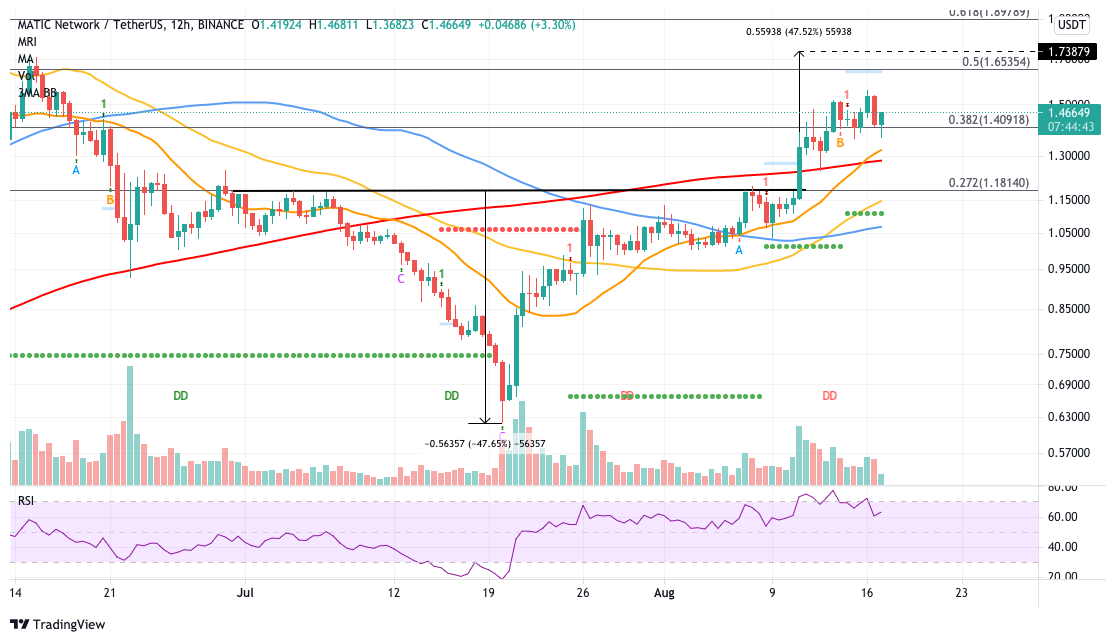
MATIC/USDT 12-hour chart
However, should buying pressure subside, the first line of defense for Polygon price appears to be at the 38.2% Fibonacci extension level at $1.40, then the 20 twelve-hour Simple Moving Average (SMA) at $1.32.
A spike in selling pressure may see Polygon price fall further to reach the 200 twelve-hour SMA at $1.27 before slumping lower to the neckline at $1.18.
Investors should note that if Polygon price falls below the neckline of the chart pattern, the bullish outlook for MATIC would then be voided.
Author

Sarah Tran
Independent Analyst
Sarah has closely followed the growth of blockchain technology and its adoption since 2016.