Stablecoin volume explodes, hits $7.4 trillion, defies crypto winter and FTX contagion
- Stablecoin volume shoots from $6 trillion in 2021 to $7.4T in 2022 while crypto markets bleed.
- Visa tops yearly volume with $12 trillion, while MasterCard and American Express fell below the global stablecoin volume.
- Cryptocurrencies search for bottom led by Bitcoin price ahead of possible year-end relief rally.

The crypto winter in 2022 has stifled growth across the board, sending giants like Three Arrows Capital and Celsius Network out of business. It has crashed market capitalization from nearly $3 trillion to $837 billion at the time of writing. Still, it did not hold back the stablecoin volume from hitting a new record high of $7.4 trillion – there were more transactions settled in stablecoins than on MasterCard.
Stablecoin transaction volume comes second only to Visa
A report by The Defiant revealed that the stablecoin volume surpassed traditional credit and debit card companies, including American Express with 1$ trillion and MasterCard with $2.2 trillion. Only Visa topped global settlement volume at $12 trillion in 2022.
According to CoinMetrics, the total trading volume of stablecoins set a new record this year, reaching 7.4 trillion U.S. dollars, surpassing the 6 trillion in 2021. The Mastercard is only 2.2 trillion. Only Visa has more transactions than stablecoins, settling $12 trillion.
— Wu Blockchain (@WuBlockchain) December 23, 2022
In just two years, transactions in the stablecoin sector are up 600%, considering only $1 trillion was settled in 2020. Data by CoinMetrics shows volume across all stablecoins rose to $7.4 trillion in 2022, up from $6 trillion in 2021.
The leading stablecoin, Tether (USDT), was the only token whose volume declined from $3.7 trillion in 2021 to $3.5 trillion this year. Its top competitor, USD Coin (USDC), doubled its volume in 2021, settling $2.9 trillion in transactions in 2022.
In terms of trade volume, all the stablecoins tracked by CoinMetrics recorded a 30% increase from $1 trillion last year. This increase is significant, keeping in mind volume from leading cryptocurrencies has plunged by over 90%. Currently, stablecoins take up approximately 18% of the total crypto market capitalization.
Spike in stablecoin volume positive for the market – Coinbase report
According to a recent crypto markets outlook report issued by Coinbase, the rise in stablecoin volume is a positive gesture. It shows investors are choosing to stay “digitally native during a market downturn.” Moreover, it emphasizes the power investors hold and could deploy as confidence in the market returns.
“Stablecoins are now one of the largest sectors in the crypto ecosystem with an outsized role in storing and transferring wealth,” Coinbase wrote in its report.
Is Bitcoin price primed for an year-end rally?
Bitcoin (BTC) price has upheld support at $16,000 since Friday last week, suggesting it could break out again. As the price moves above the dotted trend line on the daily timeframe chart below, the path with the least resistance could flip to the upside.
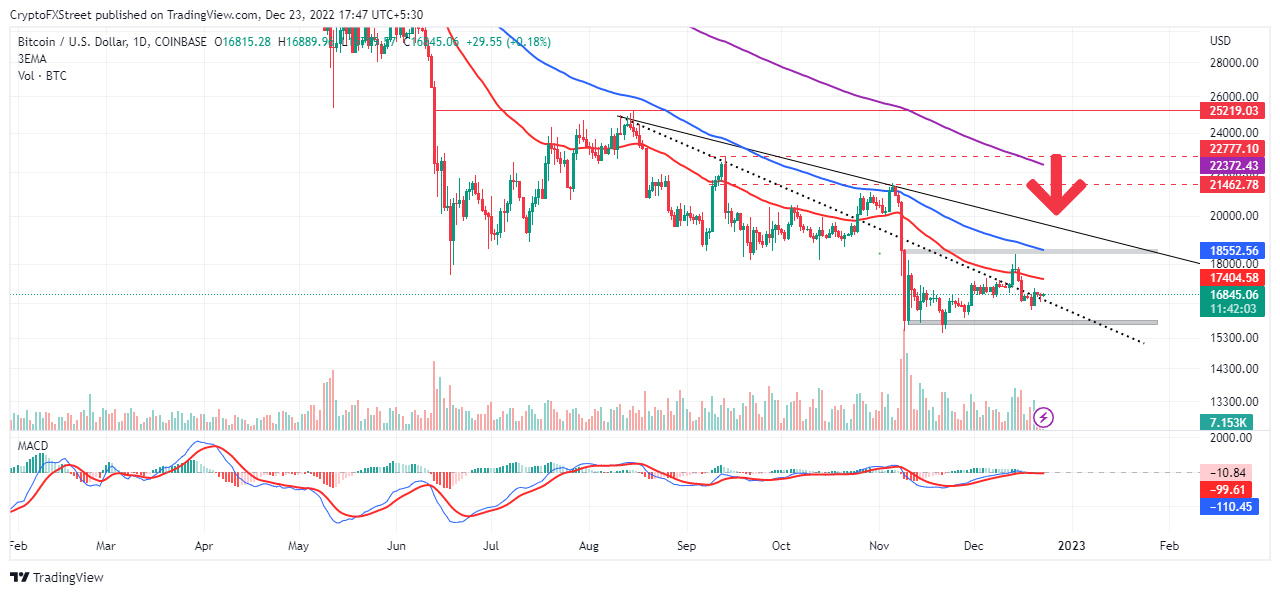
BTC/USD daily chart
The Moving Average Convergence Divergence (MACD) indicator is moving horizontally and close to the mean line (0.00) after failing to confirm last week’s buy signal. Bitcoin price requires a little push above $17,405 – in confluence with the 50-day Exponential Moving Average (EMA), to nurture a northbound move to $20,000, possibly before the New Year.
However, one popular crypto analyst and trader, Rekt Capital, recently told his followers on Twitter that Bitcoin is not done with the downtrend yet, and more lows could be on the way. He predicts a 20% drop to $13,900 unless Bitcoin price breaks and holds above resistance at $17,150.
New #BTC lows could be on the cards, especially if ~$17150 continues to act as resistance
— Rekt Capital (@rektcapital) December 19, 2022
Therefore a drop of up to -20% to ~$13900 wouldn't be out of the question
A -20% drop for $BTC would surely negatively impact Altcoins and make them drop more than -20%#Crypto #Bitcoin
Investors generally retreat for Christmas and New Year celebrations, but attention is set to remain on the bankrupt FTX exchange. Former CEO Sam Bankman-Fried arrived to the United States to answer to money laundering and fraud charges. The embattled crypto investor has been granted bail at $250 million and will stay with his parents as the case against him is heard in the courts.
Related artilces:
Binance continues asset de-listing spree as crypto winter bites hard, is relief coming in 2023?
Bitcoin prepares for spike in volatility after holding steady through US stock market bloodbath
Author

John Isige
FXStreet
John Isige is a seasoned cryptocurrency journalist and markets analyst committed to delivering high-quality, actionable insights tailored to traders, investors, and crypto enthusiasts. He enjoys deep dives into emerging Web3 tren