Solana vs. Ethereum: Renewed debate erupts over efficiency, development and scalability
- Solana's energy consumption is at 658 joules per transaction against Ethereum's higher energy usage, sparking debate over which network works better.
- Ethereum's robust developer community gives an advantage to the chain.
- The two chains compete over scalability and intrinsic design constraints.

Crypto developer who goes by the alias Ichigo on X, who is associated with Solana-based Helius Labs, has ignited another comparison between Ethereum and its smart chain competitor Solana. Ichigo pointed out that while the post-Merge Ethereum transactions use 144,000 joules of energy, Solana transactions require only 658 joules.
Solana beats Ethereum in energy efficiency
Ichigo underscored Solana's energy efficiency by stating, "The average Solana transaction uses 658 Joules of energy. That’s less than a Google search. Few."
Yes because Solana is a single-threaded global state machine that's subject to fluctuating gas costs
— Ichigo | helius.dev (@0xIchigo) October 18, 2023
Ethereum has inherent design limitations, which is why they had to move to the more modular approach of L2s. Solana was designed from the ground up with scalability in mind. It's…
Both Ethereum and Solana rely on proof-of-stake methods, which are considered more environmentally efficient. Therefore, they are often pitted against each other.
In terms of energy emissions, Solana Foundation became the first chain ever to allow real-term emission measurement earlier this year. Between April 2022 and March 2023, it reported that its 2,390 block-producing nodes had a total carbon footprint in the average emissions term of 10,651.2 tonnes CO2. Therefore, the energy per transaction comes to a mere 879 joules in the said time frame, close to the recent claims by Ichigo.
Based on data provided by the Ethereum Foundation, an estimated 2,601 megawatt hour is the requirement by the network in terms of electricity, leaving carbon emissions of 870 tonnes CO2.
Ethereum there for the “long haul”
Despite Solana's dominance in energy efficiency, Ichigo emphasized Ethereum's resilience and significance as a major player.
"Ethereum will be around for the long haul - there are too many smart people working on it," Ichigo added in response to a user.
The influencer underlined that the involvement of developers and substantial financial activity within the Ethereum Virtual Machine (EVM) makes it a long-term player. However, he anticipates that Ethereum may struggle with scaling compared to Solana given its single-threaded global state machine and fluctuating gas prices, making it less suitable for payment or decentralized finance (DeFi) applications.
The debate brings up the concept of modularity versus monolithic technology stacks, with Ichigo arguing that Solana's ground-up scalability-focused design contrasts with Ethereum's modular approach. This essentially has to do with how chains are built by taking into account speed, efficiency and flexibility.
In terms of support for decentralized finance applications, Solana dominates less than 1% of the total value locked in the crypto space. Meanwhile, Ethereum still dominates 53% of total TVL based on DeFiLlama data. While Ethereum supports 935 protocols, Solana houses 112 despite a rough year of public outages.
As per Token Terminal data, in the last 30 days, code commits that signify developer activity for Ethereum is at 1.28K while Solana is at 542.
Nonetheless, Solana has showcased its own strength with 81.49k daily active users over a 30-day average. Yet, it is still far from Ethereum's 324.21k daily active users.
An intriguing investment trend emerges, as Ethereum, despite its dominance, reports negative year-to-date flows amounting to $111 million based on CoinShares' last report. Contrarily, Solana attracted positive inflows of $59 million during the same timeframe.
This disparity signals a shift in investor preference to Solana. However, Ethereum maintains its position as the second-largest cryptocurrency with a circulating market cap of $188.59 billion, with Solana far behind at $9.93 billion.
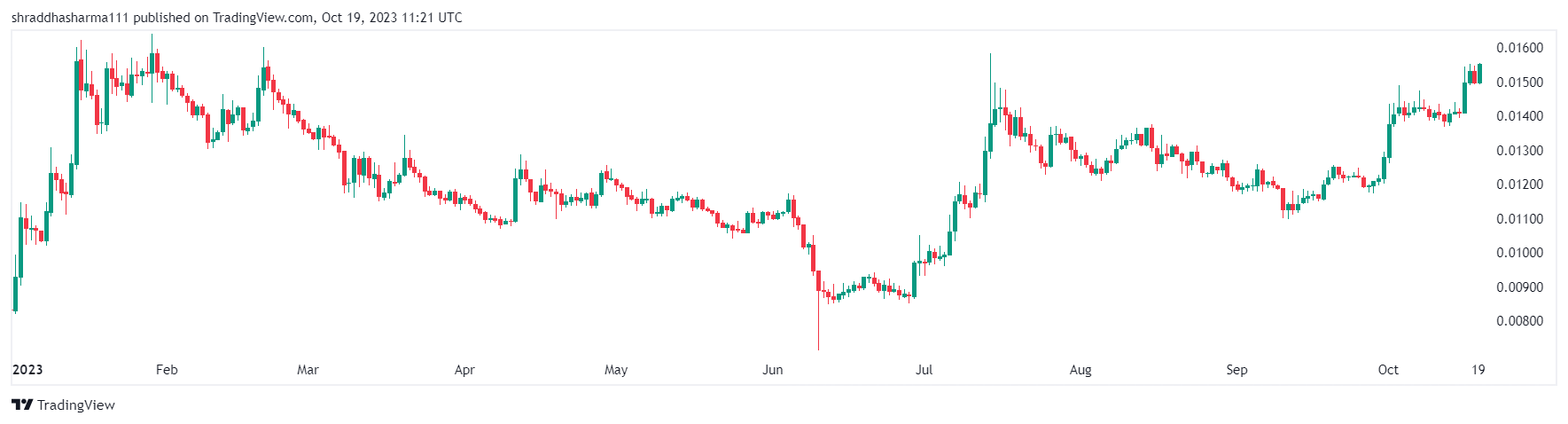
SOL/ETH YTD chart
In the comparison between Solana and Ethereum, Solana emerges as the more energy-efficient network, with its carbon footprint and transaction energy usage significantly lower than that of Ethereum. However, Ethereum remains a formidable player, thanks to its strong developer community and substantial financial activity behind it. However, it might face scalability challenges compared to Solana, making the choice between the two networks dependent on specific use cases.
Author

Shraddha Sharma
FXStreet
With an educational background in Investment Banking and Finance, Shraddha has about four years of experience as a financial journalist, covering business, markets, and cryptocurrencies.