Ripple prepares for SEC lawsuit outcome, XRP climbs past $0.51
- Ripple prepares for permanent ban on XRP sales, continues selling to international clients through foreign subsidiaries.
- If XRP sales are considered securities under crypto bill FIT21, the firm could sell XRP in regimes with different regulations.
- XRP rallies past sticky resistance, trades at $0.5282 at the time of writing.
Ripple (XRP) holders are debating the impact of the Financial Innovation and Technology for the 21st Century Act, or FIT21 on the Securities and Exchange Commission (SEC) vs. Ripple lawsuit. The outcome of the lawsuit could act as a market mover for XRP Ledger’s native token XRP’s price and affect the payment remittance firm’s institutional sales of XRP token.
According to attorney Bill Morgan, behind the X handle @Belisarius2020, Ripple has prepared for the worst outcome in the lawsuit, a permanent injunction or a complete ban on sales of XRP tokens to its institutional clients in the US.
Daily Digest Market Movers: Ripple prepares for worst outcome in SEC lawsuit
- The US House approved the FIT21 bill, a major crypto legislation cleared by one of the chambers of the Congress on Wednesday.
- As the bill makes passage to the Senate, XRP holders debate its impact on the longstanding legal battle between the US SEC and payment firm Ripple.
- In its lawsuit against Ripple, the financial regulator has asked for $2 billion in penalties and alleges unregistered securities sale (sale of XRP token) to institutional clients.
- In its defense, according to attorney Bill Morgan, Ripple is prepared for the worst case scenario in the lawsuit.
- In the worst case, the court could order a permanent injunction (a complete ban) on XRP token sales to Ripple’s institutional clients in the US. While typically this move could affect the payment firm’s business, Attorney Morgan explains that Ripple continue offering its services and sell XRP to institutional clients overseas, under entities in different licensing regimes.
The arrangements Ripple already have in place which contemplate a worst case scenario of a permanent injunction being granted (no sales of XRP to US ODL customers and sales to overseas customers through subsidiaries under other licensing regimes) would work if its sales were… https://t.co/hOdmkv8d0y
— bill morgan (@Belisarius2020) May 23, 2024
- The FIT21 bill may not negatively impact Ripple’s sales overseas and in regimes where crypto is regulated differently, where the firm has acquired the necessary licenses, and complies with the local regulations.
Technical analysis: XRP breaks past sticky resistance, trades at $0.52
Ripple price crashed nearly 18% between its April 9 top of $0.6431 and May 23 (when the price is $0.5282). The altcoin is consolidating since the decline from the April 9 top and broke past sticky resistance at $0.51 several times this week.
On Thursday, Ripple is exchanging hands at $0.5282, testing resistance at $0.5310, the 50% retracement of the decline from April 9 top of $0.6431 to the April 13 low of $0.4188.
The Moving Average Convergence Divergence, a momentum indicator, signals positive momentum underlying Ripple’s uptrend. The green histogram bars above the neutral line and MACD crossover above the signal line are signs that support a recovery thesis for Ripple.
The Relative Strength Index (RSI) reads 51.46, crossing above the neutral line, aiding the bullish narrative for the asset.
If Ripple successfully establishes itself above $0.5310, the next target is the April 22 and May 6 high of $0.5703. A run to this level would constitute 8% gains from the current level of $0.5282.
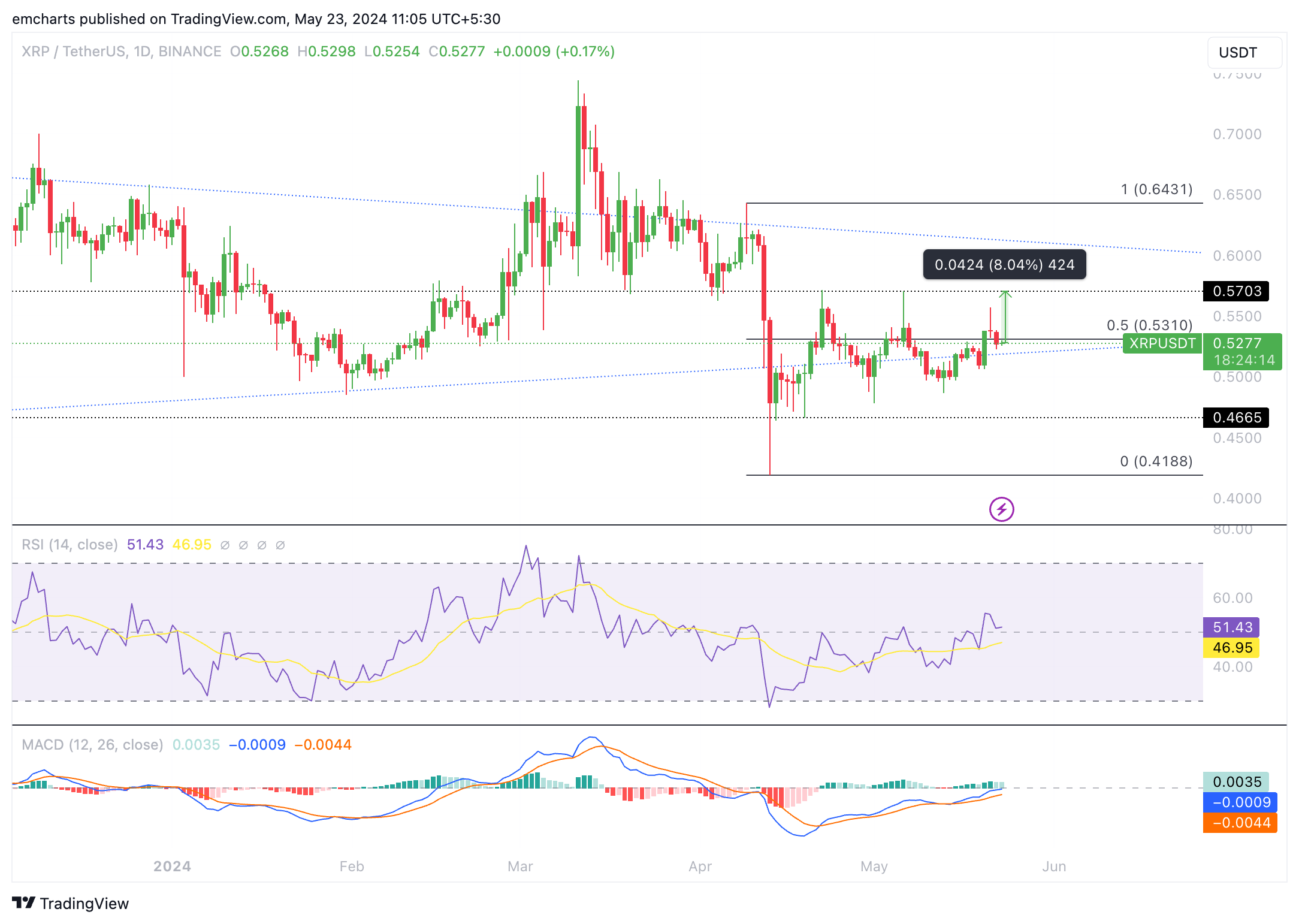
XRP/USDT 1-day chart
Though the outlook for XRP is bullish, a candlestick close above $0.5310 is needed to confirm the gains. If XRP fails to close above this level on the 1-day timeframe, it could sweep liquidity at the May 20 low of $0.5064.
The $0.50 level has emerged as key support for XRP price in the past week. Below $0.50, XRP could find support at the May 13 low of $0.4866, another crucial support level formed in the past two weeks.
SEC vs Ripple lawsuit FAQs
It depends on the transaction, according to a court ruling released on July 14: For institutional investors or over-the-counter sales, XRP is a security. For retail investors who bought the token via programmatic sales on exchanges, on-demand liquidity services and other platforms, XRP is not a security.
The United States Securities & Exchange Commission (SEC) accused Ripple and its executives of raising more than $1.3 billion through an unregistered asset offering of the XRP token. While the judge ruled that programmatic sales aren’t considered securities, sales of XRP tokens to institutional investors are indeed investment contracts. In this last case, Ripple did breach the US securities law and will need to keep litigating over the around $729 million it received under written contracts.
The ruling offers a partial win for both Ripple and the SEC, depending on what one looks at. Ripple gets a big win over the fact that programmatic sales aren’t considered securities, and this could bode well for the broader crypto sector as most of the assets eyed by the SEC’s crackdown are handled by decentralized entities that sold their tokens mostly to retail investors via exchange platforms, experts say. Still, the ruling doesn’t help much to answer the key question of what makes a digital asset a security, so it isn’t clear yet if this lawsuit will set precedent for other open cases that affect dozens of digital assets. Topics such as which is the right degree of decentralization to avoid the “security” label or where to draw the line between institutional and programmatic sales are likely to persist.
The SEC has stepped up its enforcement actions toward the blockchain and digital assets industry, filing charges against platforms such as Coinbase or Binance for allegedly violating the US Securities law. The SEC claims that the majority of crypto assets are securities and thus subject to strict regulation. While defendants can use parts of Ripple’s ruling in their favor, the SEC can also find reasons in it to keep its current strategy of regulation by enforcement.
The court decision is a partial summary judgment. The ruling can be appealed once a final judgment is issued or if the judge allows it before then. The case is in a pretrial phase, in which both Ripple and the SEC still have the chance to settle.
Author

Ekta Mourya
FXStreet
Ekta Mourya has extensive experience in fundamental and on-chain analysis, particularly focused on impact of macroeconomics and central bank policies on cryptocurrencies.