Friend.tech critics declare the platform dead as transaction volume drops 95%
- Friend.tech noted a sharp decline in its transaction volume and fee income over the past week.
- Daily new traders, transacting users have slowed down, transaction volume dropped 94.8% since August 21.
- BASE is struggling to maintain its position at the top, among competing Layer 2 chains Arbitrum and Optimism.

BASE’s decentralized social network Friend.tech is in a state of decline less than three weeks after its launch on the chain. Several users and critics on Twitter declared the platform “dead”, citing the drop in the number of users, transaction volume and other metrics.
The count of new daily users on the platform plummeted from its peak from 20,360 on August 21 to 1,811 on August 27. A data panel on Dune Analytics shows detailed statistics noting the performance of the project.
Also read: Friend.tech surprises with $2.88 million in protocol fees; critics point to a possible Ponzi scheme
Friend.tech’s metrics paint a picture of decline in popularity
The hype surrounding the blockchain-based platform fizzled out after early creators like Cobie, Hsaka Trades and crypto influencer accounts on Twitter gained popularity on Friend.tech.
According to a Bloomberg report, Friend.tech appeals to the “speculative mania” that meme coin projects like Dogecoin rely on. The protocol has raised questions as to whether speculation is required for a project to generate high revenue in the crypto ecosystem.
The platform made its debut on August 10. Since then, fees generated by Friend.tech peaked at $1.7 million on August 21 and dropped to $95,400 on August 27. At $1.7 million, Friend.tech was the highest-earning platform after the Ethereum blockchain.
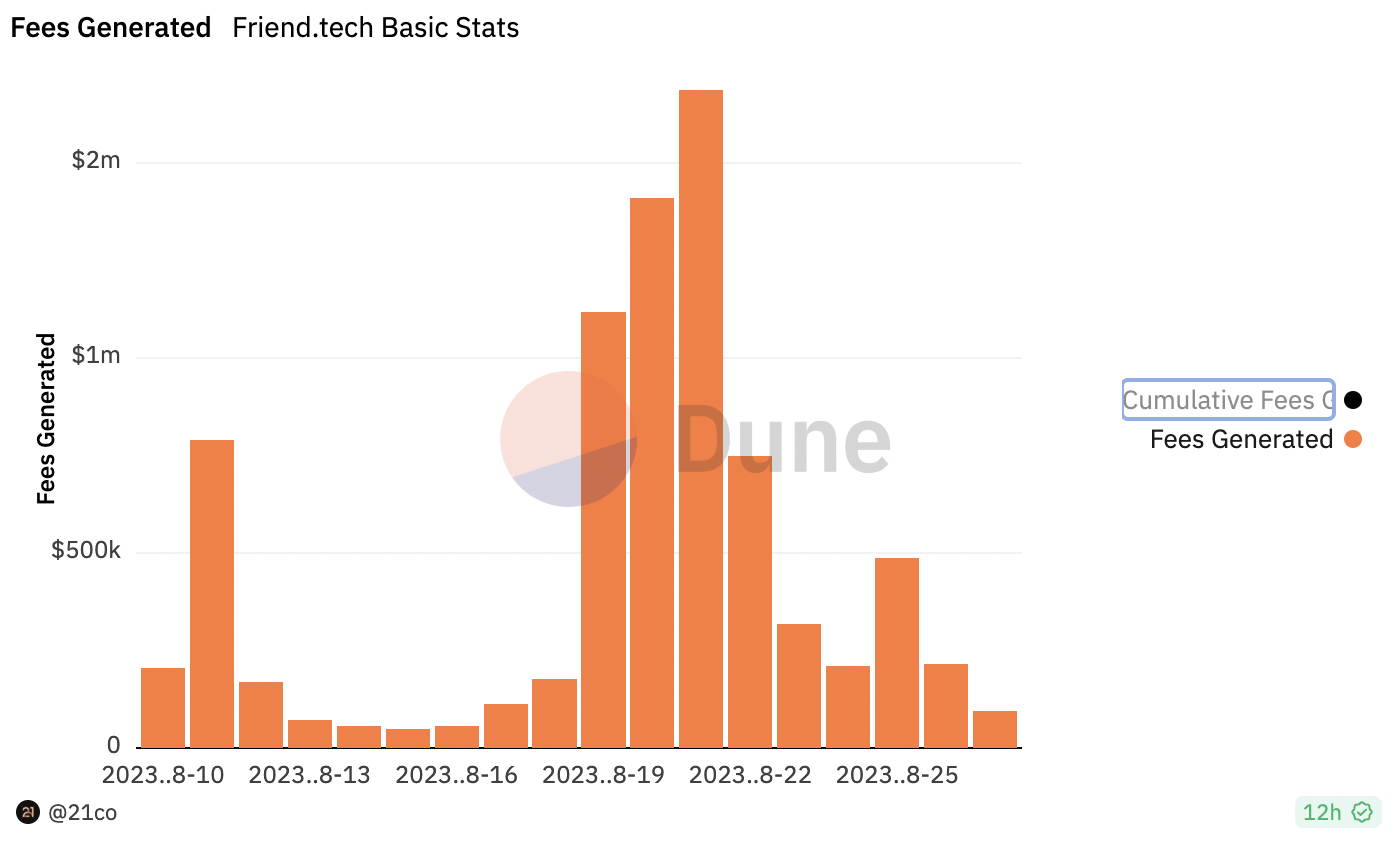
Fees generated by Friend.tech as seen on Dune Analytics
The hype has resulted in a decline of BASE’s performance against Layer 2 competitors Arbitrum and Optimism.
Arbitrum and Optimism pose tough competition to BASE
Data from a Dune Analytics dashboard compares the number of transacting addresses per day on the three chains. As of August 25, Arbitrum ranked the highest with 122,110, followed by BASE and Optimism.
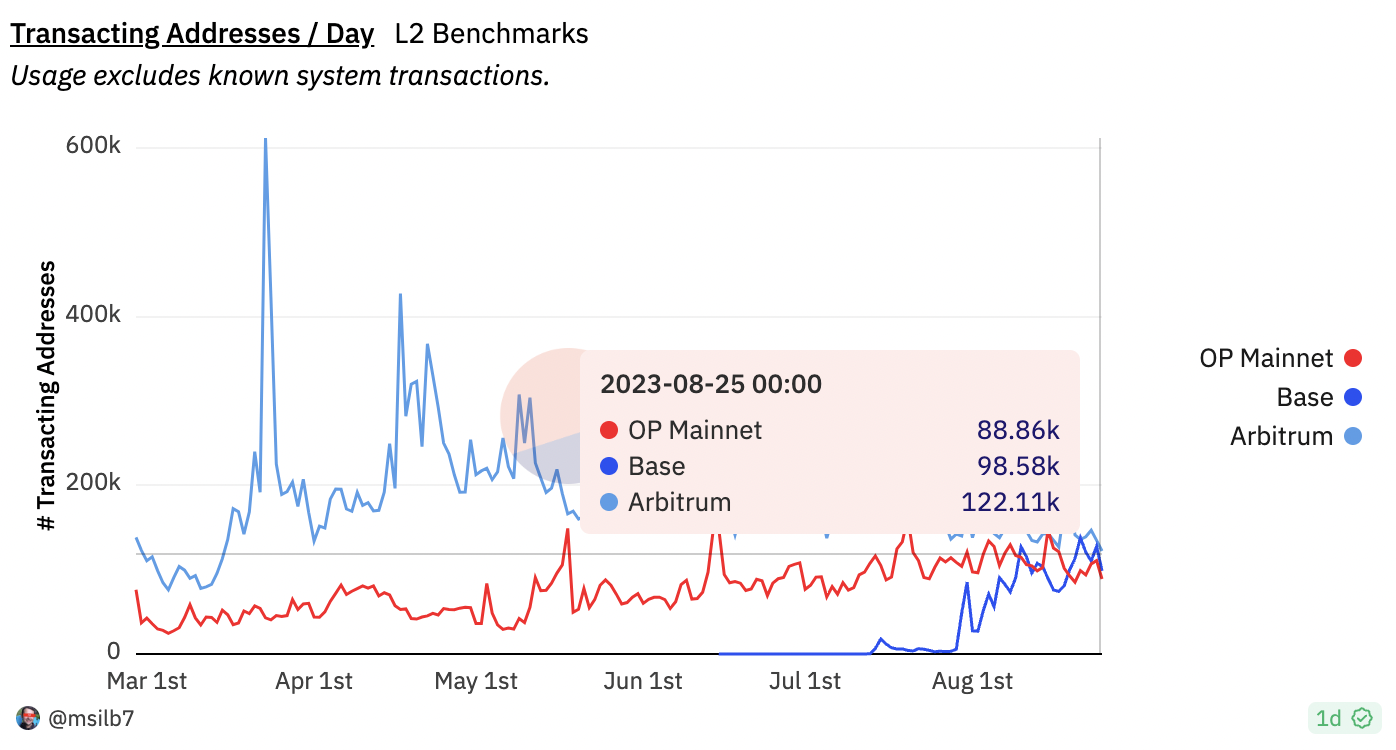
Transacting addresses/day ARB vs OP vs BASE on Dune Analytics
In terms of transactions per day, a metric that indicates the utility of a platform and its popularity among users, Arbitrum leads with 694,990, followed by BASE at 667,310 and Optimism at 328,350, seen in the chart below. Arbitrum leads in both metrics comparing the three blockchains, posing a tough competition for BASE.
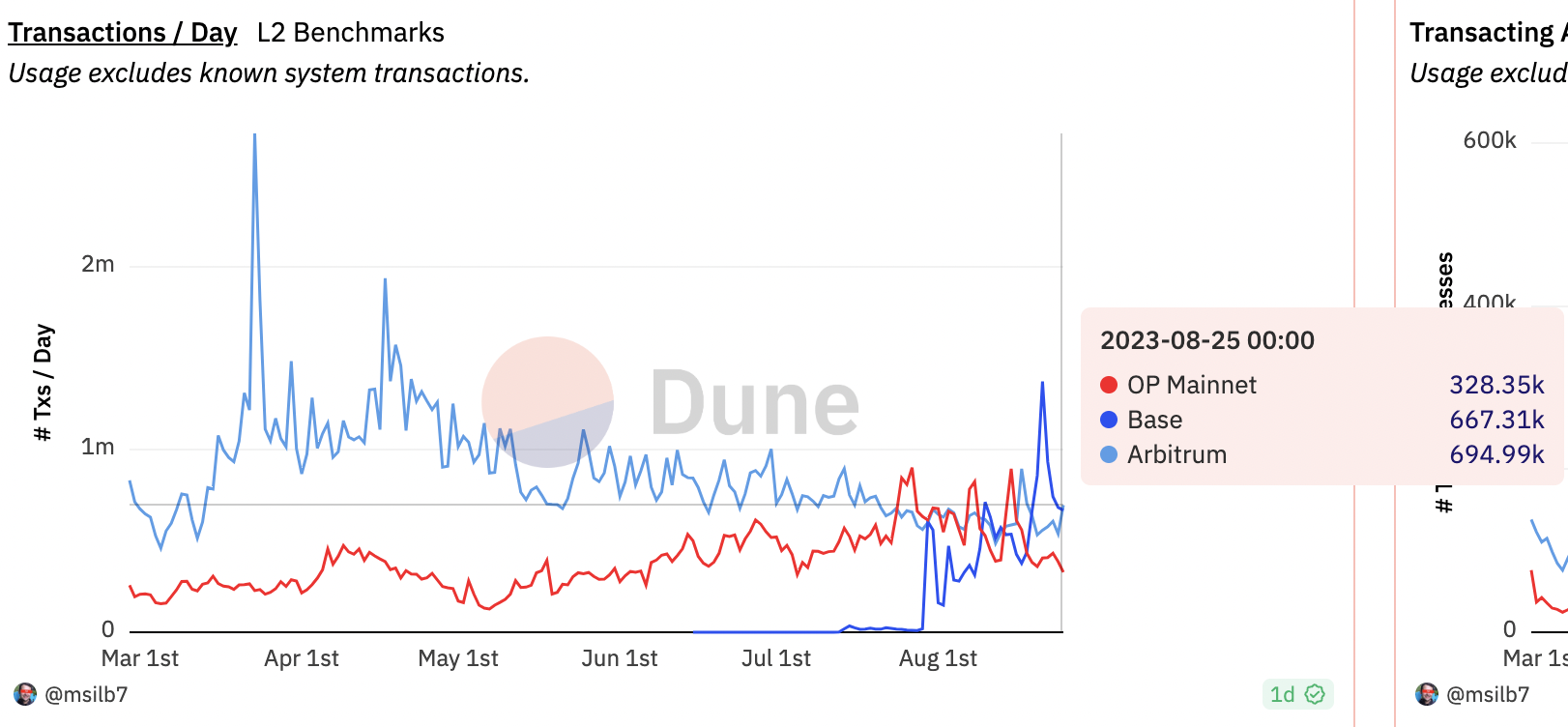
Transactions/Day for Ethereum Layer 2s on Dune Analytics
Critic of Friend.tech
Michael Gu, founder of Boxmining, shared his thoughts on Friend.tech in a recent tweet. Heobserved that buyers and sellers are tanking toward zero on the platform.
Friendtech buyers and sellers tanking to 0
— Boxmining (@boxmining) August 28, 2023
GG Friendtech? pic.twitter.com/jmXKu41KDd
Beaniemaxi, a pseudonymous NFT trader and crypto analyst, said “RIP Friendtech” in his tweet. The trader called the platform dead, citing the decline in transactions.
RIP Friendtech
— Beanie (@beaniemaxi) August 26, 2023
August 2023-August 2023 pic.twitter.com/Fb0bh23Fyo
Whether the platform is “dead” or makes a revival depends on the number of new users and demand for influencers’ keys in the near future. Until then, Layer 2 Arbitrum is outperforming BASE amid the slow but steady decline of Friend.tech.
Bitcoin, altcoins, stablecoins FAQs
What is Bitcoin?
Bitcoin is the largest cryptocurrency by market capitalization, a virtual currency designed to serve as money. This form of payment cannot be controlled by any one person, group, or entity, which eliminates the need for third-party participation during financial transactions.
What are altcoins?
Altcoins are any cryptocurrency apart from Bitcoin, but some also regard Ethereum as a non-altcoin because it is from these two cryptocurrencies that forking happens. If this is true, then Litecoin is the first altcoin, forked from the Bitcoin protocol and, therefore, an “improved” version of it.
What are stablecoins?
Stablecoins are cryptocurrencies designed to have a stable price, with their value backed by a reserve of the asset it represents. To achieve this, the value of any one stablecoin is pegged to a commodity or financial instrument, such as the US Dollar (USD), with its supply regulated by an algorithm or demand. The main goal of stablecoins is to provide an on/off-ramp for investors willing to trade and invest in cryptocurrencies. Stablecoins also allow investors to store value since cryptocurrencies, in general, are subject to volatility.
What is Bitcoin Dominance?
Bitcoin dominance is the ratio of Bitcoin's market capitalization to the total market capitalization of all cryptocurrencies combined. It provides a clear picture of Bitcoin’s interest among investors. A high BTC dominance typically happens before and during a bull run, in which investors resort to investing in relatively stable and high market capitalization cryptocurrency like Bitcoin. A drop in BTC dominance usually means that investors are moving their capital and/or profits to altcoins in a quest for higher returns, which usually triggers an explosion of altcoin rallies.
Like this article? Help us with some feedback by answering this survey:
Author

Ekta Mourya
FXStreet
Ekta Mourya has extensive experience in fundamental and on-chain analysis, particularly focused on impact of macroeconomics and central bank policies on cryptocurrencies.



