Ethereum resume sideways move as Grayscale files to withdraw Ethereum futures ETF application with the SEC
- Grayscale has withdrawn its 19b-4 application for an Ethereum futures ETF.
- SEC Chair Gensler says several crypto assets are securities as he waives off ETH classification question.
- Ethereum could sustain horizontal movement in the coming weeks.

Ethereum is hinting at a resumption of a sideways movement on Tuesday after seeing inflows for the first time in seven weeks. Grayscale withdrew its application for an Ethereum futures ETF, and the Securities & Exchange Commission’s (SEC) Chair Gary Gensler has also called most crypto assets securities following a Wells Notice targeted at ETH-related firms.
Read more: Ethereum traders show uncertainty, SEC delays decision on Invesco's ETH ETF application
Daily digest market movers: ETH inflows, whale transfers, SEC Chair
Ethereum's price uncertainty among investors is increasing despite recent updates surrounding the largest altcoin. Here are the top market movers:
- Grayscale withdrew its 19b-4 application for an Ethereum futures ETF in a recent filing on Tuesday. The asset manager initially filed for an Ethereum futures ETF on September 19 but faced several delays from the SEC, which was scheduled to decide on it on May 30.
Bloomberg analyst James Seyffart had earlier said that Grayscale’s application for an Ethereum futures ETF was a Trojan horse to corner the SEC into approving its Ethereum spot ETF application. The idea is that approving a futures ETF would mean the SEC agrees that ETH is a commodity and, hence, would have minimal reasons not to approve its spot ETF version.
However, with the withdrawal of Grayscale’s application only a few weeks before the SEC’s decision, Seyffart has expressed confusion as to why the asset manager would make this move. The SEC is due to decide on Van Eck’s spot Ethereum ETF application on May 23, with decisions on other applications coming subsequently.
Also read: Ethereum could see a brief rally despite Michael Saylor's jab at ETH ETFs
- In an interview on CNBC Squawk Box on Tuesday, SEC Chair Gensler said that most crypto assets are securities "under the law of the land as interpreted by the US Supreme Court." This response comes after he was asked about his agency's recent action to file a Wells Notice against Robinhood Crypto on Monday.
He further stated investors are not getting the "required disclosures" about these crypto assets. Gensler seemed to avoid the question when pressed if he considers Ethereum a security or commodity and, ultimately, the possibility of a spot ETH ETF.
"All I would say is, to me, the fundamental question is how do we ensure that the American investor is protected?" said Gensler. "Right now, they're not getting the required or needed disclosures, and the intermediaries in the center of this rather centralized market generally are conflicted and doing things we would never allow the New York Stock Exchange to do."
Fortune earlier reported that the SEC may be aiming to classify Ethereum as a security after subpoenaing several firms for facilitating the buying and selling of Ethereum. Ethereum infrastructure provider Consensys also announced it received a Wells notice from the regulator.
In a court filing, Consensys revealed the SEC had secretly considered ETH a security through investigative actions labeled at several firms.
- Ethereum institutional investors appear to be turning bullish for the first time in nearly two months. After seeing seven weeks of consistent outflows, ETH "broke its 7-week spell of outflows," raking in $30 million in inflows, according to data from CoinShares.
- Following ETH's recent bull-bear stalemate, FTX/Alameda Research addresses have transferred approximately 2,000 ETH worth $6.17 million to Coinbase, according to PeckShieldAlert. FTX/Alameda Research addresses have previously been marked for occasionally transferring ETH to exchanges moments before a market downturn.
- In the past 24 hours, hackers related to the Poloniex exchange and KronosResearch hack have transferred 1,100 ETH and 1,000 ETH, respectively, to US-sanctioned mixing protocol Tornado Cash, PeckShieldAlert data shows.
ETH technical analysis: ETH could begin sideways movement again
Ethereum is looking to resume a sideways movement again on Tuesday after failing to stay above the $3,161 resistance.
Read more: Ethereum to break out of bearish move, ETH ETFs unlikely in 2024
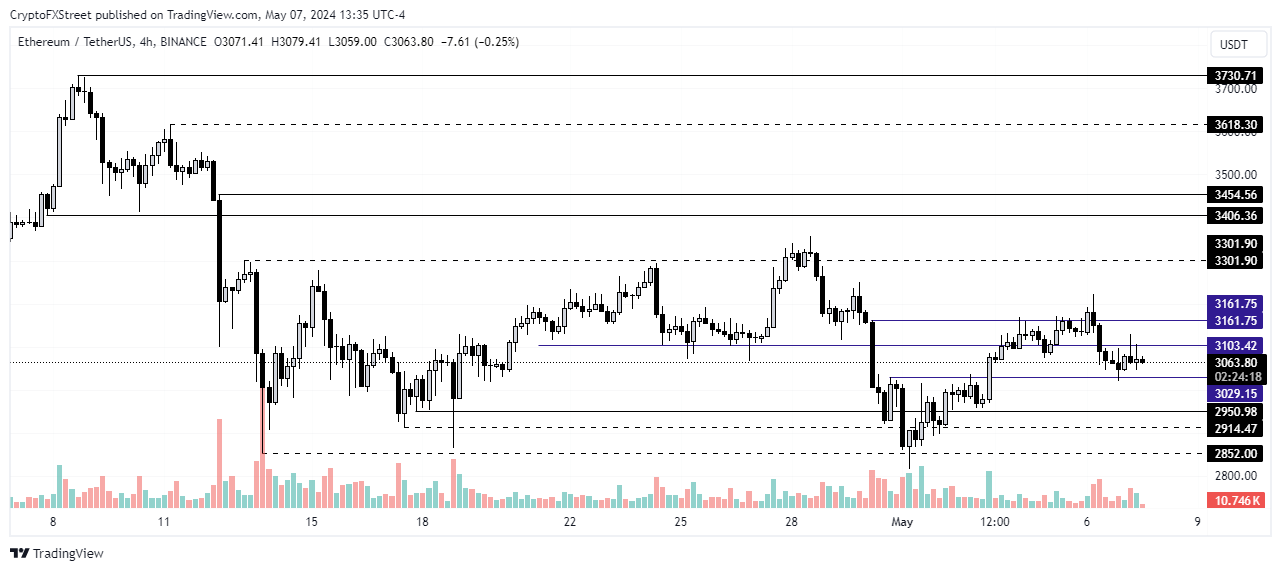
ETH/USDT 4-hour chart
ETH's current price action suggests the popular altcoin would likely follow a horizontal pattern — but more tilted towards shorts — amid uncertainty among traders.
This is confirmed by ETH's liquidations data, which — having slowed down — still sees long liquidations forming the bulk of the digital asset's total liquidations. ETH long liquidations are at $34.56 million, while shorts are at only $8.25 million, according to data from Coinglass.
Coinglass data also shows that Ethereum's open interest has remained relatively flat for the past four days, further strengthening the sideways thesis. If ETH goes below the $3,029 support, it may begin a brief bearish trend.
However, the $2,852 to $3,300 key range is also proving strong as ETH may not see any sustained move outside in the next few weeks, except if the price of Bitcoin sees a significant spike.
Ethereum is trading around $3,067, down 0.3% on the day.
Ethereum FAQs
Ethereum is a decentralized open-source blockchain with smart contracts functionality. Serving as the basal network for the Ether (ETH) cryptocurrency, it is the second largest crypto and largest altcoin by market capitalization. The Ethereum network is tailored for scalability, programmability, security, and decentralization, attributes that make it popular among developers.
Ethereum uses decentralized blockchain technology, where developers can build and deploy applications that are independent of the central authority. To make this easier, the network has a programming language in place, which helps users create self-executing smart contracts. A smart contract is basically a code that can be verified and allows inter-user transactions.
Staking is a process where investors grow their portfolios by locking their assets for a specified duration instead of selling them. It is used by most blockchains, especially the ones that employ Proof-of-Stake (PoS) mechanism, with users earning rewards as an incentive for committing their tokens. For most long-term cryptocurrency holders, staking is a strategy to make passive income from your assets, putting them to work in exchange for reward generation.
Ethereum transitioned from a Proof-of-Work (PoW) to a Proof-of-Stake (PoS) mechanism in an event christened “The Merge.” The transformation came as the network wanted to achieve more security, cut down on energy consumption by 99.95%, and execute new scaling solutions with a possible threshold of 100,000 transactions per second. With PoS, there are less entry barriers for miners considering the reduced energy demands.
Author

Michael Ebiekutan
FXStreet
With a deep passion for web3 technology, he's collaborated with industry-leading brands like Mara, ITAK, and FXStreet in delivering groundbreaking reports on web3's transformative potential across diverse sectors. In addition to