Ethereum Price Prediction: Eighteen-months ascending triangle pattern appraises $4,000 target for ETH
- Ethereum price has been consolidating along an ascending trendline for the past eighteen months, with the $2,035 level holding as resistance.
- The overall price action has formed an ascending triangle pattern, which forecasts a $4,736 price target for ETH.
- The bullish thesis will be invalidated once the altcoin breaks and closes below the ascending trendline at the $1,500 psychological level.

Ethereum (ETH) price is bullish on lower and higher timeframes alike, as token holders ride the wave of what already seems to be the making of a bull market. On the higher timeframe, however, the target objective for the largest altcoin by market capitalization looks overly ambitious, but not impossible as community members turn faces toward the exchange-traded fund (ETF) narrative and the much-anticipated Bitcoin (BTC) halving, together with their combined effect on asset prices.
Also Read: Top 3 Price Prediction Bitcoin, Ethereum, Ripple: BTC rages on, $40,000 may not be hopium after all
Ethereum price 18-month ascending triangle forecasts $4,736 target
Ethereum (ETH) price consolidating above an ascending triangle, combined with the effect of the formation of multiple local tops around the$2,035 level has led to the formation of an ascending triangle pattern.
Such a technical formation is created when the asset’s price lead to the formation of a horizontal line connecting the swing highs, while a rising trendline trails it from below connecting the swing lows. Together, the trendlines form a triangle, with traders watching for breakouts from the horizontal trendline. The target objective for such a technical formation is determined by measuring the height of the triangle and superimposing it at the breakout point.
For Ethereum price, the height of the triangle is around 134%, from $865 to $2,035 on the weekly timeframe. Superimposing this percentage difference on the weekly chart puts a target objective of $4,736.
The Relative Strength Index (RSI) spurs optimism, moving north to signify rising momentum while its position at 64 shows there is still more room to the north. Effectively, the Awesome Oscillators (AO) histogram bars are also flashing green to show the bulls maintain a strong presence in the ETH market.
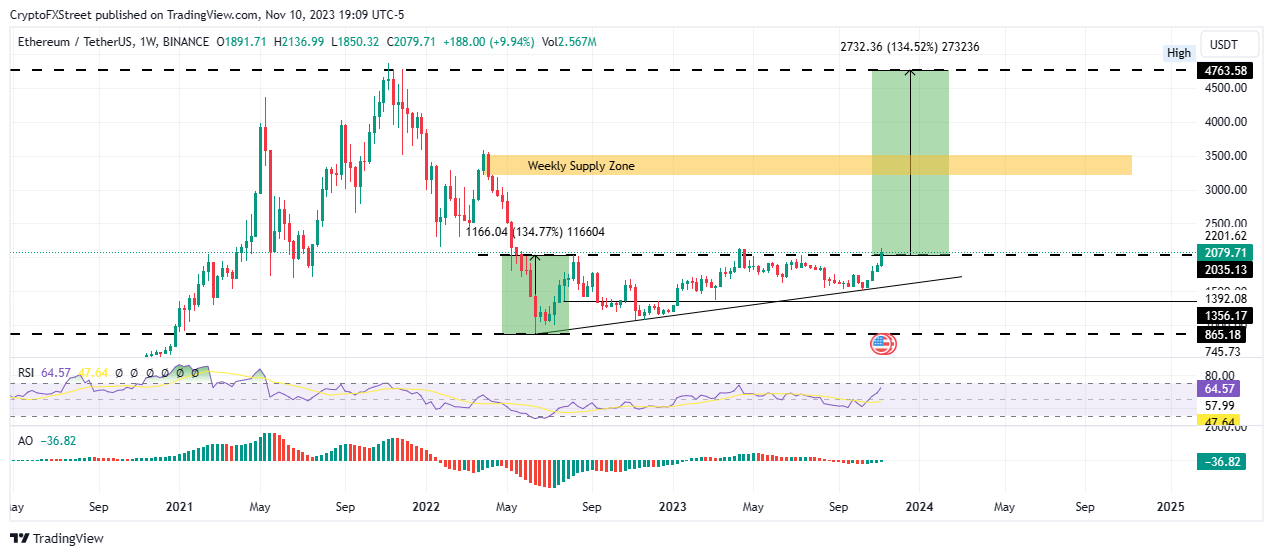
ETH/USDT 1-week chart
On the flip side, profit-taking could nullify the projection by sending Ethereum price south, potentially losing the support offered by the ascending trendline at the $1,500 psychological level. This would invalid the bullish thesis.
Ethereum FAQs
What is Ethereum?
Ethereum is a decentralized open-source blockchain with smart contracts functionality. Serving as the basal network for the Ether (ETH) cryptocurrency, it is the second largest crypto and largest altcoin by market capitalization. The Ethereum network is tailored for scalability, programmability, security, and decentralization, attributes that make it popular among developers.
What blockchain technology does Ethereum use?
Ethereum uses decentralized blockchain technology, where developers can build and deploy applications that are independent of the central authority. To make this easier, the network has a programming language in place, which helps users create self-executing smart contracts. A smart contract is basically a code that can be verified and allows inter-user transactions.
What is staking?
Staking is a process where investors grow their portfolios by locking their assets for a specified duration instead of selling them. It is used by most blockchains, especially the ones that employ Proof-of-Stake (PoS) mechanism, with users earning rewards as an incentive for committing their tokens. For most long-term cryptocurrency holders, staking is a strategy to make passive income from your assets, putting them to work in exchange for reward generation.
Why did Ethereum shift from Proof-of-Work to Proof-of-Stake?
Ethereum transitioned from a Proof-of-Work (PoW) to a Proof-of-Stake (PoS) mechanism in an event christened “The Merge.” The transformation came as the network wanted to achieve more security, cut down on energy consumption by 99.95%, and execute new scaling solutions with a possible threshold of 100,000 transactions per second. With PoS, there are less entry barriers for miners considering the reduced energy demands.
Author

Lockridge Okoth
FXStreet
Lockridge is a believer in the transformative power of crypto and the blockchain industry.