Ethereum Price Forecast: ETH plunges 6% following Fed rate decision, eyes a bounce at the $3,550 level
- Ethereum declined over 7% after the Fed announced a hawkish rate outlook for 2025.
- Ethereum could bounce back to smash key resistance levels after its Weighted Sentiment plunged to lows last seen in December 2023.
- Ethereum risks decline to $2,800 if it breaches the $3,550 support level.

Ethereum is down 6% after the Federal Reserve hinted that it will reduce its rate cut frequency in 2025. The hawkish news has sent ETH's Weighted Sentiment to lows last seen in December 2023.
Ethereum declines following Fed's hawkish decision
Ethereum dived 6% after the Fed announced a 25-basis-point rate cut and revised its rate cut projections in 2025 from four to two. According to Coinglass data, the decline sparked $102 million in ETH futures liquidations in the past 24 hours, with liquidated long and short positions accounting for $90.74 million and $12.16 million, respectively.
Following the hawkish Fed decision, Ethereum's Weighted Sentiment declined to lows last seen in December 2023.
Weighted Sentiment is obtained by measuring an asset's social volume in tandem with its overall market sentiment. This metric dips when an asset's social volume is high but the overall market sentiment is negative.
 [19.48.14, 18 Dec, 2024]-638701541977371385.png)
ETH Weighted Sentiment | Santiment
While the negative sentiment signifies a potential bearish outlook, prices have often posted an opposite reaction whenever the Weighted Sentiment sees a dip. As a result, ETH could see a bounce back to overcome key resistance levels.
Also, Ethereum long-term holders (LTH) showed resilience throughout the year, increasing their balance to a high of 110 million ETH in 2024 — i.e., over 90% of the entire ETH in circulation, per IntoTheBlock’s data. With LTH showing a bias toward accumulation, Ethereum could enjoy a significant boost in its price if the trend continues.
Long-term ETH holders showed conviction this year, with a continued increase in their collective balance.
— IntoTheBlock (@intotheblock) December 18, 2024
Roughly 110 million $ETH is now held by long-term holders. pic.twitter.com/smh7DZL1of
Meanwhile, Ethereum ETFs maintained their inflow trend on Tuesday, recording net inflows of $144.7 million, per Coinglass data. This marks seventeen consecutive days of positive flows and a cumulative net inflow of $2.46 billion for the products. Notably, BlackRock's iShares Ethereum Trust (ETHA) crossed 1 million ETH in its total net inflows as it sets sight on surpassing Grayscale's ETHE.
Ethereum Price Forecast: ETH risks decline to $2,800 if $3,550 support level fails
Ethereum saw a rejection at its yearly high resistance of $4,093 for the second time in December. The consistent rejection near $4,093 throughout the year has established it as a major resistance level for the top altcoin. Following this move, ETH declined below the support level near the upper boundary trendline of a symmetry triangle pattern.
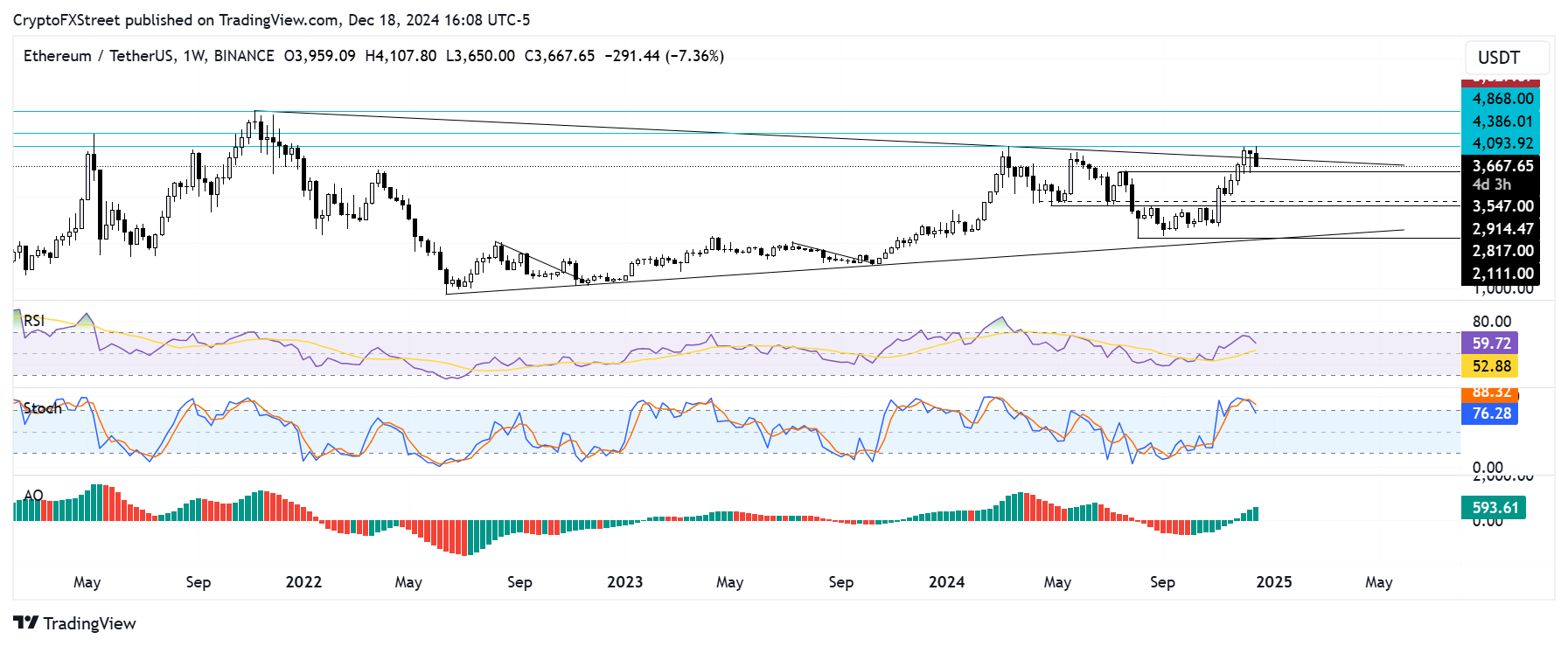
ETH/USDT weekly chart
The decline could send ETH toward the support level at $3,550. A bounce off this level could see ETH recover the support level of the triangle's upper boundary. If such a move occurs, buyers could continue asking questions of the $4,093 resistance.
A successful move above $4,093 could see ETH rally to test its all-time high resistance at $4,868. However, it has to clear another resistance level at $4,386 to complete this move.
Conversely, a breach of the $3,550 support level will send ETH toward the support zone around $2,800 to $3,000.
The Relative Strength Index (RSI) and Awesome Oscillator (AO) momentum indicators are above their neutral levels, indicating bullish momentum is still dominant in the market. The Stochastic Oscillator is in the overbought region, signaling a looming price correction.
A weekly candlestick close below $2,817 will invalidate the thesis.
Ethereum FAQs
Ethereum is a decentralized open-source blockchain with smart contracts functionality. Its native currency Ether (ETH), is the second-largest cryptocurrency and number one altcoin by market capitalization. The Ethereum network is tailored for building crypto solutions like decentralized finance (DeFi), GameFi, non-fungible tokens (NFTs), decentralized autonomous organizations (DAOs), etc.
Ethereum is a public decentralized blockchain technology, where developers can build and deploy applications that function without the need for a central authority. To make this easier, the network leverages the Solidity programming language and Ethereum virtual machine which helps developers create and launch applications with smart contract functionality.
Smart contracts are publicly verifiable codes that automates agreements between two or more parties. Basically, these codes self-execute encoded actions when predetermined conditions are met.
Staking is a process of earning yield on your idle crypto assets by locking them in a crypto protocol for a specified duration as a means of contributing to its security. Ethereum transitioned from a Proof-of-Work (PoW) to a Proof-of-Stake (PoS) consensus mechanism on September 15, 2022, in an event christened “The Merge.” The Merge was a key part of Ethereum's roadmap to achieve high-level scalability, decentralization and security while remaining sustainable. Unlike PoW, which requires the use of expensive hardware, PoS reduces the barrier of entry for validators by leveraging the use of crypto tokens as the core foundation of its consensus process.
Gas is the unit for measuring transaction fees that users pay for conducting transactions on Ethereum. During periods of network congestion, gas can be extremely high, causing validators to prioritize transactions based on their fees.
Author

Michael Ebiekutan
FXStreet
With a deep passion for web3 technology, he's collaborated with industry-leading brands like Mara, ITAK, and FXStreet in delivering groundbreaking reports on web3's transformative potential across diverse sectors. In addition to