Ethereum could sustain range-bound move following SEC Chair’s uncertainty over ETH status
- Ethereum will host traditional market participants' tokenization efforts as they look to avoid liquidity fragmentation.
- SEC Chair Gensler maintains uncertain position when asked if ETH is a commodity.
- Ethereum may sustain range-bound movement in the short term.

Ethereum's (ETH) price failed to record any gain on Friday, as its down by about 1.4%. This follows recent comments from a key BlackRock executive suggesting Ethereum will be the home of upcoming tokenization efforts from traditional market participants.
Daily digest market movers: Tokenization on Ethereum, ETH commodity question
In a panel discussion at a Coinbase event on Thursday, BlackRock's CIO of ETF and Index Investments, Samara Cohen, suggested that permissioned blockchains won't scale.
She mentioned that traditional market participants are gearing their tokenization efforts toward building on open-source Ethereum in order not to fragment liquidity, according to VanEck's Matthew Sigel.
Also read: Ethereum poised for recovery following increased exchange outflows
"If you're serious about open-source, you can't not build on Ethereum," Sigel stated.
Meanwhile, at a Senate hearing on Thursday, Securities & Exchange Commission (SEC) Chair Gary Gensler seemed to maintain an uncertain position when questioned whether ETH is a commodity. He failed to give a yes or no response again. At the same hearing, Commodity Futures Trading Commission (CFTC) Chair Rostin Behnam reiterated that ETH is a commodity. This comes after Gensler confirmed that the SEC will likely approve spot ETH ETF S-1s over the summer.
Many speculated that the SEC had begun considering ETH as a commodity after the 19b-4 approval of spot ETH ETFs. However, Gensler's recent position has caused doubts among crypto community members.
Read more: Ethereum breaches key support, receives ‘digital oil’ tag from world's largest bank
Nate Geraci, President of The ETF Store, also expressed dissatisfaction at how long it took the SEC to approve spot ETH and BTC ETFs despite allowing investors to purchase the underlying assets through publicly-traded companies like Coinbase and Robinhood.
VanEck filed for 1st spot eth ETF in May 2021...
— Nate Geraci (@NateGeraci) June 14, 2024
It's taken regulators 3yrs & *counting* to decide whether you can buy exact same thing in regulated ETF wrapper that they've allowed grandma to purchase on *publicly-traded* COIN & HOOD during same time.
Make it make sense. pic.twitter.com/u2ITOZdE8h
Bloomberg analyst Eric Balchunas replied that these products should have been approved ten years ago.
ETH technical analysis: Ethereum may sustain range-bound move
Ethereum is trading around $3,417 on Friday as it has yet to recover from losses experienced in the last 24 hours.
As stated in a previous analysis, in the short term, ETH may not see any substantial price action, but traders expect higher volatility in the coming months. However, QCP analysts noted that higher Ether volatility premiums over Bitcoin will eventually decline as the market prices in spot ETH ETF S-1 approval.
"Currently[,] ETH volume is trading at a 10 volume premium to Bitcoin, and we expect the spread to narrow with ETH overwriters returning as we wait in anticipation of an S-1 Form approval late summer," wrote QCP analysts.
Greekslive data from WuBlockchain also confirms that long traders are becoming more cost-effective as the short-term outlook appears gloomy.
"200,000 ETH options expired with a Put Call Ratio of 0.36, a max pain of $3,600 and a notional value of $710 million. ETH each major short term implied volatility (IV) is below 60%, both have fallen to a lower level, the buyer is more cost-effective," wrote WuBlockchain.
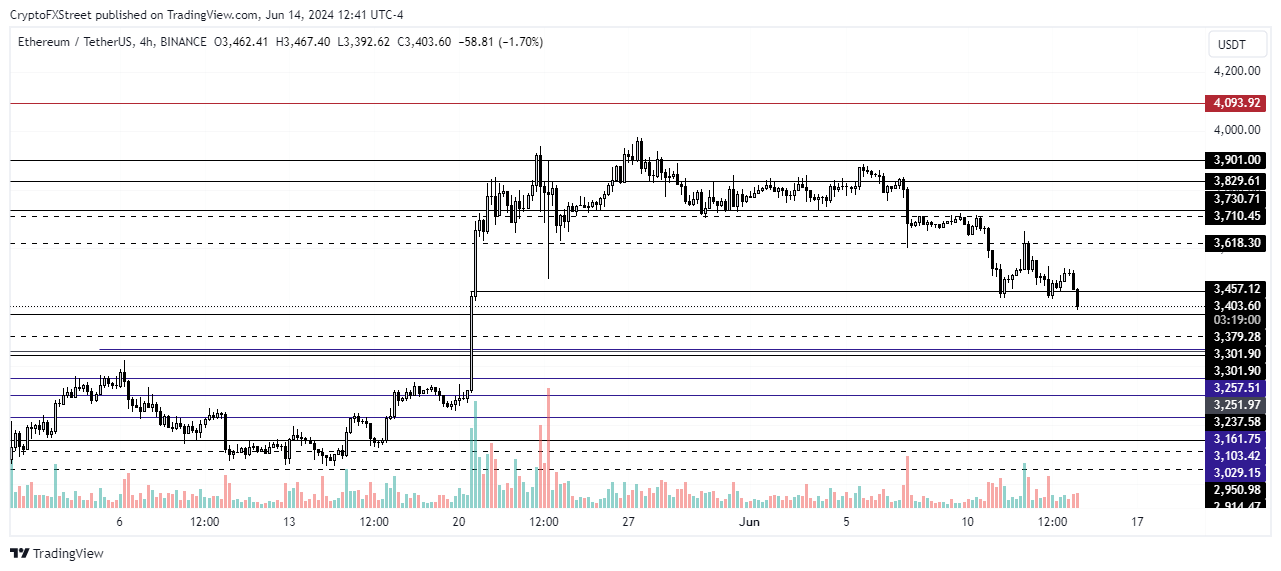
ETH/USDT 4-hour chart
As a result, ETH will likely maintain a range-bound movement between the $3,457 and $3,730 price levels in the coming weeks. If the crypto market experiences an unexpectedly bullish event, a further move to test the $3,900 resistance is expected.
Ethereum FAQs
Ethereum is a decentralized open-source blockchain with smart contracts functionality. Serving as the basal network for the Ether (ETH) cryptocurrency, it is the second largest crypto and largest altcoin by market capitalization. The Ethereum network is tailored for scalability, programmability, security, and decentralization, attributes that make it popular among developers.
Ethereum uses decentralized blockchain technology, where developers can build and deploy applications that are independent of the central authority. To make this easier, the network has a programming language in place, which helps users create self-executing smart contracts. A smart contract is basically a code that can be verified and allows inter-user transactions.
Staking is a process where investors grow their portfolios by locking their assets for a specified duration instead of selling them. It is used by most blockchains, especially the ones that employ Proof-of-Stake (PoS) mechanism, with users earning rewards as an incentive for committing their tokens. For most long-term cryptocurrency holders, staking is a strategy to make passive income from your assets, putting them to work in exchange for reward generation.
Ethereum transitioned from a Proof-of-Work (PoW) to a Proof-of-Stake (PoS) mechanism in an event christened “The Merge.” The transformation came as the network wanted to achieve more security, cut down on energy consumption by 99.95%, and execute new scaling solutions with a possible threshold of 100,000 transactions per second. With PoS, there are less entry barriers for miners considering the reduced energy demands.
Author

Michael Ebiekutan
FXStreet
With a deep passion for web3 technology, he's collaborated with industry-leading brands like Mara, ITAK, and FXStreet in delivering groundbreaking reports on web3's transformative potential across diverse sectors. In addition to