Crypto markets brace for volatility in tight race between Trump and Harris
- The US presidential election can significantly impact crypto markets due to the influence of the country’s political decisions, policies, and economic approaches.
- Data shows the crypto crowd has perceived Trump’s proposals as being a bit more specific and extensive than Harris’.
- Traders should be cautious as cryptocurrency markets are highly sensitive to political uncertainty and often show volatility during election cycles.

The US presidential election is one of the most significant events in the world. Due to the influence of the country’s political decisions, policies, and economic approaches, it can significantly impact crypto and global markets.
With the race expected to be close, the crypto community perceives Trump’s proposals as more specific and extensive than Harris’. However, traders should remain cautious as cryptocurrency markets are highly sensitive to political uncertainty and often experience increased volatility during election cycles.
Donald Trump’s outlook for crypto market
Let’s examine how Donald Trump, the first candidate, could influence the crypto market. Crypto traders have a noticeable pro-Trump bias, likely driven by his publicly stated intentions to adopt pro-crypto policies.
At the Bitcoin conference in Nashville on July 27, Trump proposed creating a strategic national Bitcoin stockpile to position the US as a leader in cryptocurrency adoption and announced plans to establish a Bitcoin and crypto presidential advisory council for clearer regulatory guidelines.
He also voiced intentions to remove the current US Securities and Exchange Commission (SEC) Chair Gary Gensler, criticizing the current administration’s regulatory stance on crypto.
Additionally, in September, Trump’s sons, Donald Trump Jr. and Eric Trump, launched World Liberty Financial (WLFI), a cryptocurrency exchange, signaling the family’s growing involvement in the industry.
Kamala Harris outlook for crypto market
Regarding the second candidate for the US presidential race, Vice President Kamala Harris has also made several statements showing support for the cryptocurrency industry. Still, she hasn’t been as explicit as Trump.
In August, Harris acknowledged blockchain’s potential across various sectors, emphasizing the need for balanced regulation that fosters innovation while ensuring consumer protection.
On September 22, during a fundraiser at Cipriani Wall Street in Manhattan, Harris expressed her intent to encourage innovative technologies like AI and digital assets while protecting consumers and investors.
In October, she unveiled plans to establish a regulatory framework for cryptocurrency and digital assets to safeguard investors. Throughout her campaign, she engaged with crypto industry leaders to discuss the future of digital assets, signaling a willingness to integrate crypto innovations into her policy agenda.
While both candidates have supported the crypto industry, the crypto crowd has perceived Trump’s proposals as being a bit more specific and extensive. Harris’ statements indicate a supportive stance but with a focus on consumer protection and regulatory frameworks.
According to Santiment’s data, the graph below shows the crowd’s perceptions of these two candidates. It shows higher mentions of Trump’s crypto discussions and policies than Harris.
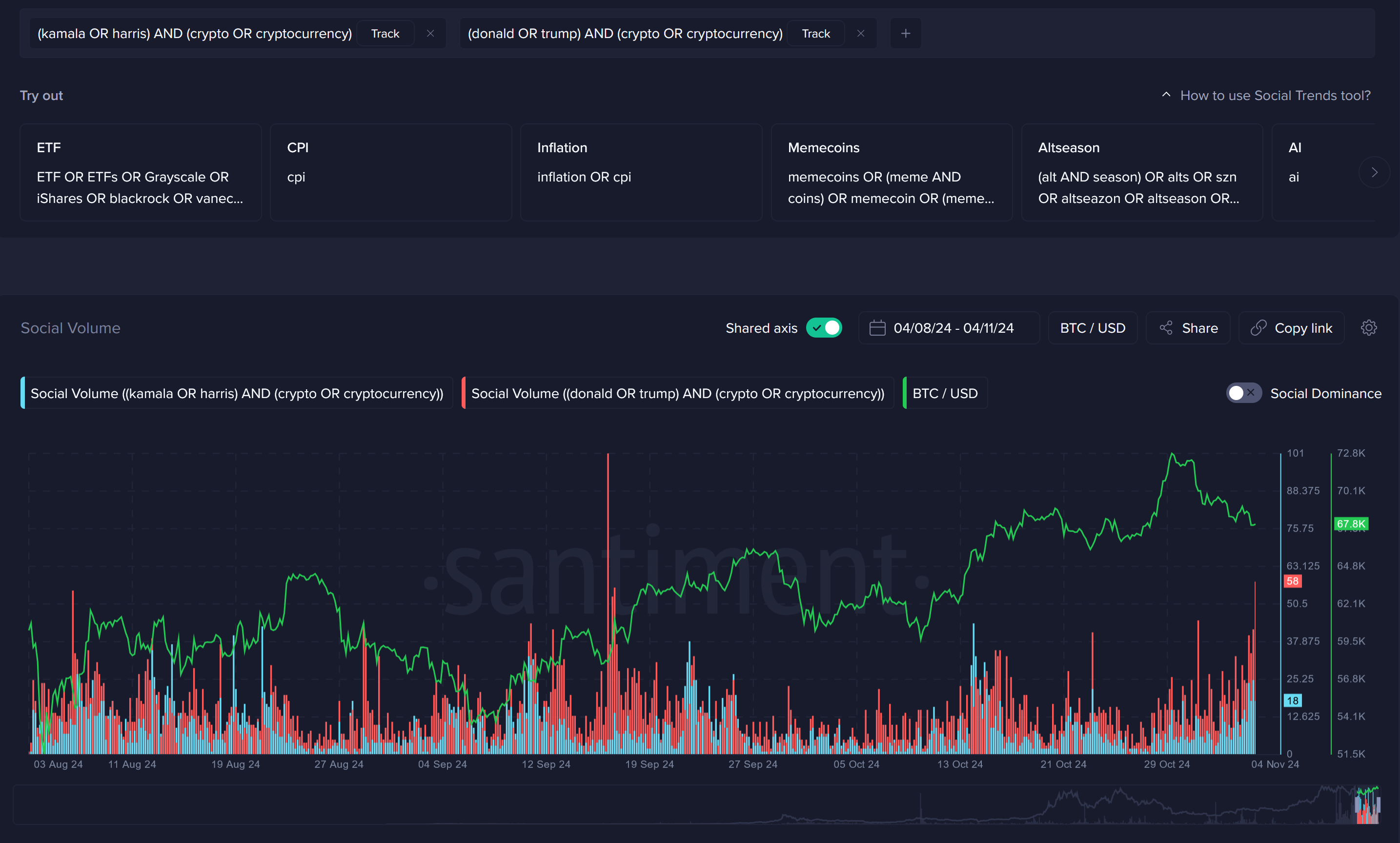
Social Volume chart. Source: Santiment
Historical crypto performance in previous US elections
Let’s see how the crypto-market has reacted overall in the previous US presidential elections.
On November 8, 2016, Bitcoin saw a five-day minor retrace of 5.5% after Trump’s victory. That period was full of many unknowns about what the former Celebrity Apprentice host would truly do as President of the United States. However, Bitcoin and altcoins quickly recovered after the initial decline.
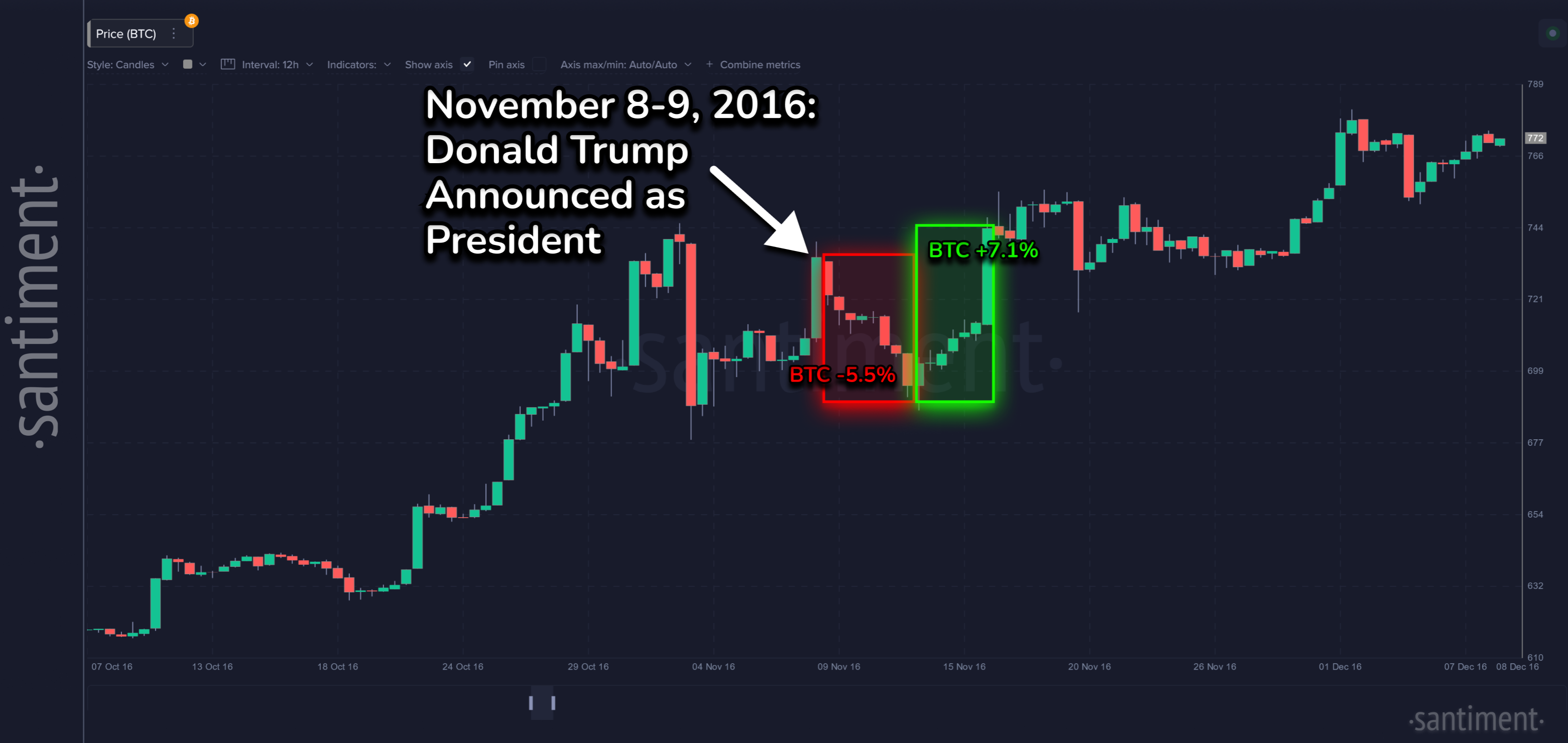
Bitcoin chart in 2016 US presidential elections. Source: Santiment
However, the November 4, 2020, election was far more positive for the crypto market after Joe Biden’s victory was announced, with Bitcoin rising over 22% in 11 days after the results were announced. However, this was also just eight months into the world’s COVID-19 shutdowns.
Many would argue that this bull run was inevitable and would have happened no matter who was elected as president or even if there had been no election. Mostly, the rally was fueled by the interest-rate cut and the direct rounds of stimulus checks received by US households because of COVID-19 shutdowns.
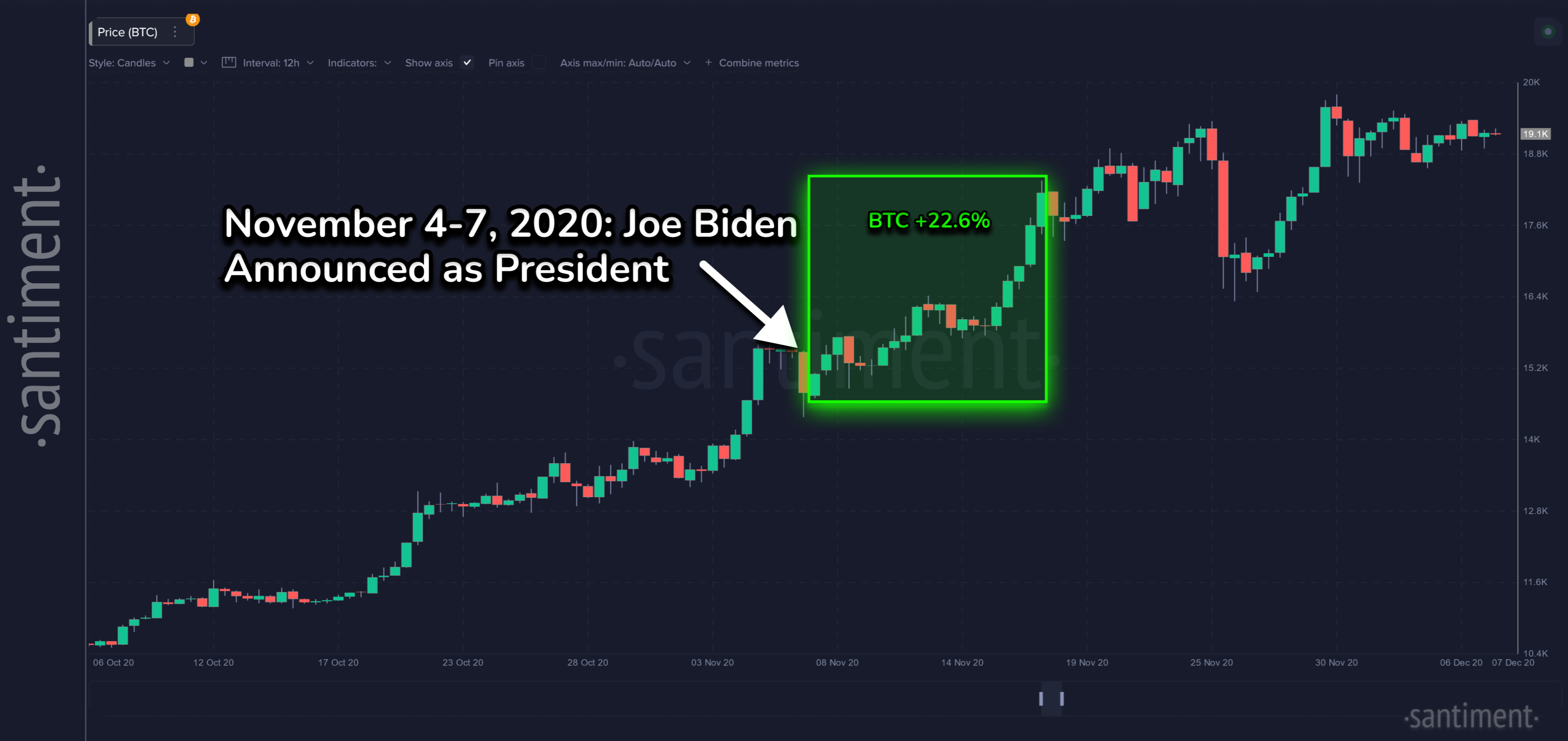
Bitcoin chart in 2020 US presidential elections. Source: Santiment
As mentioned above, the two most recent elections lack sufficient data and sample size to draw reliable conclusions about cryptocurrency’s performance. In 2016 and 2020, markets experienced a bullish surge immediately or within a week after the new president was announced.
Despite the limited data, one clear trend emerges: cryptocurrency markets are highly sensitive to political uncertainty and often show volatility during election cycles. Traders react to policy changes, regulatory shifts, and the candidates’ rhetoric.
As the final election results are confirmed, crypto markets will likely see significant price movements based on perceived support or restrictions. This election outcome will be critical for the crypto community as investors closely monitor the incoming administration’s stance on digital assets.
Bitcoin, altcoins, stablecoins FAQs
Bitcoin is the largest cryptocurrency by market capitalization, a virtual currency designed to serve as money. This form of payment cannot be controlled by any one person, group, or entity, which eliminates the need for third-party participation during financial transactions.
Altcoins are any cryptocurrency apart from Bitcoin, but some also regard Ethereum as a non-altcoin because it is from these two cryptocurrencies that forking happens. If this is true, then Litecoin is the first altcoin, forked from the Bitcoin protocol and, therefore, an “improved” version of it.
Stablecoins are cryptocurrencies designed to have a stable price, with their value backed by a reserve of the asset it represents. To achieve this, the value of any one stablecoin is pegged to a commodity or financial instrument, such as the US Dollar (USD), with its supply regulated by an algorithm or demand. The main goal of stablecoins is to provide an on/off-ramp for investors willing to trade and invest in cryptocurrencies. Stablecoins also allow investors to store value since cryptocurrencies, in general, are subject to volatility.
Bitcoin dominance is the ratio of Bitcoin's market capitalization to the total market capitalization of all cryptocurrencies combined. It provides a clear picture of Bitcoin’s interest among investors. A high BTC dominance typically happens before and during a bull run, in which investors resort to investing in relatively stable and high market capitalization cryptocurrency like Bitcoin. A drop in BTC dominance usually means that investors are moving their capital and/or profits to altcoins in a quest for higher returns, which usually triggers an explosion of altcoin rallies.
Author

Manish Chhetri
FXStreet
Manish Chhetri is a crypto specialist with over four years of experience in the cryptocurrency industry.