Celo price confirms breakout after CELO L2 migration details
- Celo price broke out 15% on March 1, when the network executed its migration to Layer 2.
- CELO continues to hold above $1.1172, increasing the odds for a further upside.
- A break and close below $1.1022 would produce a lower low, provoking a continued drop.

Celo (CELO) price remains broadly bullish, with multiple technical indicators favoring the upside, after the revelation of details relating to the network’s migration to Layer 2 (L2) on March 1.
Also Read: Three sectors that could thrive as 2024 bull market warms up
Celo price defends gains after CELO L2 migration details
During the ETH Denver on March 1, the Celo network revealed details about Celo’s migration to an L2 on Ethereum, also termed CEL2.
"The Road to CEL2: Migrating to an L2 & Unlocking 1B Users."
— ETHDenver (@EthereumDenver) March 1, 2024
Presented by @RegenRene from @Celo
Watch the full video below pic.twitter.com/LKyKLrMuLJ
Celo price soared 15% on March 1, a consequence of the ‘buy the rumor’ situation. However, even as traders cash in on the ‘sell the news situation,’ the Celo price continues to hold above the key support of $1.1172, confirming the breakout.
Amid the ongoing correction, sidelined or late investors are likely to find another buying opportunity around the $1.1172 threshold before the next leg up.
Multiple technical indicators support the bullish thesis, starting with the price strength of 76. While it shows that CELO is overbought, the Relative Strength Index (RSI) has been recording higher highs, reflecting steadily rising momentum. With this, it is likely that the RSI, currently dipping, could bounce back after bulls have another buy opportunity lower.
Increased buying pressure could see Celo price shatter past the $1.2560 range high, potentially creating a higher local top.
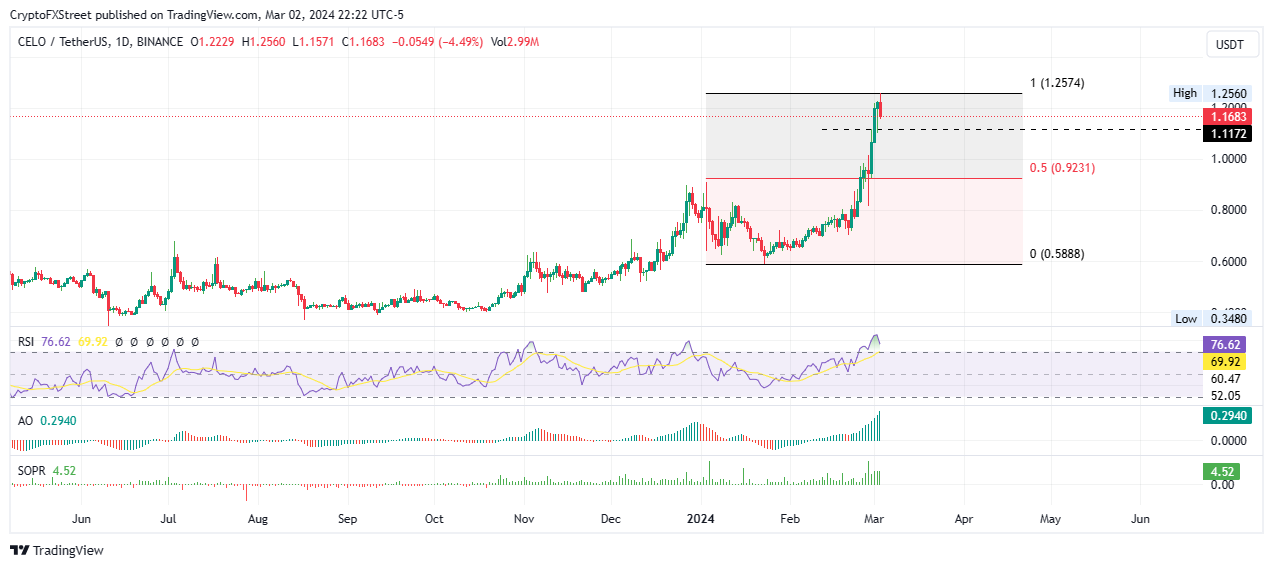
CELO/USDT 1-day chart
Conversely, the Spent Output Profit Ratio (SOPR) position above 1, shows that the owners of the spent outputs for CELO are in profit at the time of the transaction. Reflecting the degree of profit booking as CELO coins move on-chain, this implies that the coins moved, on average, are selling at a profit.
The fact that this indicator is trading higher shows that profits are being realized with the potential for previously illiquid supply being returned to liquid circulation. This threatens the upside potential of Celo price.
Already the RSI is nose-diving, showing falling momentum, likely after buyer exhaustion. If the price drops and closes below the $1.1022 low of the March 2 session would produce a lower low, catalyzing the continuation of a move south.
Cryptocurrency metrics FAQs
What is circulating supply?
The developer or creator of each cryptocurrency decides on the total number of tokens that can be minted or issued. Only a certain number of these assets can be minted by mining, staking or other mechanisms. This is defined by the algorithm of the underlying blockchain technology. Since its inception, a total of 19,445,656 BTCs have been mined, which is the circulating supply of Bitcoin. On the other hand, circulating supply can also be decreased via actions such as burning tokens, or mistakenly sending assets to addresses of other incompatible blockchains.
What is market capitalization?
Market capitalization is the result of multiplying the circulating supply of a certain asset by the asset’s current market value. For Bitcoin, the market capitalization at the beginning of August 2023 is above $570 billion, which is the result of the more than 19 million BTC in circulation multiplied by the Bitcoin price around $29,600.
What is trading volume?
Trading volume refers to the total number of tokens for a specific asset that has been transacted or exchanged between buyers and sellers within set trading hours, for example, 24 hours. It is used to gauge market sentiment, this metric combines all volumes on centralized exchanges and decentralized exchanges. Increasing trading volume often denotes the demand for a certain asset as more people are buying and selling the cryptocurrency.
What is funding rate?
Funding rates are a concept designed to encourage traders to take positions and ensure perpetual contract prices match spot markets. It defines a mechanism by exchanges to ensure that future prices and index prices periodic payments regularly converge. When the funding rate is positive, the price of the perpetual contract is higher than the mark price. This means traders who are bullish and have opened long positions pay traders who are in short positions. On the other hand, a negative funding rate means perpetual prices are below the mark price, and hence traders with short positions pay traders who have opened long positions.
Author

Lockridge Okoth
FXStreet
Lockridge is a believer in the transformative power of crypto and the blockchain industry.