Cardano price at a critical juncture while ADA bears prepare for descent toward $0.81
- Cardano price is at a make-or-break point as the critical level of support will determine the asset’s next moves.
- ADA could be headed lower with a 22% descent if the crucial line of defense fails to hold.
- Cardano could continue to be sealed in a downtrend unless the token slices above the upper boundary of the governing technical pattern.

Cardano price continues on in its prevailing downtrend as the buyers are nowhere to be found. ADA is nearing a critical support line which could determine the token’s next move as slipping below this level would put a bearish target at $0.80 on the radar.
Cardano bears eye 22% drop
Cardano price has formed a descending parallel channel on the 3-day chart, suggesting that ADA is sealed in a downtrend.
The last line of defense for Cardano price before additional bearish moves are anticipated is at the 200 three-day Simple Moving Average (SMA) at $1.03. Falling below this level would unravel a 22% descent toward the lower boundary of the governing technical pattern at $0.81, coinciding with the February 21 low in 2021.
Additional selling pressure may see Cardano price slice below the downside trend line of the prevailing chart pattern toward the 127.2% Fibonacci extension level at $0.71, intersecting with the February 6 low in 2021.
However, if a spike in buy orders occurs, Cardano price will face immediate resistance at the 78.6% Fibonacci retracement level at $1.07.
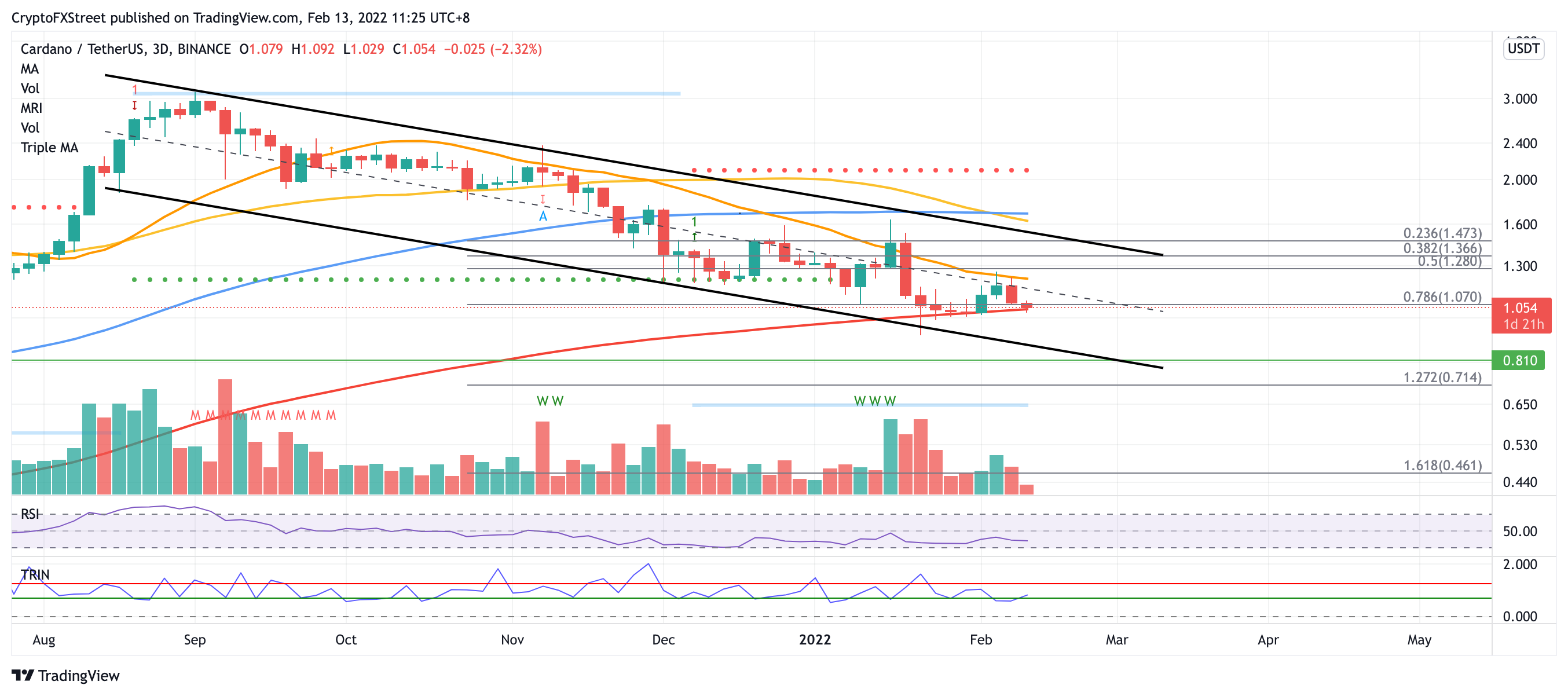
ADA/USDT 3-day chart
Additional obstacles may emerge at the middle boundary of the governing technical pattern at $1.14, then at the 21 three-day SMA at $1.22.
Cardano price must also break above the 50% retracement level at $1.28, the 38.2% Fibonacci retracement level at $1.36 and the 23.6% Fibonacci retracement level at $1.47, which coincides with the upper boundary of the descending parallel channel pattern in order to escape the downtrend.
However, even if Cardano slices above the topside trend line of the governing technical pattern, ADA will face further hurdles at the 50 three-day SMA at $1.61 and the 100 three-day SMA at $1.70 next.
Author

Sarah Tran
Independent Analyst
Sarah has closely followed the growth of blockchain technology and its adoption since 2016.