Breaking: BitMEX accused of attempting to evade U.S. regulations according to CFTC charges
- BitMEX has just been accused of several illegal activities by the CFTC.
- Co-founder Samuel Reed was arrested this morning in Massachusetts.

The U.S. Commodity Futures Trading Commission (CFTC) has just accused BitMEX of allegedly facilitating unregistered trading to customers. According to the official report, the CTFC has filed a civil enforcement action in the U.S. District Court of the Southern District of New York charging three individuals that own and operate BitMEX.
The individuals charged include the owner and founder Arthur Hayes, Ben Delo, and Samuel Reed. James McDonald, the Director of the Division of Enforcement stated:
Effective anti-money laundering procedures are among the fundamental requirements of intermediaries in the derivatives markets, whether in traditional products or in the growing digital asset market. This action shows the CFTC will continue to work vigilantly to protect the integrity of these markets
The U.S. Attorney for the District of New York has indicted all three individuals along with Gregory Dwyer on federal charges of 'violating the Ban Secrecy Act and conspiracy to violate the Bank Secrecy Act'.
According to the CTFC release, BitMEX has allegedly been offering illegal leveraged retail commodity transactions, futures, options, and swaps on cryptocurrencies since November 2014.
The complaint also names HDR Global Services Limited, a Bermudian entity that employes personnel for BitMEX since 2018. The report also states that BitMEX has failed to implement Anti-Money Laundering and Know-Your-Customer measures.
BitMEX has not implemented any AML policies or procedures, which arerequired of financial institutions such as FCMs to prevent or detect, among other things, terroristfinancing or other criminal activity
UPDATE: Co-Founder Samuel Reed was arrested Thursday morning in Massachusetts while the rest remain at large.
Not the first time BitMEX was accused of illegal activities
Back in May 2020, the derivatives exchange was also accused in court of facilitating a 'myriad of illegal activities' according to a lawsuit filed by BMA LLC in the United States District.
BMA LLC also claims that around 15% of BitMEX's 2019 trading volume is coming from U.S. traders even though the exchange is not licensed in the country. The official team of BitMEX, through HDR Global Trading stated:
We’re aware of a complaint filed by “BMA LLC”, formerly known as ‘Bitcoin Manipulation Abatement, LLC’, in the US District Court for the Northern District of California. Having reviewed a draft version of their complaint, which is clearly rehashed from information culled from the internet, we confirm we will be defending ourselves vigorously against this spurious claim
Repercussions in the price of Bitcoin and the market
Minutes after the news came out, the price of Bitcoin crash 3.5% within one hour and bears are eying up further downside action. The entire cryptocurrency market wiped $10 billion in market capitalization in less than one hour. A lot of investors are going short, which means betting against the price of Bitcoin or other digital assets.
BTC Longs vs Shorts Chart
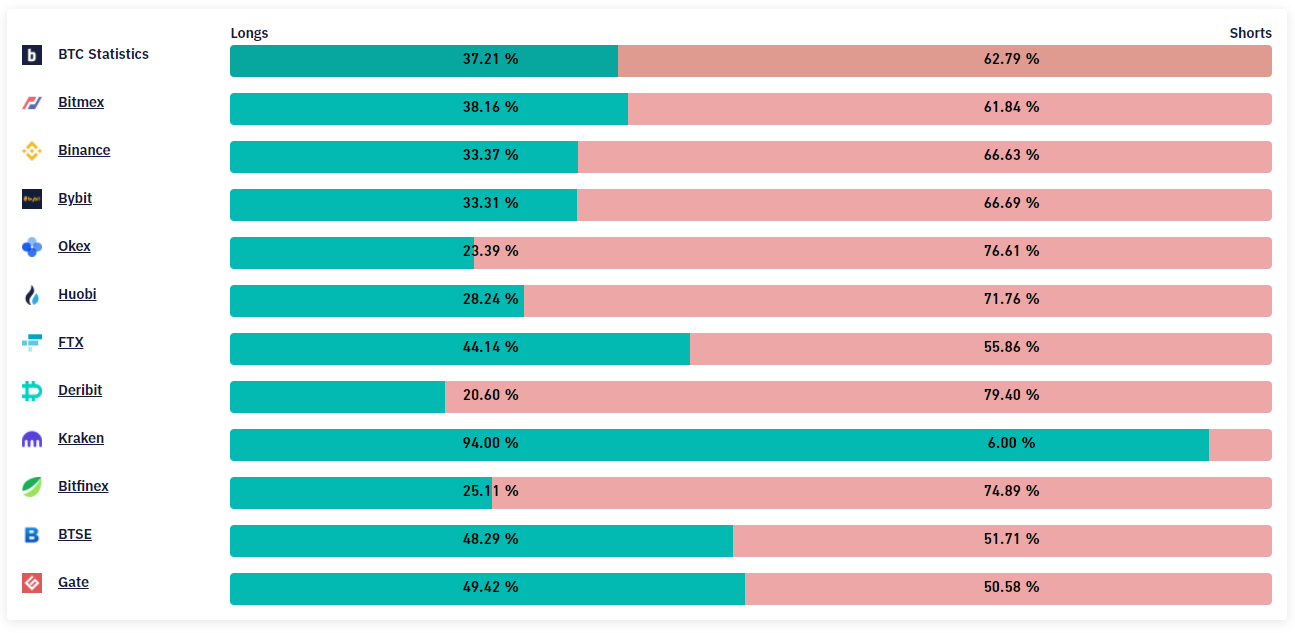
According to a recent report by ByBt, the ratio of shorts vs longs turned in favor of shorts in all exchanges including BitMEX, Binance, or Okex. Although Bitcoin is the most affected currency, the number of shorts also increased for Ethereum, LTC, and XRP.
BTC/USD 1-hour chart
-637371674675524180.png)
Bitcoin was trading around $10,900 before the crash and has now lost the 50-SMA, the 100-SMA, and the 200-SMA as well as several support levels at $10,670, $10,625, and $10,590.
BTC IOMAP Chart
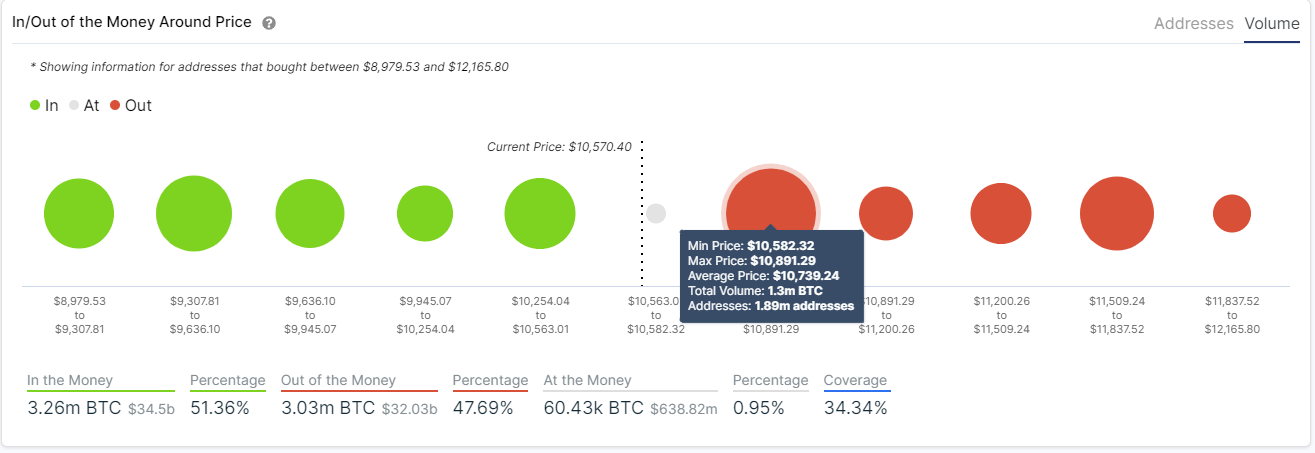
The In/Out of the Money Around Price chart by IntoTheBlock shows steep resistance ahead between $10,582 and $10,891. Inside this range, 1.3 million BTC were bought. On the other side, the range between $10,254 and $10,563 is not as strong with only 700,000 BTC bought. If bulls lose this support area, Bitcoin can slide below $10,200 and re-test $10,000.
BTC/USD daily chart
-637371675690194564.png)
On the daily chart, the price of Bitcoin stands at a crucial support level in the form of the 100-SMA. A successful defense of this level would be a good short-term help for the bulls. However, considering the massive selling pressure we are seeing, the most likely scenario for Bitcoin is a dip towards the last low at $10,200.
Author

Lorenzo Stroe
Independent Analyst
Lorenzo is an experienced Technical Analyst and Content Writer who has been working in the cryptocurrency industry since 2012. He also has a passion for trading.