Bitcoin price hits $50,000 as Wall Street buys BTC en masse
- Bitcoin price has nicked the $50,000 target, levels last tested on December 28, 2021.
- BTC could extend the gains to clear the $60,000 psychological level, last tested on November 21, 2021.
- Caution is advised as BTC is already massively overbought with the RSI reading well above 70.

Bitcoin (BTC) price revisited the late 2021 highs on Monday, a move that passes as a milestone to the BTC community. It comes ahead of the halving event, and therefore sates the pace for what could kickstart the next bull cycle in the cryptocurrency market.
Also Read: Breaking: Bitcoin price hits $50,000 for the first time in two years
Wall Street is buying Bitcoin in volumes
Bitcoin purchases have skyrocketed since the landmark approval of spot BTC exchange-traded funds (ETFs) in the US on January 10. Reports indicate that Wall Street could be buying BTC en masse with data showing purchases upwards of 12.5x more BTC per day than the network can produce.
Wall Street LOVES bitcoin.
— Pomp (@APompliano) February 12, 2024
They are buying up 12.5x more bitcoin per day than the network can produce.
The march to a new all-time high is underway if this continues.
I explain this on my segment with @SquawkCNBC this morning. pic.twitter.com/0zRc3RQ4hY
With this, VC investor Bitcoiner and entrepreneur Anthony Pompliano says, “Bitcoin has become Wall Street’s favorite asset.” Pompliano also highlighted that Wall Street “not just likes, but loves Bitcoin,” attributing the turnout to the recently launched spot ETFs, which in his opinion, have set a record in the history of this type of asset.
Based on Pompliano’s calculations, 80% of all the BTC that is currently circulating in the market has not been moved over the last half year. Further, just about $200 billion in Bitcoin can actually be traded. With this, he concludes that the ETFs have managed to scoop 5% of all the BTC supply that now trades in the market barely 30 days since the investment product went live in the market.
Following the $50,000 milestone, Mexican billionaire Ricardo Salinas said, "You have to know how to be patient, not get scared when it goes down and buy" it.
Bitcoin price outlook as Wall Street goes berserk with spot BTC ETFs
After tagging the $50,000 psychological level, Bitcoin price has retraced, coming on the back of traders cashing in early on the gains. It also follows the typical correction characteristic of an overbought asset with the Relative Strength Index (RSI) reading above 70.
Nevertheless, the upside potential remains alive for Bitcoin price, considering that the RSI remains northbound and suggests rising momentum. The Moving Average Convergence Divergence (MACD) indicator is also above its signal line (orange band) with both in positive territory.
Increased buying pressure could see Bitcoin price make a decisive move above the $50,000 blockade with a possible extension to the $60,000 psychological level. Such a move would constitute a 20% climb above current levels.
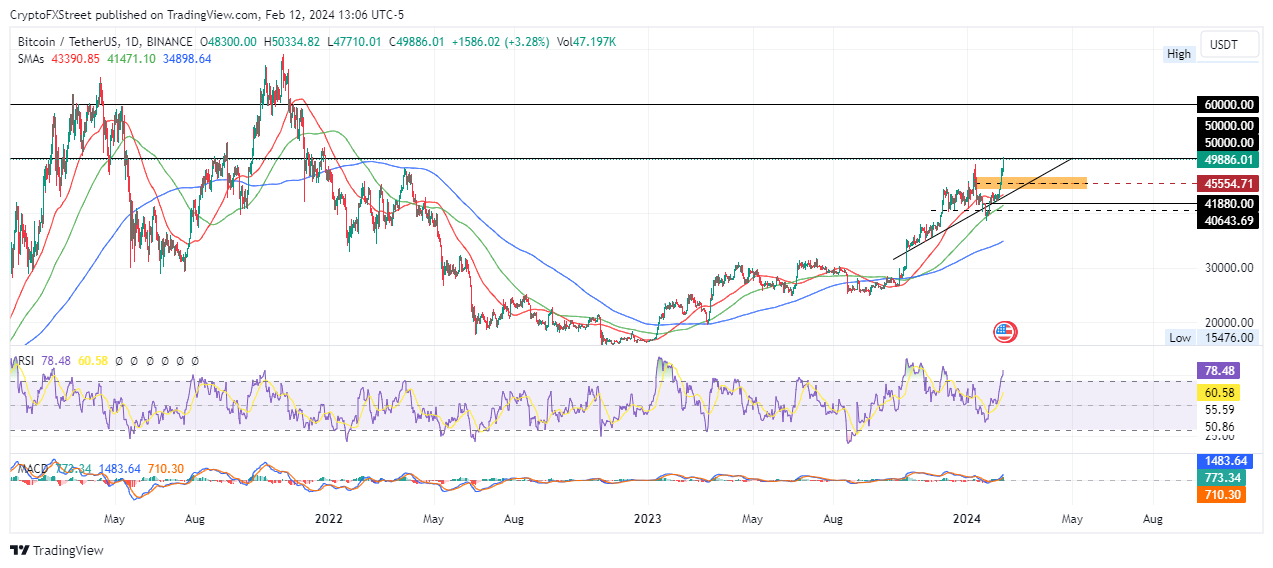
BTC/USDT 1-day chart
On the other hand, if profit-taking abounds, Bitcoin price could retract further, possibly falling into the supply zone that currently provides support between $44,300 and $46,760. A break and close below the midline of this order block at $45,554 would confirm the continuation of the fall.
Such a directional bias could see Bitcoin price lose support due to the ascending trendline to test the $41,880 support, or in a dire case, roll over to tag $40,643.
Cryptocurrency prices FAQs
How do new token launches or listings affect cryptocurrency prices?
Token launches like Arbitrum’s ARB airdrop and Optimism OP influence demand and adoption among market participants. Listings on crypto exchanges deepen the liquidity for an asset and add new participants to an asset’s network. This is typically bullish for a digital asset.
How do hacks affect cryptocurrency prices?
A hack is an event in which an attacker captures a large volume of the asset from a DeFi bridge or hot wallet of an exchange or any other crypto platform via exploits, bugs or other methods. The exploiter then transfers these tokens out of the exchange platforms to ultimately sell or swap the assets for other cryptocurrencies or stablecoins. Such events often involve an en masse panic triggering a sell-off in the affected assets.
How do macroeconomic releases and events affect cryptocurrency prices?
Macroeconomic events like the US Federal Reserve’s decision on interest rates influence risk assets like Bitcoin, mainly through the direct impact they have on the US Dollar. An increase in interest rate typically negatively influences Bitcoin and altcoin prices, and vice versa. If the US Dollar index declines, risk assets and associated leverage for trading gets cheaper, in turn driving crypto prices higher.
How do major crypto upgrades like halvings, hard forks affect cryptocurrency prices?
Halvings are typically considered bullish events as they slash the block reward in half for miners, constricting the supply of the asset. At consistent demand if the supply reduces, the asset’s price climbs. This has been observed in Bitcoin and Litecoin.
Author

Lockridge Okoth
FXStreet
Lockridge is a believer in the transformative power of crypto and the blockchain industry.