Bitcoin complex under pressure amid BCH hard fork, Ripple outperforms

The much-expected Bitcoin Cash hard fork resulted in two separate coins on November 15, as Bitcoin ABC and nChain, two leading Bitcoin Cash developer communities, failed to find a common ground to continue operating under one roof.
Bitcoin ABC, which stands for ‘Adjustable Blocksize Cap’, believed that the Bitcoin Cash’s network was sound and needed minor upgrades, while nChain opted for more drastic changes, aiming to restore ‘more original operation nodes’, removing the limit of 201 opcodes per script, and more importantly, quadrupling the maximum block size from the actual 32MB to 128MB.
Hence, Bitcoin Cash SV, the Satoshi’s Version, has seen the daylight as a result of the November 15 hard fork.
Today, traders shall trade BCHABC (Bitcoin Cash ABC) and BCHSV (Bitcoin Satoshi’s Version) separately. The BCH ABC could be seen as the continuation of the former Bitcoin Cash.
The network split has of course triggered a hash war, as miners were curious to compare the computing power of both chains. Although Bitcoin Cash lead the battle in the first days following the fork, it is probably too early to tell which one will ‘win’ the battle in the long run. In theory, nothing prevents both coins to coexist and to thrive.
November 15th impact on major cryptocurrency prices
The cryptocurrency markets were trading steadily in a wait-and-see mode since at least two months to November 15, with a slightly negative bias. Hence, traders were prepared for a sharp positive or negative breakout to shatter the silence.
The Bitcoin Cash’s November 15th hard fork pulled the trigger for a significant market unwind after a prolonged period of low price volatility.
Bitcoin Cash ABC and Bitcoin Cash SV under selling pressure
On the front line, both Bitcoin Cash ABC and Bitcoin Cash SV came under a decent selling pressure due to looming uncertainties following the Bitcoin Cash hard fork.
Bitcoin Cash ABC tested the $200 level following the fork, shredding more than two thirds of its value since its mid- November peak of $630.
Bitcoin Cash SV faced a constant downside pressure after having traded above the $200 mark on November 15. The pair made a recovery attempt to $140 on November 17, yet failed to extend gains above this level and steadily gave back gains to reach the $50 mark at the time of writing.
The new coin could have hard time gathering a decent funding in the actual bearish market environment, even more as it will most likely be facing one important challenge in the immediate future: convincing miners to get on board. Remember, higher blocks require higher energy consumption, which could hold many miners back from joining the BCH SV’s network in the short to medium term. Therefore, the $100 level could act as a strong psychological resistance in the foreseeable future.
Bitcoin tanks below $5000
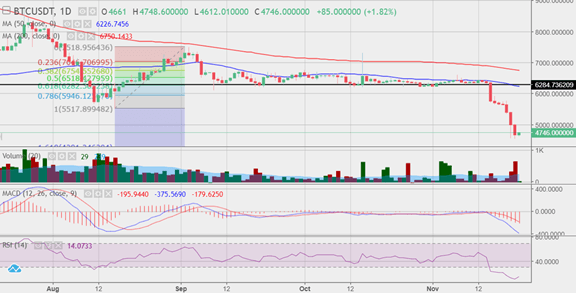
Bitcoin interestingly failed in its safe-haven role following the BCH hard fork. The sell-off intensified as the most popular cryptocurrency couldn’t capture the panic outflows. Crypto-traders preferred leaving the market altogether, instead of finding refuge in Bitcoin. This market behavior hinted at a broader thrust issue in cryptocurrencies.
The BTC/USDT slipped below the critical $5000 level for the first time since October 17th, 2017. This move should highly compromise the widely expected price recovery before the end of the year and push the major cryptocurrencies into a prolonged bear market, hammering expectations of a much-hoped end-of-year rally in cryptocurrency prices.
Ripple outperforms
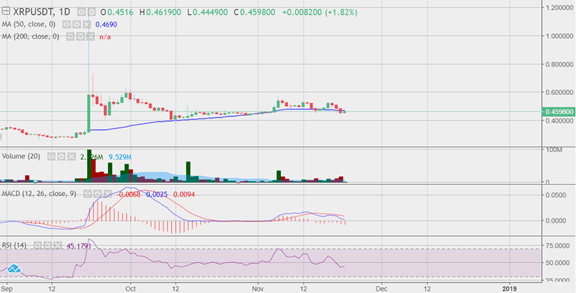
Ripple is one exception. The XRP proved to be an efficient diversification asset during the post-fork sell-off. There is a solid rational behind the Ripple’s immunity: its centralized structure.
In opposition to its major rivals, Ripple is not a decentralized cryptocurrency, hence it is not subject to the same set of risks than an open-source blockchain, where decisions are made by independent, decentralized miner communities. In contrary, Ripple’s decisions are made by a central authority; hence Ripple is not subject to hard-fork risks.
In the aftermath of the BCH hard fork, we clearly observed that Ripple’s centralized structure has been an interesting feature for portfolio diversification, despite being criticized by most crypto-purists.
Is the idea of one global cryptocurrency plausible?
The Bitcoin Cash hard fork has once again hinted that the idea of a single, global cryptocurrency could be unrealistic.
Remember, Bitcoin Cash is already a Bitcoin spin-off. Now, it has split into two cryptocurrencies itself and similar hard forks are more likely than not to happen in the future. This raises the question of how plausible the idea of one global, decentralized cryptocurrency is.
By definition, a decentralized cryptocurrency is an open-source network. The community of miners are given the power to decide on the operational rules. In such democratic system, it is highly unlikely that most miners will be continuously sharing the same view. Hence, the hard forks are inevitable as the communities expand and the technology improves. So, one can defend that the cryptocurrency fundamentals, themselves, are the major caveat to the rise of a single cryptocurrency.
This reasoning does not mean that cryptocurrencies will suffer in the future. Most major cryptocurrencies offer a set of unique decentralized services and dapps to their users. They do have viable business models, which fit perfectly for operating and funding within the cryptocurrency framework. The blockchain technology is here to stay and the appropriate usage of this technology should benefit to well-calibrated businesses.
Hence, moving forward, picking the promising cryptocurrencies will certainly be critical for navigating successfully through the cryptocurrency markets.
Author

Ipek Ozkardeskaya
ipekScope
Ipek Ozkardeskaya began her financial career in 2010 in the structured products desk of the Swiss Banque Cantonale Vaudoise. She worked in HSBC Private Bank in Geneva in relation to high and ultra-high-net-worth clients.