Bitcoin bears attempt to pin BTC price under $23K ahead of this month’s options expiry

$1.9 billion in BTC options are set to expire on Feb. 24, and bulls are well positioned to profit despite the Federal Reserve's intention to cool off the U.S. economy.
Bitcoin's 16% price gain between Feb. 13 and Feb. 16 practically extinguished the bears' expectation for a monthly options expiry below $21,500. As a result of the abrupt rally, these bearish bets are unlikely to pay off, especially since the expiry occurs on Feb. 24. However, bulls were not counting on the strong price rejection at $25,200 on Feb. 21 and this reduces their odds of securing a $480 million profit in this month’s BTC options expiry.
Bitcoin investors' primary concern is a stricter monetary policy as the U.S. Federal Reserve (FED) increases interest rates and reduces its $8 trillion balance sheet. Feb. 22 minutes from the latest Federal Open Market Committee's (FOMC) meeting showed that members were in consensus on the most recent 25 bps rate hike and that the FED is willing to continue raising rates as long as deemed necessary.
St. Louis FED President James Bullard told CNBC on Feb. 22 that a more aggressive interest rate hike would give them a better chance to contain inflation. Bullard said,
"Let's be sharp now, let's get inflation under control in 2023.
If confirmed, the increased interest rate pace would be negative for risk assets, including Bitcoin, as it draws more profitability for fixed-income investments.
Even if the newsflow remains negative, bulls still can profit up to $480 million in Friday's monthly options expiry. However, bears can still significantly improve their situation by pushing the BTC price below $23,000.
Bears were not expecting Bitcoin to hold $22,000
The open interest for the Feb. 24 monthly options expiry is $1.91 billion, but the actual figure will be lower since bears expected prices below $23,000. Nevertheless, these traders were surprised as Bitcoin gained 13.5% between Feb. 15 and Feb. 16.
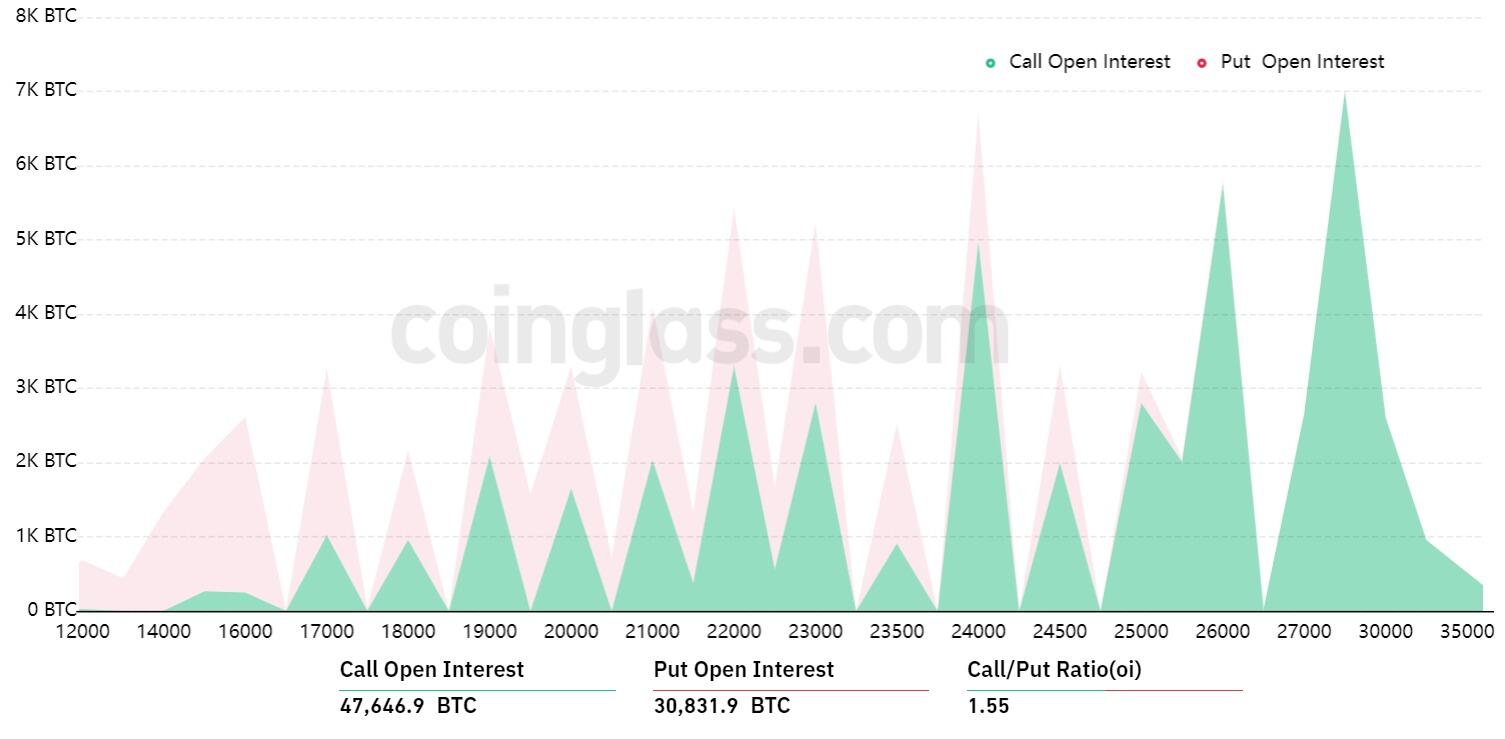
Bitcoin options aggregate open interest for Feb. 24. Source: CoinGlass
The 1.55 call-to-put ratio reflects the imbalance between the $1.16 billion call (buy) open interest and the $750 million put (sell) options. If Bitcoin's price remains near $24,000 at 8:00 am UTC on Feb. 24, only $125 million worth of these put (sell) options will be available. This difference happens because the right to sell Bitcoin at $22,000 or $23,000 is useless if BTC trades above that level on expiry.
Bulls aim for $23,000 to secure a $155 million profit
Below are the four most likely scenarios based on the current price action. The number of options contracts available on Feb. 17 for call (bull) and put (bear) instruments varies, depending on the expiry price. The imbalance favoring each side constitutes the theoretical profit:
- Between $22,500 and $23,000: 12,500 calls vs. 10,700 puts. The net result favors the call (bull) instruments by $40 million.
- Between $23,000 and $24,000: 16,200 calls vs. 7,600 puts. The net result favors the call (bull) instruments by $200 million.
- Between $24,000 and $24,500: 21,100 calls vs. 5,200 puts. Bulls increase their advantage to $385 million.
- Between $24,500 and $25,000: 23,200 calls vs. 3,600 puts. Bulls dominate by profiting $480 million.
This crude estimate considers the call options used in bullish bets and the put options exclusively in neutral-to-bearish trades. Even so, this oversimplification disregards more complex investment strategies.
For example, a trader could have sold a call option, effectively gaining inverse exposure to Bitcoin above a specific price, but unfortunately there's no easy way to estimate this effect.
The FED's tightening policy is the bears’ best shot
Bitcoin bulls must push the price above $24,500 on Feb. 24 to secure a potential $480 million profit. On the other hand, the bears' best-case scenario requires a 3.5% price dump below $23,000 to minimize their losses.
Considering the negative pressure from the FED's desire to weaken the economy and contain inflation, bears have good odds of improving their situation and settling with a $40 million loss on Feb. 24. This movement might not be successful, but it is bears' only way out of multi-million losses on the BTC monthly options expiry.
Looking at a broader time frame, investors still believe the FED is destined to reverse the current monetary policy in the second half of 2023 — possibly paving the way for a sustainable rally ahead of the April 2024 Bitcoin block reward halving.
Author

Cointelegraph Team
Cointelegraph
We are privileged enough to work with the best and brightest in Bitcoin.