Arbitrum price rises by 10% in 24 hours even as zkSync challenges its dominance in L2 market
- Arbitrum price shot up by 10% after noting a bullish divergence on the 4-hour chart,
- zkSync Era's fee share in the L2 market is at 20% currently, nearing Optimism's 30% dominance.
- Arbitrum still has the upper hand in terms of investor interest, verified by the project's adoption rising by 70% in the last four days.

Arbitrum propelled Layer-2 solutions into the limelight after launching its token ARB recently. This propelled investor interest in these chains and increased the inflows into the L2 market. Soon after zkSync Era entered the space with its mainnet and is already on its way to fight with Arbitrum for the lead.
Arbitrum and zkSync fight for the crown
Arbitrum took over the L2 market from Optimism which was the leader of the space for a long time. Since the launch of its native token on March 23, the total value locked on the L2 solution doubled to $6.5 billion. A day later zkSync Era's alpha mainnet launched, and in the span of a month, its TVL shot up to $261 million. Collectively, both the L2 chains increased the interest of the investors in the L2 market, and as a result, the total TVL has increased by nearly 65%.
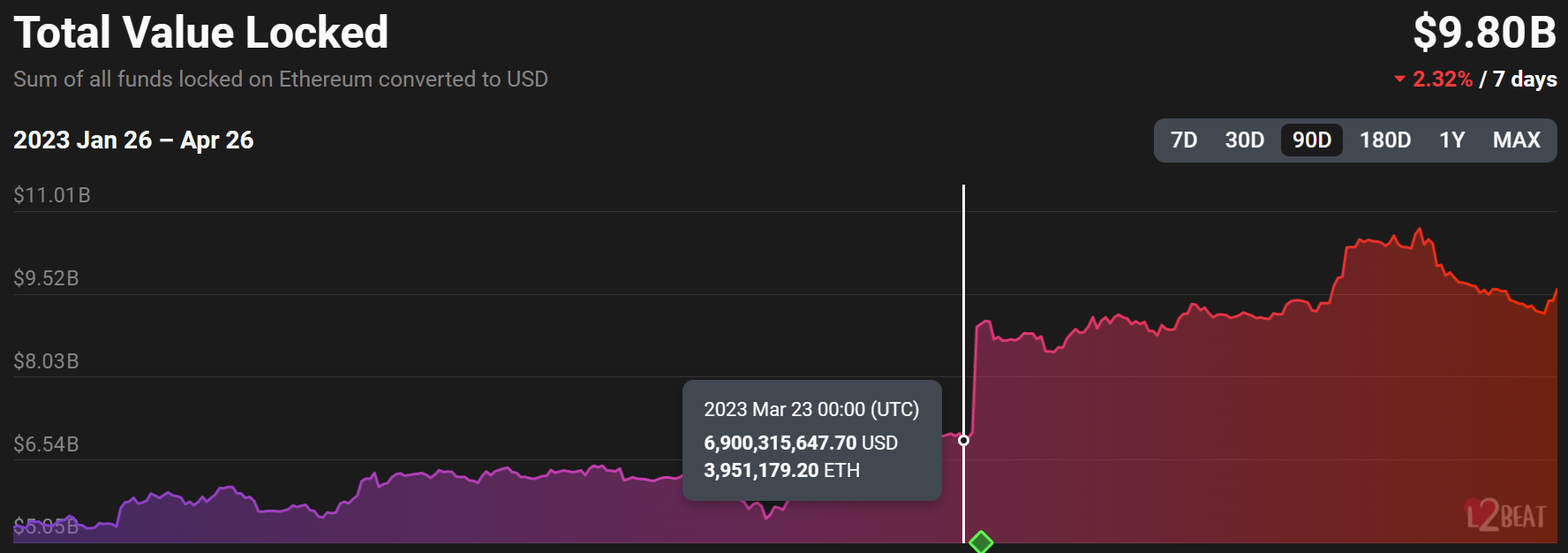
Total value locked on L2 chains
Furthermore, zkSync's hype and Arbitrum's dominance are subsiding Optimism's demand, which once had dominance in terms of fee share. However, at the moment, zkSync Era is on the verge of overtaking Optimism. In the past two months, Optimism's fee share reduced from nearly 40% to less than 30%, and since zkSync's mainnet launch, its dominance grew to almost 20%. Given the steadily rising interest in the L2, it may not be long before Optimism is pushed to third place.
Layer-2 | Data Fee Share Landscape
— zkSync Insider ▪️ (@zkSync_Insider) April 26, 2023
After the mainnet of @zksync Era, the layer-2 landscape has been significantly changed by the existence of #zkSyncEra.
Below is the % of top layer-2:
Dominance of zkSync is increasing
% of #Optimism and #Arbitrum is reducing#zkSync pic.twitter.com/QYuMFrmpeW
One of the biggest differences between Arbitrum and zkSync Era is the foundation of the chains. While the former is an Optimism rollup, the latter is a zero-knowledge (zk) rollup. Optimism rollups still rely on the trust in validators and thus assume transactions are valid by default.
Zk rollups are rising in demand since people don't necessarily trust the Optimism method and require a validity proof to be published on-chain for all off-chain computation. Although the latter results in higher costs, which is why the demand is relatively lower still.
Regardless, despite zkSync Era's emergence, Arbitrum's growth is still consistent, backed by its users who recovered from the recent debacle by the development team. The ARP-1 proposal, which created confusion amongst the users and Arbitrum regarding the allocation of 750 million ARB tokens, drew a wedge between the two. This was later fixed by Arbitrum by scrapping the proposal.
Since then the project has observed stark growth in its user base as it gains traction in the DeFi market. The rate at which new addresses are being formed on the network has risen by 70% in the span of four days from 6,167 to 10,506.
 [21.13.48, 26 Apr, 2023]-638181217277390273.png)
Arbitrum network growth
Thus, Arbitrum is banking on this confidence, moving on to the next phase of its development roadmap, beginning the $120 million DAO distribution. Executed 48 hours ago, about 1.13% of all ARB tokens have been allocated to qualifying DAOs on the network.
Investors initially had mixed responses to this airdrop, with many even expecting a price decline. However, in the last 48 hours, Optimism rose, effectively reviving ARB price and resulting in a nearly 11% rally.
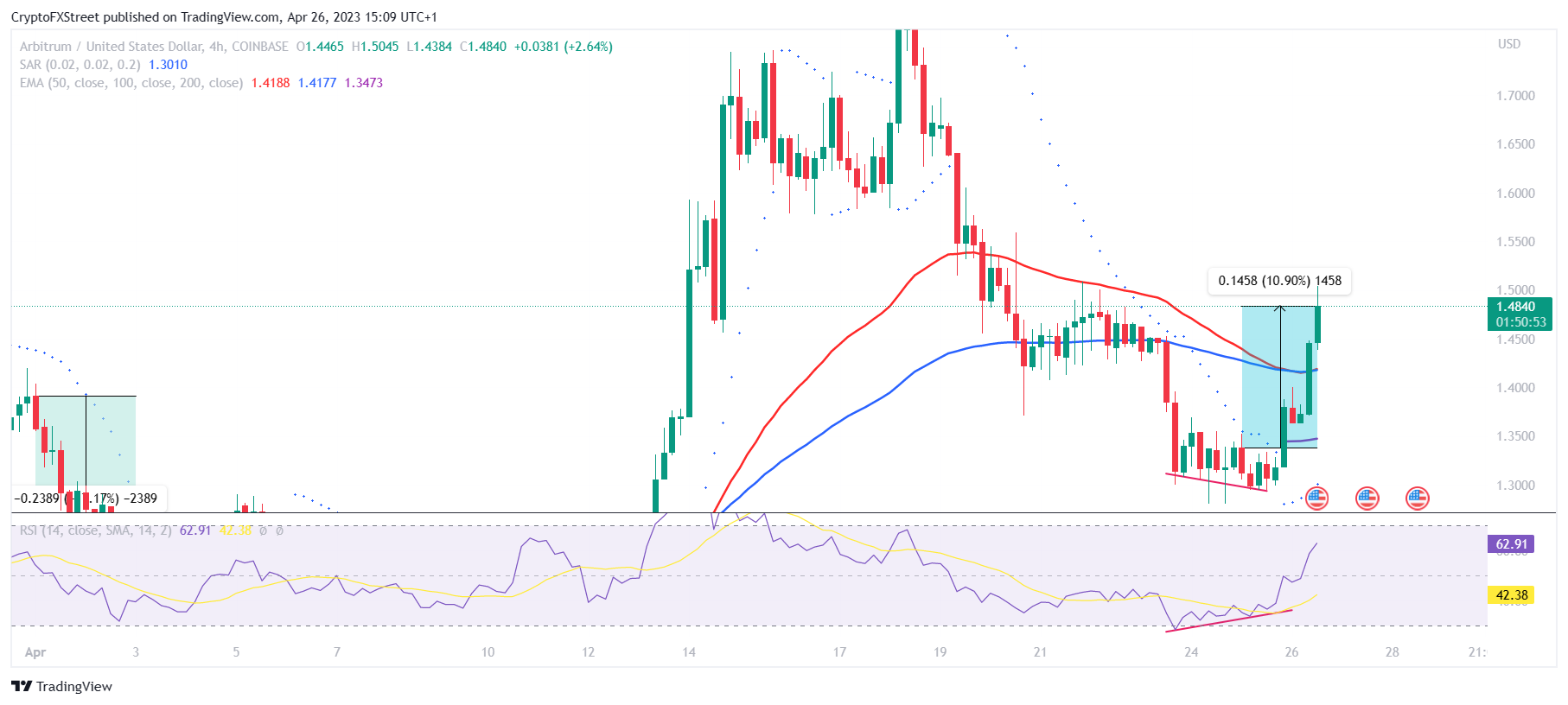
ARB/USD 4-hour chart
Trading at $1.48 at the time of writing, the altcoin successfully executed the bullish divergence with RSI observed over the last few days on the 4-hour chart. The broader market's bullish cues provided additional support to the cryptocurrency, resulting in the price rise.
Author

Aaryamann Shrivastava
FXStreet
Aaryamann Shrivastava is a Cryptocurrency journalist and market analyst with over 1,000 articles under his name. Graduated with an Honours in Journalism, he has been part of the crypto industry for more than a year now.