|

WTI Probes 1-Year Low at $50.00 – Time for a Dead Cat Bounce?

When it comes to traders’ fears about the spread of coronavirus, actions can speak louder than words (and data). For instance, the Chinese government’s “aggressive” decision to essentially quarantine nearly 50M people and build two new hospitals in record time foreshadowed that the number of infections was likely to get worse before it got better, a dynamic that has played out over the last two weeks.

A similar dynamic is taking place in the oil market today. According to Bloomberg, Chinese demand for oil products has fallen 20% amidst the lockdown; the estimated 3M b/d decline in demand would mark the worst demand shock since the Great Financial Crisis. Meanwhile, a separate Reuters report that OPEC+ is considering a 500k b/d production cut as early as the middle of this month to try to address the steep drop in demand confirms the severity of the issue.

When it comes to oil prices, traders have been selling first and asking questions later. The price of West Texas Intermediate crude oil has collapsed by nearly 25% in less than a month, and despite today’s recovery in other risk assets, WTI continues to probe new lows heading into the close. As the chart below shows, WTI is testing the psychologically-significant $50.00 level, its lowest price in over a year:
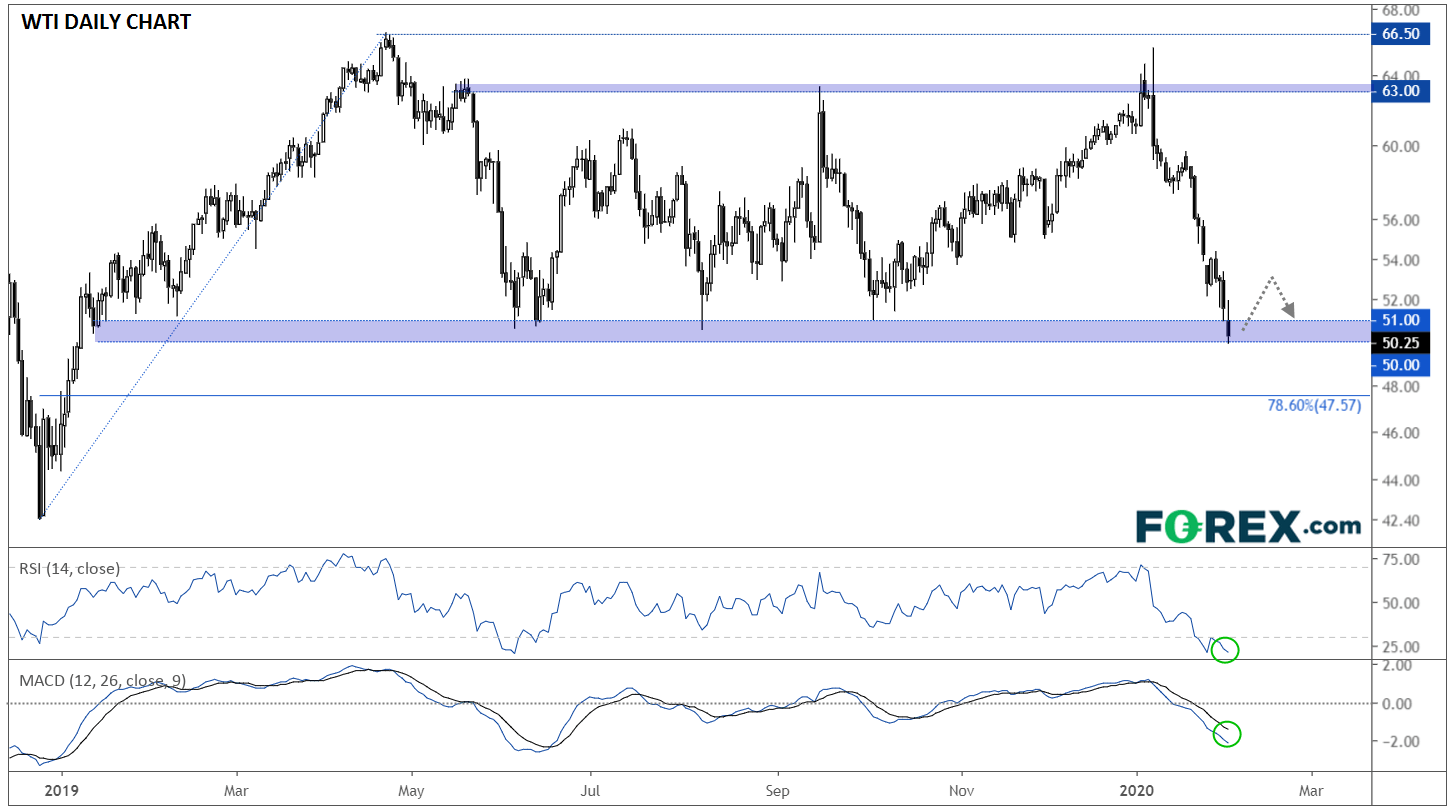
Over the past 12 months, the $50.00-51.00 corridor has provided support for prices, and with the RSI deeply in oversold territory as of writing, an oversold bounce from these levels cannot be ruled out. That said, until authorities can provably contain the spread of coronavirus, oil traders may look at any near-term rally as a “dead cat bounce” and look to re-enter short positions on any bounce toward the $53.00-54.00 area. Meanwhile, if oil is able to close below $50.00, the next logical level of support would be the 78.6% Fibonacci retracement of the H1 2019 rally near 47.50.

Author

Matt Weller, CFA, CMT

Matt Weller, CFA, CMT

Faraday Research

Matthew is a former Senior Market Analyst at Forex.com whose research is regularly quoted in The Wall Street Journal, Bloomberg and Reuters. Based in the US, Matthew provides live trading recommendations during US market hours, c


More from Matt Weller, CFA, CMT
Share:

Editor's Picks

GBP/USD stays firm near 1.3350 amid easing Mideast tensions

GBP/USD builds on Friday's modest bounce from a three-week low and gains strong follow-through positive traction at the start of a new week on Monday. This marks the second straight day of gains, with the major trading near 1.3350 in European trading amid a pause in the Middle East conflict and a broadly weaker US Dollar. Traders brace for the Fed and BoE policy announcements later in the week.

EUR/USD holds gains near 1.1400 as USD slips on Iran diplomacy hopes

EUR/USD holds sizeable gains near the 1.1400 mark in the European session on Monday. The intraday strength is sponsored by a broadly weaker US Dollar, weighed down by renewed optimism over a diplomatic resolution to end a five-month-old US-Iran war.

Gold stands firm on US-Iran diplomacy hopes, reduced Fed hike bets; bulls lack conviction
Gold (XAU/USD) continues with its struggle to capitalize on a modest gap-up opening beyond the $4,100 mark through the early European session on Monday as bulls seem hesitant ahead of the crucial FOMC meeting this week. Heading into the key central bank event, reviving hopes for a diplomatic resolution to end a five-month-old US-Iran war led to a steep fall in crude oil prices.
Cardano: Under pressure as bearish derivatives cap recovery

Cardano remains under pressure, trading lower at $0.165 on Monday after mild losses in the previous week. Weakening derivatives metrics and subdued momentum indicators suggest that ADA's upside move remains limited, keeping downside risks in focus. Derivatives data for Cardano shows bearish sentiment among traders.

Australian Dollar outlook: Chances of another rally won’t be decided in Canberra, but in Washington

The Australian Dollar rode a rollercoaster in the first half of the year, hitting a four-year high and then correcting. The currency enters the second half with an outlook full of uncertainty due to renewed hostilities in the Middle East, which clouds the inflation outlook and interest rates.

US Dollar mid-year outlook: Exceptional currency, exceptional risks?
The US Dollar enters the second half of 2026 in a markedly different position from a year ago. The King currency has recovered, reflecting persistent US inflation, changing expectations for Fed policy, geopolitical tensions and renewed demand for defensive assets.