Week ahead: Will good economic news be bad news for stocks?


It’s a big week for US earnings and economic data, the question for investors is whether renewed signs of economic strength is bad news for stock markets? Tech stocks had their worst day of the year on Friday, and the Nasdaq slumped more than 2%. Nvidia was down 10% and Netflix, which disappointed the market with lower-than-expected future earnings forecasts, slumped 9%, rounding off a bad week for the streaming giant. However, stock index futures in Europe and the US are higher as we start a new week.
Tech sell off not triggered by wider risk aversion
Traders sold growth stocks and headed to defensives last week, and the Magnificent 7 had their worst weekly performance since 2022 and are back at February levels. The driver of the sell off is not immediately clear. We do not believe that it is geopolitical. The dollar barely moved and backed away from recent highs at the end of last week. Added to this, the 10- year Treasury yield closed the week 2 basis points higher, as investors managed to absorb the geopolitical tensions in the Middle East with ease. We think that the sell off in the Nasdaq was down to 2 factors: some hesitation around earnings reports, and concerns about excessive valuations.
Tesla: A weak start to tech earnings season expected
Tesla reports earnings on Tuesday, after announcing that it was laying off 10% of its staff last week. This is an ominous sign ahead of the Q1 earnings report; however, a lot of bad news is expected. Analysts have cut their expectations for revenues and earnings from Tesla in the past 4 weeks, according to data from Bloomberg. Revenue estimates have been slashed by 9%, the market now expects quarterly revenue to come in at $22.30bn, net income is expected to be $1.79bn, this figure has fallen by nearly 20% in the past 4 weeks. Earnings per share is expected to be $0.52, which suggests meagre profit growth. There is a concern that EPS for Q1 could be lower than this after the surprise announcement of job cuts. Globally, electric vehicle demand is weakening, which may show up in Tesla’s earnings. A lot of bad news is already priced in to Tesla, its share price is lower by more than 40% YTD. Thus, the focus will be on the forecasts for future growth. If the share price is to recover, then Elon Musk will need to show the path to strong deliveries and a return to decent profit growth in the coming quarters.
Will AI deliver the goods?
Meta will report earnings on Wednesday, followed by Microsoft and Alphabet on Thursday. This week will be a key test for the market, which has lent on AI to drive the rally in stocks this year. But now it is crunch time, can AI deliver the goods? Will it drive strong profit growth at these tech giants? This is a busy week for US earnings reports, the market will also be wondering if we can expect to see a boost in profitability at companies outside of tech due to the effects of AI.
At this early stage, earnings season has had a mixed start. The magnitude of earnings surprises is currently above the 10 -year average, however, there have been some notable downward revisions to earnings estimates for some big names in healthcare, which is weighing on the earnings growth rate. So far, the 14% of companies on the S&P 500 that have released their earnings reports, have, as a whole, reported positive earnings growth YoY, for the third straight quarter, according to FactSet.
FTSE 100 highlights its defensive credentials
This has not boosted market sentiment. The S&P 500 fell more than 5% last week, the Nasdaq tanked and fell by nearly 7%. While most global indices recorded a weekly decline, the FTSE 100 was the most resilient global index, highlighting its defensive qualities that can perform well when volatility rises. The Vix index, Wall Street’s fear gauge rose again at the end of last week and is heading back towards the 20 level, however, we would note that for now this is a strong level of resistance.
Small caps led large caps on Friday
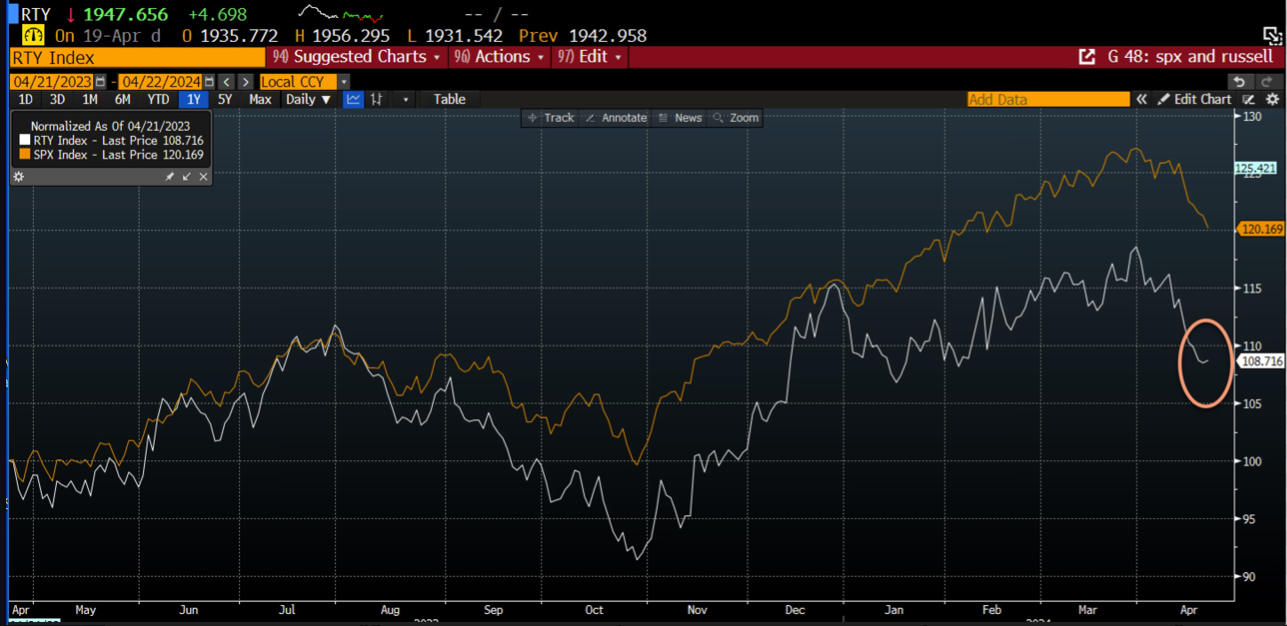
Interestingly, at the end of last week, the Russell 2000, the smaller cap US index, staged a mini recovery late on Friday. This suggests that the sell-off in tech stocks is down to fundamental factors, rather than geopolitics and external factors. Nervousness around earnings reports and high valuation levels drove some investors into smaller cap stocks at the end of last week. Whether or not that continues, could depend on the outcome of this week’s key earnings releases. As you can see in the chart below, the Russel 2000 rose on Friday, although US blue chips experienced a deep sell off. This could be a sign of a rotation into cheaper, smaller stocks, or a bit of contrarian optimism after a bruising week for risk sentiment.
Russel 2000 (white line) and S&P 500, normalized to show how they move together
Source: XTB and Bloomberg
US GDP could surprise on the upside
Economic data is also in focus this week as we won’t hear from the Fed as it is their blackout period ahead of their meeting on 1st May. The key releases include the first quarter GDP report for the US, economists are expecting a reading of 2.5%, down from the 3.4% rate in Q4 2023. Any upside surprise could be seen as making the Fed likely to defer rate cuts even further into the future, which may hurt risk sentiment. The latest estimate from the Atlanta Fed’s GDPNow model is 2.9%, thus US GDP could surprise on the upside for the first quarter. It’s also worth noting that the longer run pace of quarterly growth that doesn’t trigger inflation above the Fed’s 2% target is 1.8%. This suggests that the Q1 GDP report will reinforce the inflationary risks from the Fed cutting rates too quickly.
Will the core PCE really move the dial for markets?
The core PCE, the Fed’s preferred gauge of inflation, is released on Friday, and this is likely to get a lot of attention. The monthly rate is expected to come in at 0.3%, the annual rate is expected at 2.7%, down a touch from 2.8% in February. This figure gets a lot of attention, somewhat needlessly in our view, as the CPI tells us what we need to know about inflation: the disinflation trend is on pause and volatile energy prices are creating inflation. The market reaction to the March CPI report was brutal, we do not think that the PCE report will have the same effect, especially if it comes in at or close to consensus.
April PMI reports to give update on Q2 economic performance
Elsewhere, global preliminary PMI reports for April will also be released. These reports will be watched closely to see if they give us a steer on whether the pick up in the manufacturing sector has continued. In Europe, the Eurozone’s 1-year CPI expectations are released on Friday. The German IFO is released on Wednesday. In the UK, the Rightmove house prices, CBI total orders and selling prices for the industrial sector will be released for April on Monday. Public sector finances and the April PMI reports are released on Wednesday, followed by CBI retail sales and consumer confidence on Friday.
BoJ in focus as Yen remains in doldrums
In Japan, the market will focus on Tokyo CPI on Friday, this will be released ahead of the outcome of the BOJ meeting. No change is expected, but comments from BOJ officials will be monitored closely. The yen remains at low levels and although USD/JPY’s gains seem to be capped for now, this pair is still above 154.50. The market will be listening out for any talk about currency intervention, or whether the BOJ will speed up the pace of monetary tightening to try and temper the yen’s decline. This meeting has the potential to trigger volatility in the FX space this week and is one to watch.
Sentiment remains fragile
Overall, this is a week for assessing the fundamentals. Earnings reports will need to be immaculate to boost risk appetite, and any weakness may be punished by the market. However, the sell off on Friday was brutal, thus the selling pressure on global stocks may ease as we start a fresh week and stock index futures have risen slightly at the start of this week. However, sentiment is fragile, and strong economic data, particularly in the US, could derail any recovery.
Author
Kathleen Brooks
XTB UK
Kathleen has nearly 15 years’ experience working with some of the leading retail trading and investment companies in the City of London.