USD/JPY Price Forecast: Pullback could be seen as buying opportunity amid BoJ uncertainty
- USD/JPY drifts lower after verbal intervention from Japanese authorities on Friday.
- A modest USD pullback contributes to the slide, though the downside seems limited.
- The BoJ rate-hike uncertainty might cap the JPY ahead of Japan’s general election.


The USD/JPY pair meets with some supply on Friday and for now, seems to have snapped a two-day losing streak to its highest level since early August, around the 150.30 area touched the previous day. Spot prices slide below the 150.00 psychological mark during the early European session amid verbal intervention from Japanese authorities, though the uncertainty over the Bank of Japan's (BoJ) rate-hike plans should limit the downside.
Japan's top currency diplomat, Atsushi Mimura, warned against speculative trading and said that authorities are watching FX moves with a high sense of urgency. Furthermore, Deputy Chief Cabinet Secretary Kazuhiko Aoki noted that it is important for currencies to move in a stable manner reflecting economic fundamentals, fueling speculations about a possible government intervention to prop up the domestic currency.
Meanwhile, government data released earlier today showed that Japan's headline Consumer Price Index (CPI) decelerated from the 3% year-on-year (YoY) rate to 2.5% in September. Adding to this, Core CPI, which excludes volatile fresh food items, rose 2.4% from a year earlier. This marked a notable slowdown from 2.8% or a 10-month high recorded in August and was led by the rollout of temporary government subsidies to curb utility bills.
That said, the gauge stripping away the effects of fresh food and fuel, which is closely watched by the Bank of Japan (BoJ) as a better indicator of demand-driven price moves, edged up to the 2.1% YoY rate in September from 2.0% previous. This provides a headroom for the BoJ to keep raising interest rates. That said, a surprise opposition to further rate hikes from Japan's Prime Minister Shigeru Ishiba could hinder the BoJ’s policy normalization path.
Furthermore, expectations that the Federal Reserve (Fed) will proceed with modest rate cuts, bolstered by Thursday's upbeat US macro data, should limit the intraday US Dollar (USD) pullback from a two-and-half-month top. This might further lend support to the USD/JPY pair, warranting some caution for aggressive bearish traders. Investors now look to the US housing market data and Fed Governor Christopher Waller's speech for a fresh impetus.
Technical Outlook
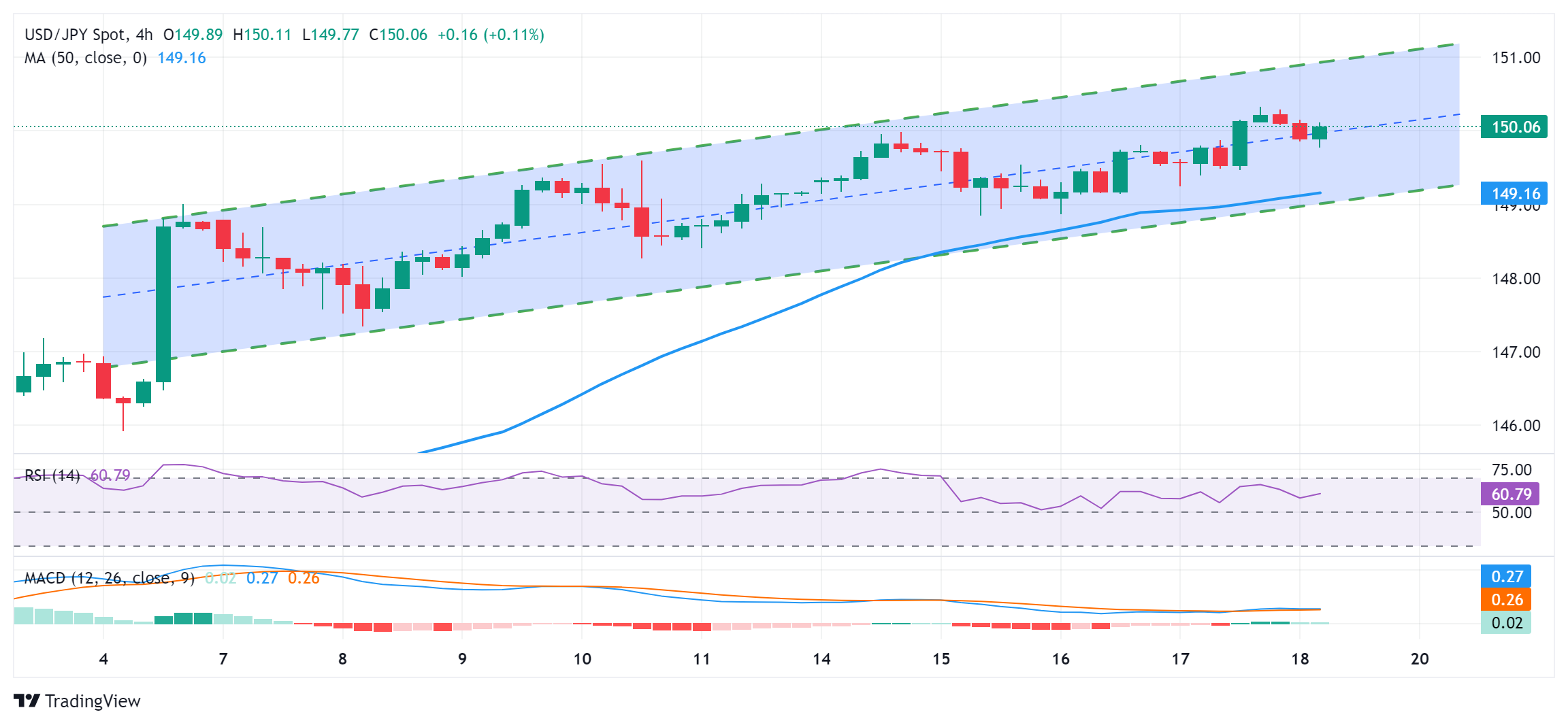
From a technical perspective, the recent move-up witnessed over the past two weeks or so, along an upward-sloping channel, points to a short-term bullish trend. Moreover, oscillators on the daily chart are holding comfortably in positive territory and are still away from being in the overbought zone. This, in turn, suggests that the path of least resistance for the USD/JPY pair is to the upside. Hence, any subsequent fall is more likely to attract fresh buyers near the 149.45-149.35 horizontal support and remain limited near the 149.00 mark, representing the lower boundary of the said channel. That said, a convincing break below the latter could make spot prices vulnerable to accelerate the corrective fall to the 148.60-148.55 region en route to the 148.00 mark and last week's swing low, around the 147.35-147.30 zone.
On the flip side, momentum above the monthly peak, around the 150.30 area touched on Thursday, could extend further towards the August swing high, around the 150.85-150.90 region. This said area nears the trend-channel resistance, which if cleared decisively will reinforce the near-term positive outlook for the USD/JPY pair and pave the way for a further appreciating move. Spot prices might then aim to reclaim the 152.00 mark and climb further towards the next relevant hurdle near the 152.70-152.75 region.
USD/JPY 4-hour chart
Premium
You have reached your limit of 3 free articles for this month.
Start your subscription and get access to all our original articles.
Author
Haresh Menghani
FXStreet
Haresh Menghani is a detail-oriented professional with 10+ years of extensive experience in analysing the global financial markets.

















