USD/JPY Forecast: Seems vulnerable amid hawkish BoJ talks, break below 100-day SMA awaited
- USD/JPY prolongs its downtrend for the third straight day and dives to a multi-week low.
- Bets for an imminent shift in the BoJ’s policy stance lift the JPY and exert heavy pressure.
- The uncertainty over the Fed’s rate-cut bets weighs on the USD and fails to lend support.

The USD/JPY pair remains under heavy selling pressure for the third successive day on Thursday and drops to a four-week low, around the 148.00 mark during the early European session. The Japanese Yen (JPY) gets a strong boost in the wake of bets that the Bank of Japan (BoJ) could exit the negative interest rates regime as soon as this month. On Wednesday, Jiji News Agency reported that some BoJ members are likely to say that removing negative interest rates is reasonable at the March meeting. Adding to this, BoJ board member Junko Nakagawa said on Thursday that Japan’s economy is moving steadily to sustainably achieve the 2% inflation target. Furthermore, BoJ Governor Kazuo Ueda said that the central bank will consider rolling back the massive stimulus programme once the positive cycle of wages and inflation is confirmed.
This comes on top of speculations that the ongoing annual wage negotiations will yield bumper pay hikes for the second year in a row, which could fuel demand-driven inflation. Moreover, the latest data from Japan showed that wage growth marked the highest increase since last June, while real wages recorded a smaller than estimated and the slowest drop in a year. This, in turn, bolsters the case for an imminent shift in the BoJ's policy stance. In contrast, the Federal Reserve (Fed) Chair Jerome Powell told lawmakers on Wednesday that the central bank will cut interest rates this year, though wants to see more evidence that inflation is falling to the 2% target. The comments reaffirmed bets for a June Fed rate cut, which continues to weigh on the US Dollar (USD) and turns out to be another factor exerting pressure on the USD/JPY pair.
Minneapolis Fed President Neel Kashkari downplayed speculations about more aggressive policy easing and said that he may reduce the number of cuts in 2024, to only one in the wake of the incoming stronger macro data. This, in turn, triggers a modest bounce in the US Treasury bond yields, though does little to inspire the USD bulls or lend any support to the USD/JPY pair. Apart from this, persistent geopolitical tensions could further benefit the JPY's relative safe-haven status and suggest that the path of least resistance for spot prices is to the downside. Traders now look to Fed Chair Powell's second day of testimony, which, along with the US Weekly Initial Jobless Claims and Trade Balance data, will influence the USD price dynamics. The market attention will then shift to the release of the US Nonfarm Payrolls (NFP) report on Friday.
Technical Outlook
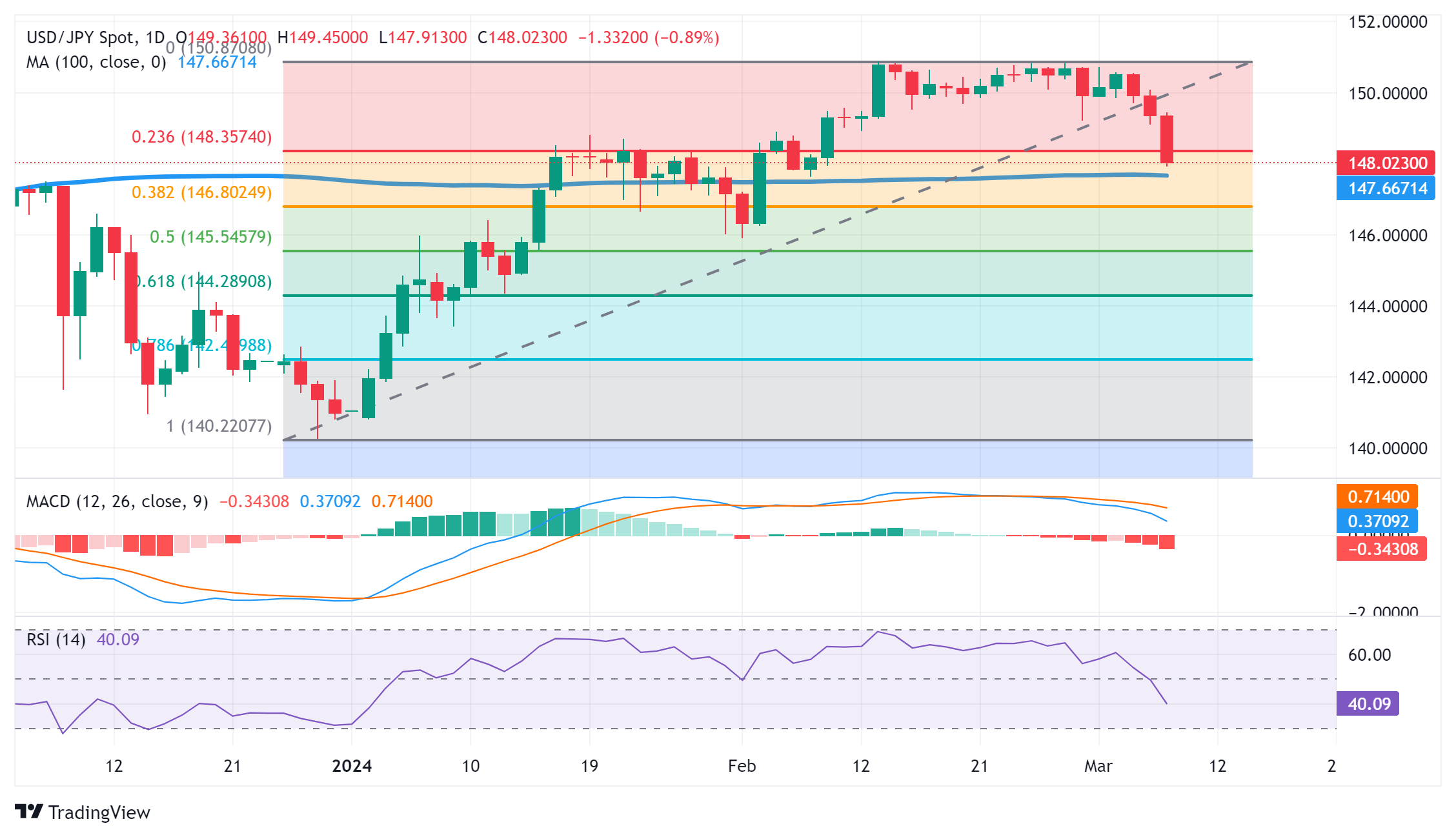
From a technical perspective, a convincing break below the 23.6% Fibonacci retracement level of the December-February rally could be seen as a fresh trigger for bearish traders. The downward trajectory, however, stalls near the 148.00 mark, just ahead of the 100-day Simple Moving Average (SMA), near the 147.80 region, which should now act as a key pivotal point. Given that oscillators on the daily chart are holding deep in the negative territory, some follow-through selling below the latter could make the USD/JPY pair vulnerable. The subsequent downfall could extend further towards the 147.00 mark en route to the 38.2% Fibo. level, around the 146.80-146.75 region.
On the flip side, the 148.35 zone, represents the 23.6% Fibo. support breakpoint, now seems to act as an immediate hurdle. Any further recovery beyond might be seen as a selling opportunity and runs the risk of fizzling out rather quickly near the 149.00 mark. That said, a sustained strength beyond the latter might trigger a short-covering rally and lift the USD/JPY pair to the 149.60-149.70 horizontal support-turned-resistance en route to the 150.00 psychological mark.
Author

Haresh Menghani
FXStreet
Haresh Menghani is a detail-oriented professional with 10+ years of extensive experience in analysing the global financial markets.