|

USD/JPY Analysis: Short-term neutral, bulls in the driver’s seat

USD/JPY Current Price: 108.60

  • The Japanese adjusted trade deficit resulted in ¥-97.2B in September.
  • US Treasury yields posted a modest intraday advance, so did equities.
  • USD/JPY retaining its short-term bullish stance, critical resistance at 109.31.
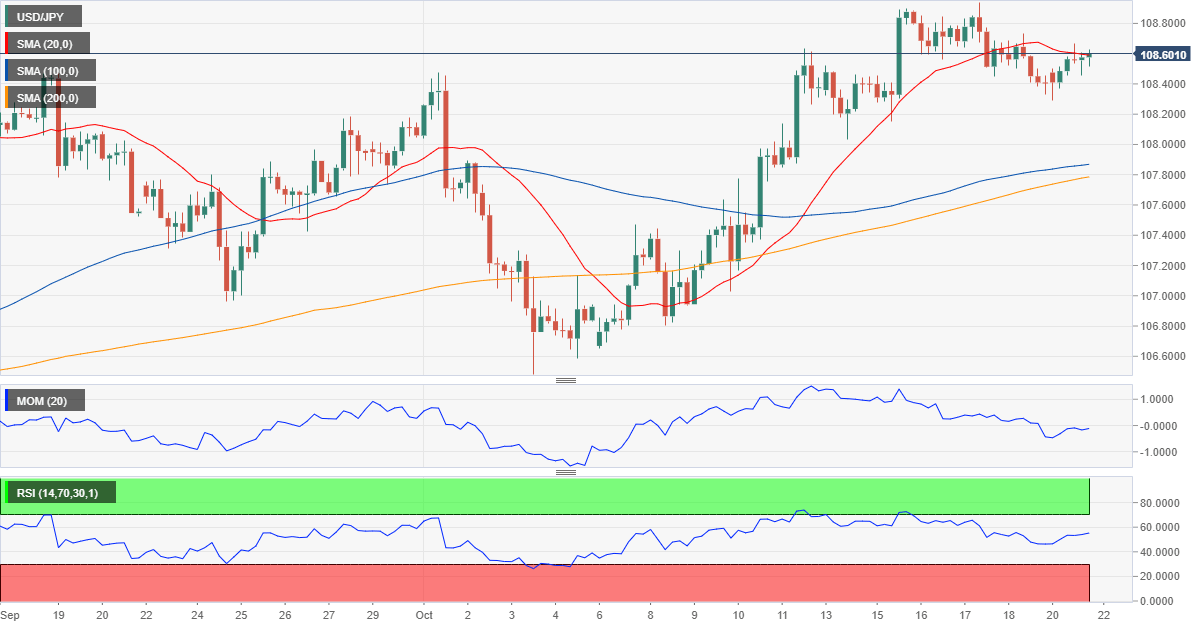
The USD/JPY pair settled around 108.60, recovering after a soft start to the day. The Japanese yen enjoyed some temporal demand at the beginning of the day, with the pair falling to 105.28, as concerns about Brexit developments favored the safe-haven currency. The dismal mood was short-lived but didn’t turn into a positive one. By the end of the day, equities closed with modest daily gains, while government bond yields ticked marginally higher, backing the pair’s recovery.

Japan published this Monday the September Merchandise Trade Balance, which posted a smaller-than-anticipated adjusted deficit of ¥-97.2B. In the same month, Imports declined by 1.5%, while exports slid 5.2%. It’s a bank holiday in Japan this Tuesday, which means no macroeconomic announcement will be made.

USD/JPY short-term technical outlook

The USD/JPY pair has bounced from around the 23.6% retracement of its latest daily advance, which indicates that bulls retain control of the pair. In the short-term, however, the 4-hour chart shows that it remained capped by a directionless 20 SMA, while technical indicators remain flat around their midlines, reflecting the ongoing wait-and-see stance. The bullish case remains alive, with buyers targeting 109.31, August monthly high.

Support levels: 108.25 108.00 107.75

Resistance levels: 108.65 109.00 109.35

View Live Chart for the USD/JPY

Author

Valeria Bednarik

Valeria Bednarik was born and lives in Buenos Aires, Argentina. Her passion for math and numbers pushed her into studying economics in her younger years.


More from Valeria Bednarik
Share:

Editor's Picks

AUD/USD climbs as Fed’s Williams push the brakes on rates

The Aussie Dollar registers a gain of over 0.34% against the US Dollar on Tuesday as news flows remain quiet, with US data coming mixed, while hostilities in the Middle East continue. The AUD/USD trades at 0.6983.

USD/JPY extends retreat below 158.50 as intervention risks loom

USD/JPY is dropping below 158.50 in the Asian session on Tuesday, snapping a two-day winning streak and pulling back from an over two-week top touched the previous day, despite Japan's soft PPI inflation print. Bulls turn cautious amid speculation that authorities will step in to prop up the Japanese Yen, which, in turn, weighs on the pair.

Gold: Bears struggle to breach below $4,150

Gold now gives away its initial gains and resumes its decline, revisiting the $4,160 region per troy ounce on Tuesday. The precious metal’s pullback comes despite the fresh downward trend in the Greenback in combination with a mixed performance of US Treasury yields across the board and easing tensions on the geopolitical front.

Ethereum holds $2,500 as open interest drops to lowest level since February
Ethereum (ETH) quickly bounced back above $2,500 on Tuesday after sharp Asian equity selloffs briefly spilled into the crypto market. South Korea's KOSPI declined 5.4% while Japan's Nikkei 225 dropped by 1.8%. The volatility spike bled into cryptocurrencies, triggering a cascade of forced liquidations.
S&P 500 earnings just hit a record. The AI data centre bill hasn't landed yet
S&P 500 companies are on track for a third straight quarter of earnings growth above 25%, according to FactSet. Their profit margin hit 17% in the April-June quarter, the highest in FactSet data going back to 2009. The cash behind those earnings has been shrinking for two years, and almost all of the shrinkage is in the handful of companies building data centres for artificial intelligence (AI).
Has Bitcoin really escaped the macro forces it was built to fight?
Over 17 years ago, Satoshi Nakamoto designed Bitcoin (BTC) on the back of a global financial crisis as an alternative to the global monetary system outside the control of central banks, governments and traditional intermediaries. This raises a key question: has Bitcoin really become independent of the macroeconomic forces it was built to challenge?















