USD/JPY Elliott Wave technical analysis [Video]
![USD/JPY Elliott Wave technical analysis [Video]](https://editorial.fxstreet.com/images/Markets/Currencies/Majors/USDJPY/forex-us-and-japanese-currency-pair-with-calculator-4564032_XtraLarge.jpg)

USD/JPY Elliott Wave technical analysis
Function: Trend.
Mode: Impulsive.
Structure: Black wave 5.
Position: Red wave 5.
Direction next higher degrees: Black wave 5 (started).
Details: Black wave 4 looking completed at 152.970. Now black wave 5 is in play. Wave Cancel invalid level: 152.970
The USD/JPY Elliott Wave Analysis for the Day Chart examines the market behavior of the U.S. Dollar against the Japanese Yen using Elliott Wave Theory to determine its trend, mode, and structure. This analysis provides insights into the current and upcoming wave patterns and highlights key levels to watch.
Function: The function of the current market pattern is "Trend," indicating that the structure represents a continuation of a directional movement rather than a correction or reversal. This trend function suggests that the market is in a strong and sustained movement.
Mode: The mode is described as "impulsive," indicating that the price action is characterized by sharp and strong movements in a specific direction. Impulsive waves generally consist of five sub-waves and are typically indicative of a clear trend.
Structure: The structure in play is the "black wave 5," which represents the final wave in an impulsive sequence. This usually leads to the culmination of the current trend and is often followed by a significant correction or reversal.
Position: The position within the structure is "red wave 5," which is a component of the broader black wave 5. This position indicates that the market is in the final stages of the current impulsive move, suggesting that a correction or change in trend could follow once this wave completes.
Direction next higher degrees: The direction for the next higher degrees is also "black wave 5," indicating that the broader trend is still active, suggesting that there's more upward potential within this final impulsive wave.
Details: The details section highlights that "black wave 4" was completed at 152.970, signaling the end of the corrective phase and the beginning of black wave 5. This wave is now in play, indicating that the final leg of the current trend has started. The Wave Cancel invalid level is also set at 152.970, implying that if the price falls below this level, the Elliott Wave structure might be invalidated, indicating a possible change in the trend's dynamics.
In summary, the USD/JPY Elliott Wave Analysis for the Day Chart suggests that the market is in the final stages of an impulsive trend (black wave 5), with "red wave 5" underway. The completion of "black wave 4" at 152.970 signals the start of the final impulsive phase, indicating that a correction or reversal could follow after black wave 5 completes. The Wave Cancel invalid level at 152.970 serves as a critical threshold for monitoring the validity of the current wave structure, guiding traders in their analysis and strategy.

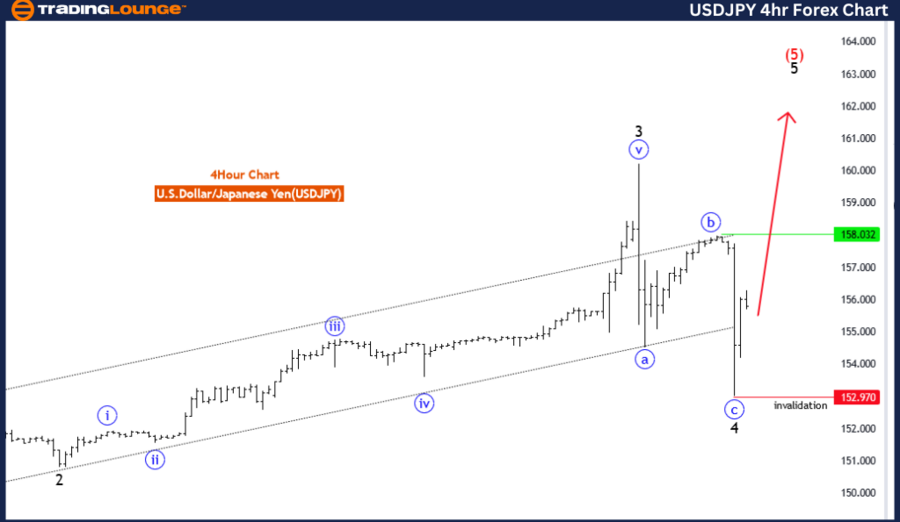
USD/JPY four-hour chart
FUNCTION: Trend
MODE:impulsive
STRUCTURE:black wave 5
POSITION: red wave 5
DIRECTION NEXT HIGHER DEGREES: black wave 5 ( started)
DETAILS black wave 4 looking completed at 152.970 . Now black wave 5 is in play. Wave Cancel invalid level: 152.970
The USD/JPY Elliott Wave Analysis for the 4 Hour Chart focuses on the U.S. Dollar's performance against the Japanese Yen. It uses Elliott Wave Theory to explain the current market structure and its expected direction, providing insights into potential trading opportunities and risks.
Function: The analysis indicates that the current market function is "Trend," suggesting that the structure represents a continuation of an existing trend rather than a correction or reversal. This trend function generally involves a sequence of impulsive waves, indicating a strong directional move.
Mode: The mode is classified as "impulsive," indicating that the price action is characterized by a rapid and significant movement, typically composed of five distinct waves within the Elliott Wave framework. This impulsive mode suggests a clear and strong trend direction.
Structure: The structure is identified as "black wave 5," indicating that the current wave is the final wave of an impulsive sequence. This typically leads to a more significant correction or a change in trend direction after it completes.
Position: The position is described as "red wave 5," which is part of the larger black wave 5, suggesting that the market is in the final stages of the broader impulsive trend. This position indicates a potential end to the current upward trend, with a subsequent correction or reversal expected.
Direction for the next higher degrees: The direction for the next higher degrees is also "black wave 5," indicating that the broader trend is still underway, suggesting more room for upward movement.
Details: In the details section, it is noted that "black wave 4" was completed at 152.970, indicating that the corrective phase has ended, and the final black wave 5 is now in play. The Wave Cancel invalid level is also set at 152.970, meaning that if the price crosses this level, the current Elliott Wave structure could be invalidated, suggesting a change in trend dynamics.
In summary, the USD/JPY Elliott Wave Analysis for the 4 Hour Chart suggests that the market is in the final stages of an impulsive trend (black wave 5), with "red wave 5" underway. The black wave 4 was completed at 152.970, signaling the end of the correction and the beginning of the final impulsive phase. The Wave Cancel invalid level is also set at 152.970, serving as a critical threshold for monitoring the validity of the current Elliott Wave structure. This analysis can help traders understand the current trend and anticipate potential market changes.
USD/JPY Elliott Wave technical analysis [Video]
Author
Peter Mathers
TradingLounge
Peter Mathers started actively trading in 1982. He began his career at Hoei and Shoin, a Japanese futures trading company.

















