US October Retail Sales Preview: US Dollar unlikely to find reprieve
- Retail Sales in the US are expected to rise by 1% following a stagnant September.
- Risk perception is likely to continue to drive the US Dollar's (USD) valuation.
- Market participants will pay close attention to the Q3 earnings reports of big retailers.

Retail Sales in the United States (US) are forecast to rise by 1% in October after staying unchanged at $684 billion in September. The US Dollar (USD) has been struggling to find demand following the softer-than-expected Consumer Price Index (CPI) figures for October and the Retail Sales report is unlikely to impact the USD’s valuation in a meaningful way.
According to the CME Group FedWatch Tool, the probability of a smaller, 50 basis points (bps), Federal Reserve rate increase in December stands at 80%, up significantly from 50% before the October inflation report. Although some FOMC policymakers urged markets not to get ahead of themselves by pricing in a less aggressive tightening outlook, the sharp decline witnessed in the US Dollar Index showed that investors had been looking for an opportunity to unwind crowded Dollar longs.
Market implications
Since the US Census Bureau’s Retail Sales data is not adjusted for price changes, it will not offer an accurate picture of consumer activity. Nevertheless, an unexpected decline in Retail Sales could trigger a “bad news is good news” reaction in financial markets as it would point to a slowdown in consumer demand, which the Fed has been trying hard to achieve by hiking rates. In that scenario, risk flows could continue to dominate the markets and make it difficult for the US Dollar (USD) to hold its ground against its risk-sensitive rivals, such as the Euro (EUR) and the Pound Sterling (GBP).
On the other hand, better-than-expected growth in sales could help the USD stage a recovery. However, a USD-positive market reaction should remain short-lived unless there is a noticeable negative shift in risk sentiment.
It’s worth noting that several big retailers in the US are scheduled to report third-quarter earnings this week. Investors are likely to pay closer attention to these numbers rather than the Retail Sales report.
At the time of press, Walmart's shares were up nearly 5% on the day after the retail giant announced that it expects sales in the US to increase by 5.5% in fiscal 2023, compared to 4.5% in the previous earning report. Lowe’s, Target and TJX Companies will release earnings figures on Wednesday. Macy’s, Kohls, Ross Stores and Gap will report on Thursday before Foot Locker and Buckle Inc. wrap up the week.
To summarize, October Retail Sales report should do little to nothing to influence the market pricing of the Fed’s rate. Hence, overall risk perception should continue to drive the US Dollar’s action in the short term. In case Wall Street’s main indexes remain bullish in the second half of the week with big retailers reporting better-than-forecast earnings, the USD could have a hard time staging a rebound.
US Dollar Index technical outlook
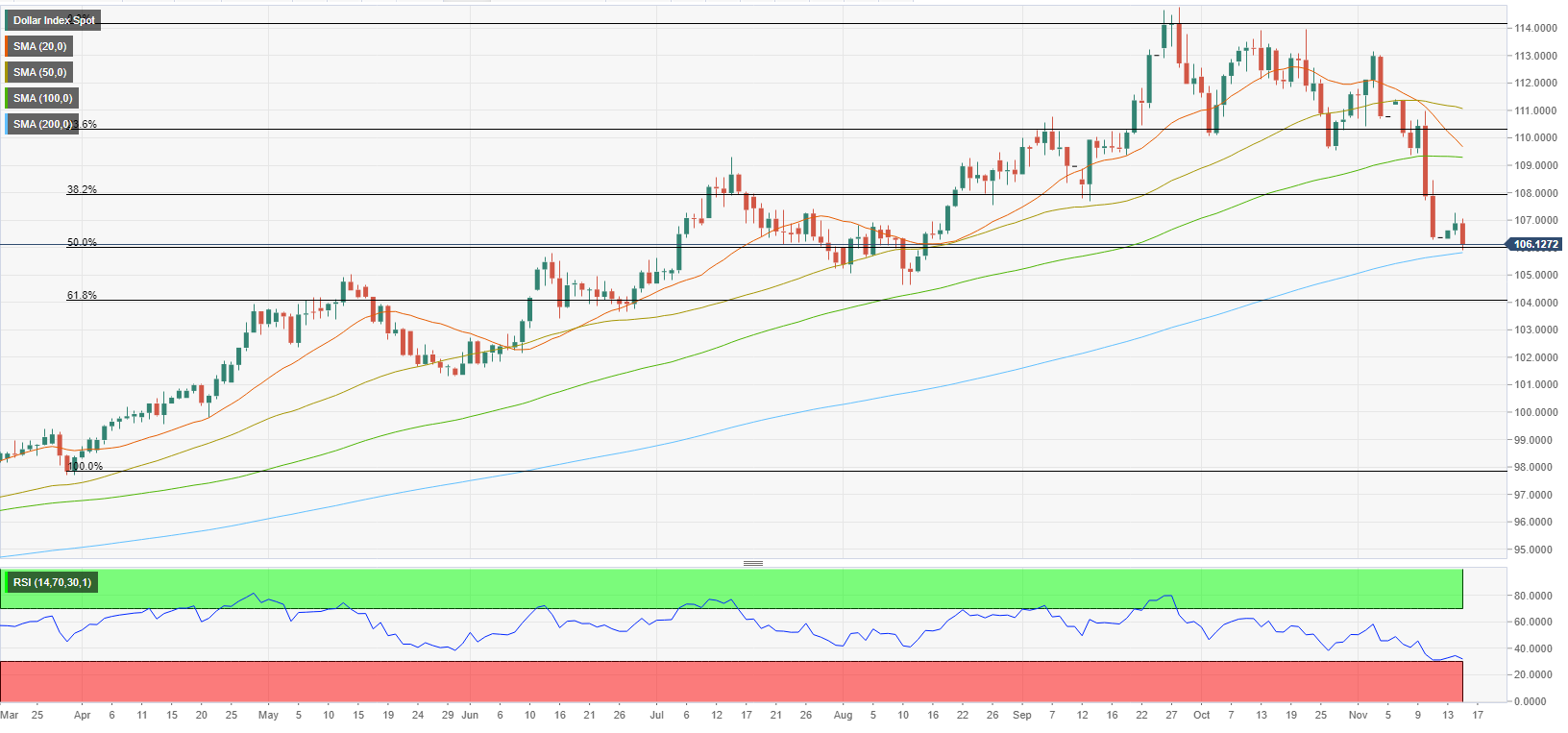
US Dollar Index trades within a touching distance of 106.00. The 200-day Simple Moving Average (SMA) and the Fibonacci 50% retracement of the March-October uptrend reinforce that support. In case the index drops below that level and fails to reclaim it, it could target 105.00 (psychological level) and 104.00 (Fibonacci 61.8% retracement) next.
On the upside, interim resistance seems to have formed at 107.00 (static level) ahead of 108.00 (Fibonacci 38.2% retracement). With a daily close above the latter, the index could extend its recovery toward 109.00, where the 100-day SMA is located.
In the meantime, the Relative Strength Index (RSI) indicator on the daily chart stays near 30, suggesting that there could be a technical correction before the next leg lower.
Author

Eren Sengezer
FXStreet
As an economist at heart, Eren Sengezer specializes in the assessment of the short-term and long-term impacts of macroeconomic data, central bank policies and political developments on financial assets.

















