US Non-Manufacturing PMI July Preview: Second thoughts on the US economy
- Services activity predicted to moderate in July after sharp June recovery.
- Manufacturing PMI, new orders surpass forecasts in July, employment lags.
- Second wave Covid cases had little impact on manufacturing PMI.
- Minimal market effect anticipated with payrolls awaited on Friday.

Activity in the dominant US services sector is forecast to moderate as the second wave of Covid cases in the South and West had forced some states to restrict their reopening programs in July.
The purchasing managers’ index from the Institute for Supply Management (ISM) is expected to slip to 55 from June’s unexpectedly strong score—50.1 had been forecast-- of 57.1. Sentiment last month nearly matched the pre-pandemic level in February of 57.3.
New orders are projected to rise to 64.7 in July from 61.6 in June which was the highest reading since February’s 63.1 and the second best outlook in a year.
Employment is forecast to climb into expansion at 51.1 from 43.1 in June. The prices paid index is expected to be 64 in July up from 62.4 the previous month.
Manufacturing PMI
The projected negative effects of the second wave in the July PMI indexes, except possibly in employment, never materialized.
The overall gauge was forecast to rise from 52.6 in June to 53.6 in July. It came in at 54.2. The forward looking new orders index soared to 61.5 from 56.4 in June, for the highest score since September 2018. It had been predicted to drop to 46.8.
Manufacturing new orders index
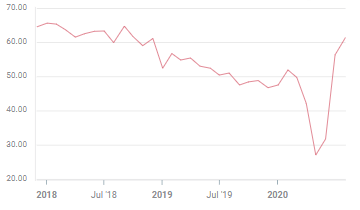
Only the employment index at 44.3, though an improvement from June’s 42.1, missed its 48.3 forecast and remained in contraction.
Retail sales and PCE
The June results for the two main consumption statistics were better than forecast. Retail sales in May and June more than covered the losses in March and April and the wider personal spending (personal consumption expenditures, PCE) data replaced 72.3% of the pandemic declines.
July’s results may or may not confirm the second wave thesis. Sales will be reported on August 14 and personal spending information on August 28.
Home sales
Sales of existing homes rose 20.7% in July, a bit less than the 24.8% forecast and new home sales jumped 13.8%, almost four times the 3.5% forecast. Though home purchases were helped by some of the lowest mortgage rates on record and a rebound from the March and April near halt in purchases, neither category showed any reluctance by buyers.
Fed manufacturing surveys
Survey indexes for regional manufacturing from the New York, Richmond and Kansas City Federal Reserve banks rose sharply and only the Philadelphia index had a small decline, though it was better than forecast.
New York Fed manufacturing survey

Consumer confidence
Consumer sentiment in the Michigan consumer sentiment survey registered a drop in July. The index slipped to 72.5 from 78.1 in June.
Michigan index

Conclusion and markets
The performance of the July manufacturing PMI is the strongest indicator that the service sector outlook will be untouched by the supposed negative impact of the second wave of the Covid pandemic. That implication is backed by the strong housing sales and Fed manufacturing surveys which showed no drop in consumer or manufacturing activity but countered by the notable decline in consumer sentiment.
Currency markets have sold the US dollar to per-pandemic levels over the last three weeks largely on anticipated economic weakness. That stance is unlikely to change until the July non-farm results on Friday, though a stronger than forecast services PMI will probably spur some serious second thoughts.
Author

Joseph Trevisani
FXStreet
Joseph Trevisani began his thirty-year career in the financial markets at Credit Suisse in New York and Singapore where he worked for 12 years as an interbank currency trader and trading desk manager.
















