US Michigan Consumer Sentiment June Preview: Optimism and how to get it
- Consumer sentiment forecast to edge higher in June.
- Retail sales may require rising consumer outlook before recovering.
- Dollar weaker on continuing risk abatement momentum.

Consumer sentiment and spending are the crucial factors in restoring the health of the US economy.
If consumption resumes at a rapid pace, even though it will be lower than in previous quarters, many small business may gain enough of a cash infusion to remain open and rehire workers.
After two months and more of partial or complete lockdown there is a large amount of deferred individual and household consumption that could assist the recovery. Consumers need to feel that the worst of the viral outbreak and the economic paralysis is over before they return to the malls and stores. Despite the rise of on-line shopping the bulk of US consumer spending still take place in person.
Michigan consumer sentiment and the labor market
The preliminary Michigan consumer sentiment index is forecast to rise 75 in June from May’s 72.3 reading. The index for current conditions is expected to climb to 85 from 82.3 and the expectations gauge may increase to 70 from 65.9.
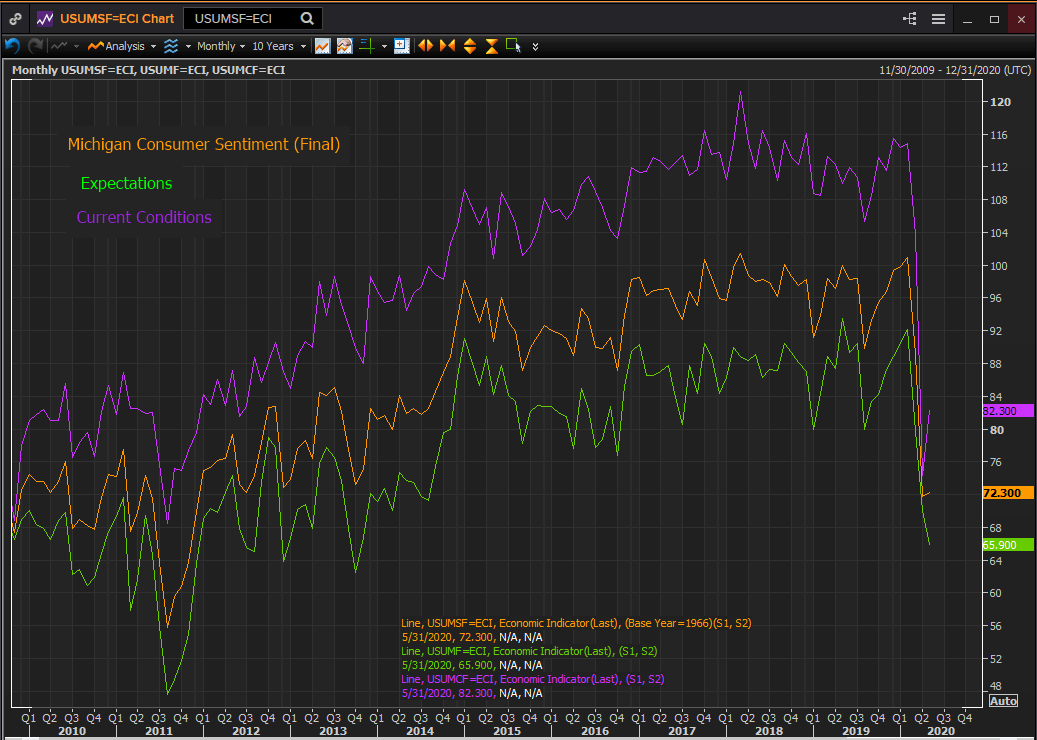
Americans are generally an optimistic group and it was consumer spending that kept the economy rolling in 2018 and 2019 as the China trade dispute took an ever larger bite out of business spending until it virtually ceased in the second half of last year.
Sentiment remained at or near its highest levels since the recession and financial crisis until March, supported by the best labor market and lowest unemployment rates in half century.
The ability and ease of finding employment is probably the most important component of consumer satisfaction. Following the firing of upwards of 40 million people in the last three months and loss of 20 million jobs from the April payrolls, the March and April decline in sentiment was among the steepest in the 68 year track of the series.
The rehabilitation in outlook to levels that foster normal levels of consumer spending may require a more substantial recovery in the labor market than the 2.5 million workers, 12% of the April losses, who were hired or rehired in May.
Sentiment and retail sales
Sales in May are expected to rise 7% when reported this coming Tuesday. If accurate that would be less than half the 16.4% crash in April.
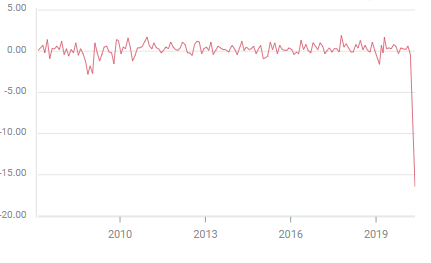
Likewise the control group category that enters the Bureau of Economic Analysis GDP calculation is forecast to rise 3.8% after tumbling 15.3% in April. Neither prediction is evidence of a resurgent consumer.
Conclusion and the dollar
The damage to the American economy, the labor market and consumer sentiment from the pandemic public health measures, what Federal Reserve Chairman Powell called,” the biggest economic shock to the US and the world in living memory,” is unlikely to dissipate until there is solid indication that jobs are returning. If that occurs then all else may follow.
Although the May payrolls report was, again in Chairman Powell’s words, “probably the biggest surprise anyone can remember’” one month is not enough to allay the fears and restore economic confidence.
What is true for the consumer also applies to the US dollar, both await the arrival of a positive new narrative. Their immediate fates are, in fact, identical.
Author

Joseph Trevisani
FXStreet
Joseph Trevisani began his thirty-year career in the financial markets at Credit Suisse in New York and Singapore where he worked for 12 years as an interbank currency trader and trading desk manager.