|

US Dollar Index outlook: Dollar Index in defensive after a double upside rejection

US Dollar Index

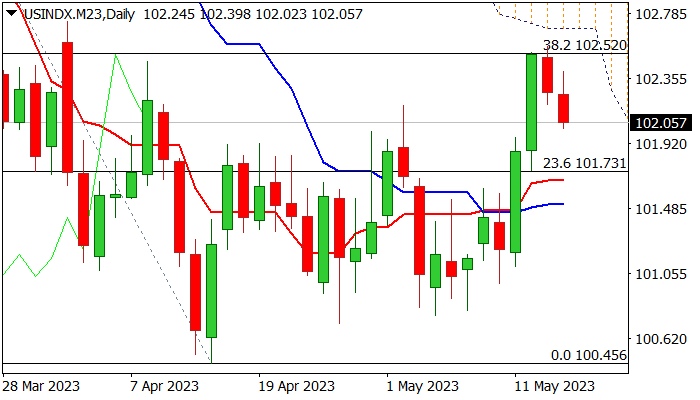
The dollar dipped further on Tuesday morning, extending pullback into second consecutive day after bulls repeatedly failed to break through pivotal Fibo support at 102.52 (38.2% of 105.85/100.45 downleg).

Upside rejection formed a double-top and signals a bull-trap, which adds to the downside pressure.

Conflicting signals on daily chart (strong bullish momentum, overbought stochastic and MA’s in mixed setup) require caution as last week’s strong recovery stalled at a breakpoint zone, also weighed by the nearby base of falling and thickening daily Ichimoku cloud (102.68).

The action failed to violate these barriers and generate fresh bullish signals for further gains, as subsequent pullback shifts near-term risk to the downside, although hopes that bulls may regain ground would be still alive if dips stay above 101.70 (broken Fibo 23.6% / daily Tenkan-sen).

Near-term action remains weighed by uncertainty over debt ceiling crisis, as President Biden was optimistic, while Republicans say that two sides are still far from reaching a deal, ahead of the expected meeting later today.

Res: 102.52; 102.68; 103.15; 103.26.
Sup: 101.91; 101.70; 101.52; 101.09.
Dollar Index

Author

Slobodan Drvenica

Slobodan Drvenica

Windsor Brokers

Industry veteran with over 22 years’ experience, Slobodan Drvenica joined Windsor Brokers in 1995 when he was an active trader for more than 10 years, managing the trading desk and own account departments.


More from Slobodan Drvenica
Share:

Editor's Picks

AUD/USD keeps the red near 0.6950 after weak Aussie jobs data

AUD/USD holds losses near 0.6950 on disappointing Australian jobs data, extending the previous day's retracement slide from the monthly high and hitting a fresh weekly low during Thursday’s Asian session. Meanwhile, declining US bond yields drag the US Dollar away from the April 2025 high, touched after Wednesday's hot US CPI, helping limit losses for the currency pair.

USD/JPY slides back below 158.00 as USD reverses post-CPI gains

USD/JPY extends the previous day's pullback from a three-week high, attracting follow-through selling and sliding below 158.00 during Thursday's Asian session. Traders remain on high alert amid speculation that authorities will step in to prop up the Japanese Yen. The US Dollar, meanwhile, reverses Wednesday's hot CPI-led gains to April 2025 highs as US bond yields retreat on China bond-buying talk, further pressuring the pair.

Gold: Upside remains capped by $4,200

Gold regains the smile and leaves behind three consecutive days of losses, advancing to the $4,170 region per troy ounce on Thursday. The precious metal’s recovery comes amid the fresh offered stance in the Greenback and declining US Treasury yields while investors remain cautious ahead of the Fed’s Warsh speech on Friday.

Bitcoin rebounds to $82,000 as PPI hits 6.3%, nearly $1B liquidated
Bitcoin (BTC) recovered near $82,000 on Thursday after briefly falling below $80,000, paring losses triggered by hotter-than-expected US inflation data. September PPI inflation rose 6.3% YoY, exceeding forecasts of 5.3% and marking its second-highest level since November 2022. Core PPI inflation climbed to 5% annually, above expectations of 4.4%.
Budget preview: Is Healey impressing the bond market?

There is less than 2 weeks to go before the Chancellor delivers his first budget. Unusually for the UK, the economic and financial backdrop to this budget is upbeat. UK bonds have been rallying, the FTSE 100 is the top performing major stock index this week, and the Pound is also stabilising versus the Dollar.

Everyone's dumping Gold after hot US inflation. Here's why $4,100 could be a floor, not a cliff
Gold (XAU/USD) is recovering from a sharp sell-off triggered by hotter-than-expected United States (US) inflation data released on Wednesday. The precious metal briefly plunged toward $4,073 as investors increased their bets on further Federal Reserve (Fed) interest rate hikes before recovering as US Treasury yields and the US Dollar (USD) reversed their initial gains.















