US Conference Board Consumer Confidence January Preview: Now who's happy, We're all happy
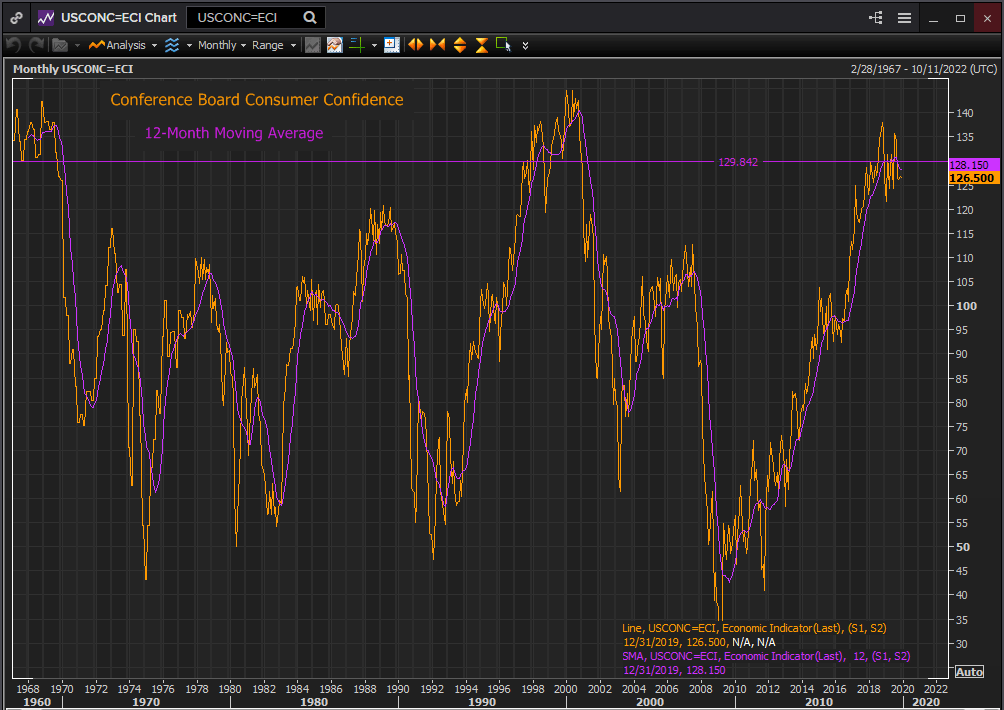
- Consumer confidence remains healthy and spending strong.
- Michigan sentiment has rebounded to near post-recession high.
- Job creation, wages and historically low unemployment support outlook.

The Conference Board, a private non-profit business organization, will issue its January Consumer Confidence index on Tuesday January 28th at 15:00 GMT, 10:00 EST.
Forecast
The Conference Board Consumer Confidence Index is expected to rise to 128.0 in January from 126.5 in December. The Present Situation Index was 170.0 in December and 166.6 in November. The Expectations Index was 97.4 in December and 100.3 in November.
Reuters
US labor market and consumer confidence
Nothing is more important to consumer outlook than employment and wages. To paraphrase William Faulkner, ‘Work is the only thing a man can do for eight hours a day’ *.
The US economy has created jobs for the longest stretch on record. Unemployment is at a five decade low and has averaged less than 4% for almost two years. In spite of the odd weak month and the decline in the monthly totals in 2019, new hires remain far ahead of underlying growth in the labor force. Wages, as a consequence, have advanced at 3% or better for 14 month to November. Last month wages gains dropped to 2.9%.
Initial jobless claims, one of the most reliable indicators of incipient trouble in the labor economy, had a four-week moving average of 213,250 in the latest reporting week (January 16th). Like unemployment this is also a nearly 50 year low. The rise in the final week of December to 233,500 has completely reversed.
The consumer economy
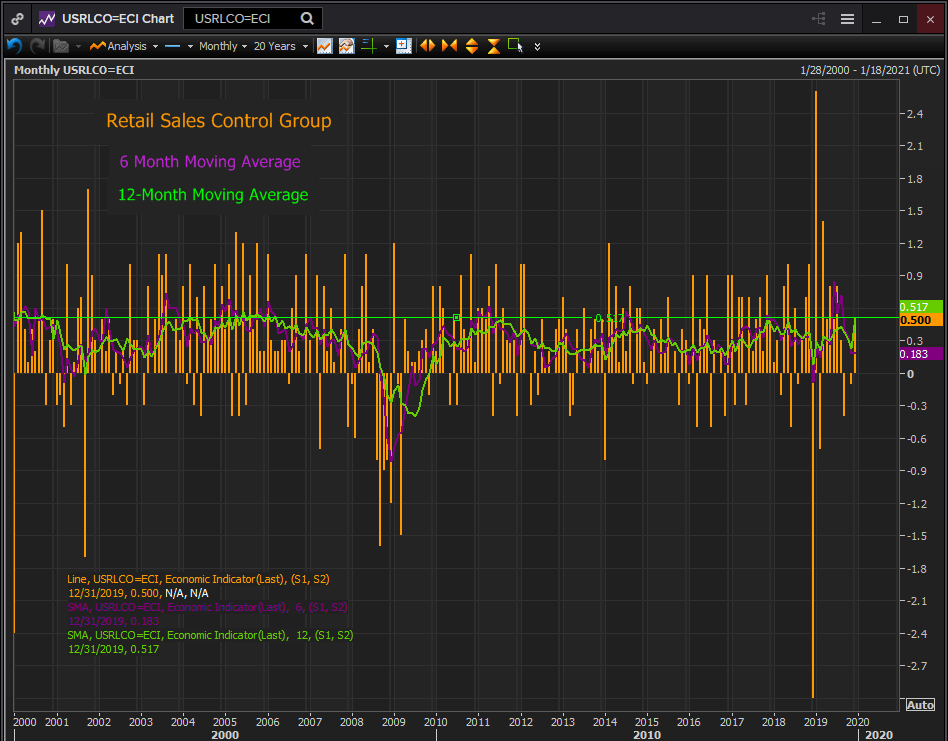
The retail sales control group, the Bureau of Economic Analysis’ GDP consumption component, has averaged a 0.517% increase over the last 12 months. That is the strongest year for consumption since March 2006.
Reuters
Whatever the tenor of the US electorate on other topics, consumers, as might be expected, are spending at a rate that reflects the realities of the excellent labor market and compensation.
Conclusion: the Fed and the dollar
The Fed’s three rate cuts were intended to reinforce the US economy against the threats of the trade dispute with China, Brexit and slowing global growth. Specifically, the governors wanted to insure that the benefits of job creation and the tight labor market continued to flow to the economy and to the areas of labor forces that had been ignored in previous expansions.
Consumer sentiment, though it is not a measure that the Fed normally mentions directly, is one of the key indicators of the success of Fed policy. If the consumer is working and pleased, the US economy, which is 70% or more consumption, will grow and prosper. Even with the current near recession in business investment, the US has managed a 2.07% growth rate over the last three quarters (Q2 2.0%, Q3 2.1%, Q4 estimated 2.1%).
The US economy will be, for the next few months, the main focus for comparison and rate policy. Consumer sentiment is a crucial component that, though it is not usually a traded indicator, helps set the background for the markets and the US dollar.
*Mr. Faulkner’s actual quote gives a slightly different cast. “It's a shame that the only thing a man can do for eight hours a day is work. He can't eat for eight hours; he can't drink for eight hours; he can't make love for eight hours. The only thing a man can do for eight hours is work. ” Mr. Faulkner who was one of America’s most prolific authors, did not elaborate on his denied preference.
Author

Joseph Trevisani
FXStreet
Joseph Trevisani began his thirty-year career in the financial markets at Credit Suisse in New York and Singapore where he worked for 12 years as an interbank currency trader and trading desk manager.

















