Uranus in Taurus; Bankers go bonkers

Mamas, don’t let your children grow up to be cowboys.
Don’t let them pick guitars or drive them old trucks.
Let ‘em be doctors and lawyers and such…
‘Cos they’ll never stay home and they’re always alone
Even with someone they love.
- Waylon Jennings, duet with Willie Nelson, originally by Ed and Patsy Bruce. “Waylon and Willie” album, 1978
One of the correlations I have uncovered in my years of researching Mundane and Financial Astrology as it relates to human activity, is that Uranus in a sign points to a sector of the economy that undergoes a boom and bust.
In its 84-year orbit around the Sun, Uranus spends about 7 years in each sign. Each sign rules a particular segment of the economy, or market sector. Aquarius, for example, rules technology. When Uranus made its seven-year journey through Aquarius, 1995-2003, the tech-heavy NASDAQ index soared to record highs – and then collapsed dramatically. That is, Uranus first entered Aquarius on April 1, 1995. It lasted only two months before retrograding back into Capricorn, June 9, 1995 through January 12, 1996. It stayed in Aquarius until March 10, 2003, when it briefly entered Pisces for six months (until September 15, 2003), before retrograding back into Aquarius, until it finally exited for good on December 30, 2003. Thus, it would be correct to state that Uranus was fully in Aquarius January 12, 1996, through March 10, 2003. It would also be correct to state that Uranus was mostly in Aquarius from April 1, 1995 through December 30, 2003. For our purposes of demonstrating the boom/bust nature of Uranus in a sector of the economy (or stock market) that is ruled by the sign Uranus is in, it doesn’t matter which beginning and end date is used. In either case, that market sector will explode to a peak, and then collapse, usually when Uranus is in the seven-year segment where it does not retrograde back and forth between signs.
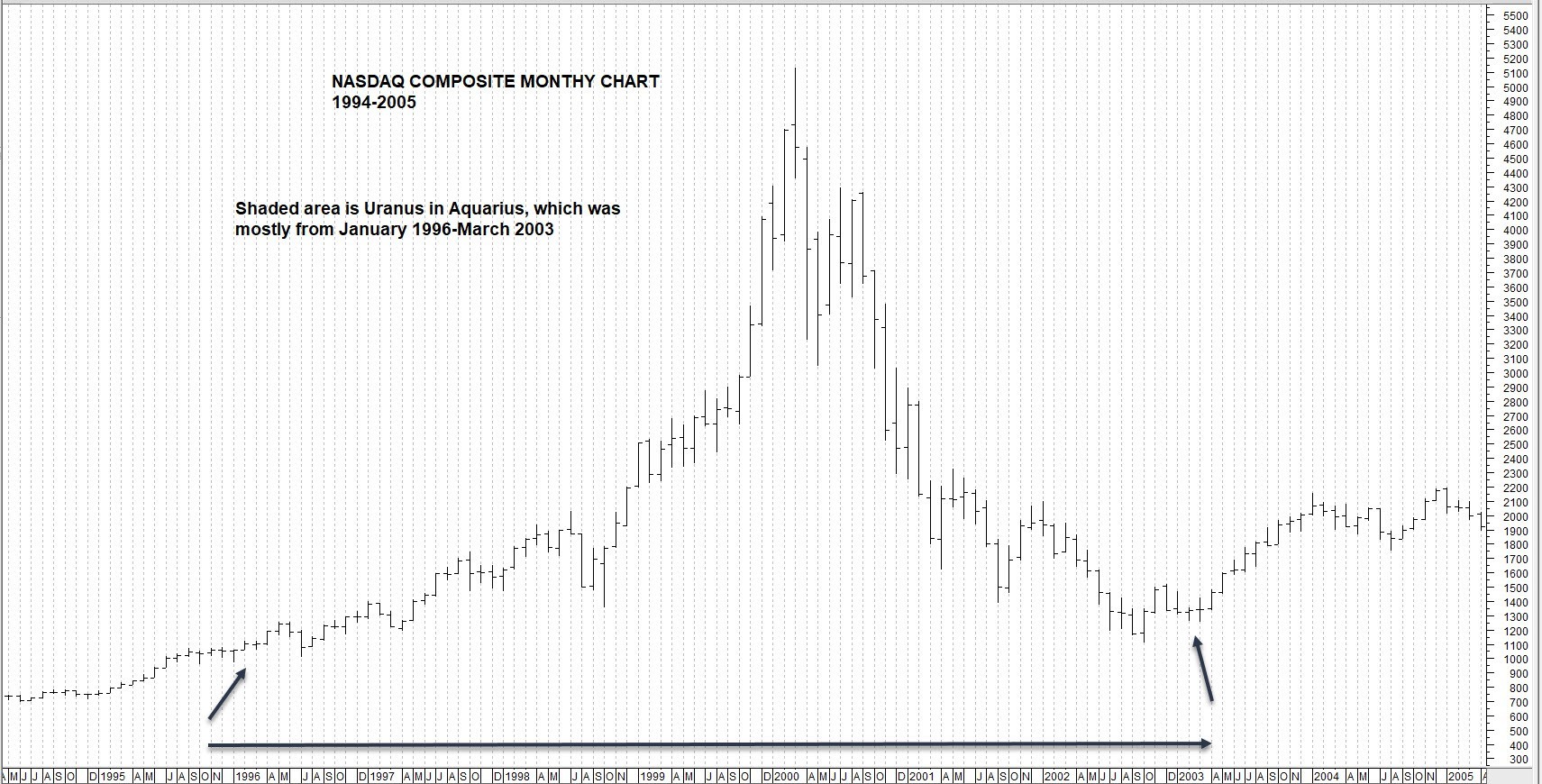
If we start with January 1996, the NASDAQ had a low of 969.95 that month. In the next 4 years, it exploded to a new all-time high of 5132.52 in March 2000, a gain of 429%. Not a bad return for a 4-year investment – if you were able to get in at the low in January 1996 and out at the top in March 2000. However, over the following 2-½ years, the bubble burst, and the NASDAQ collapsed 78.4%, plunging all the way down to 1108.49 in October 2002. Uranus was still in Pisces. Thus, the boom and bust characteristic of Uranus in the tech-related sign of Aquarius was very much evident.
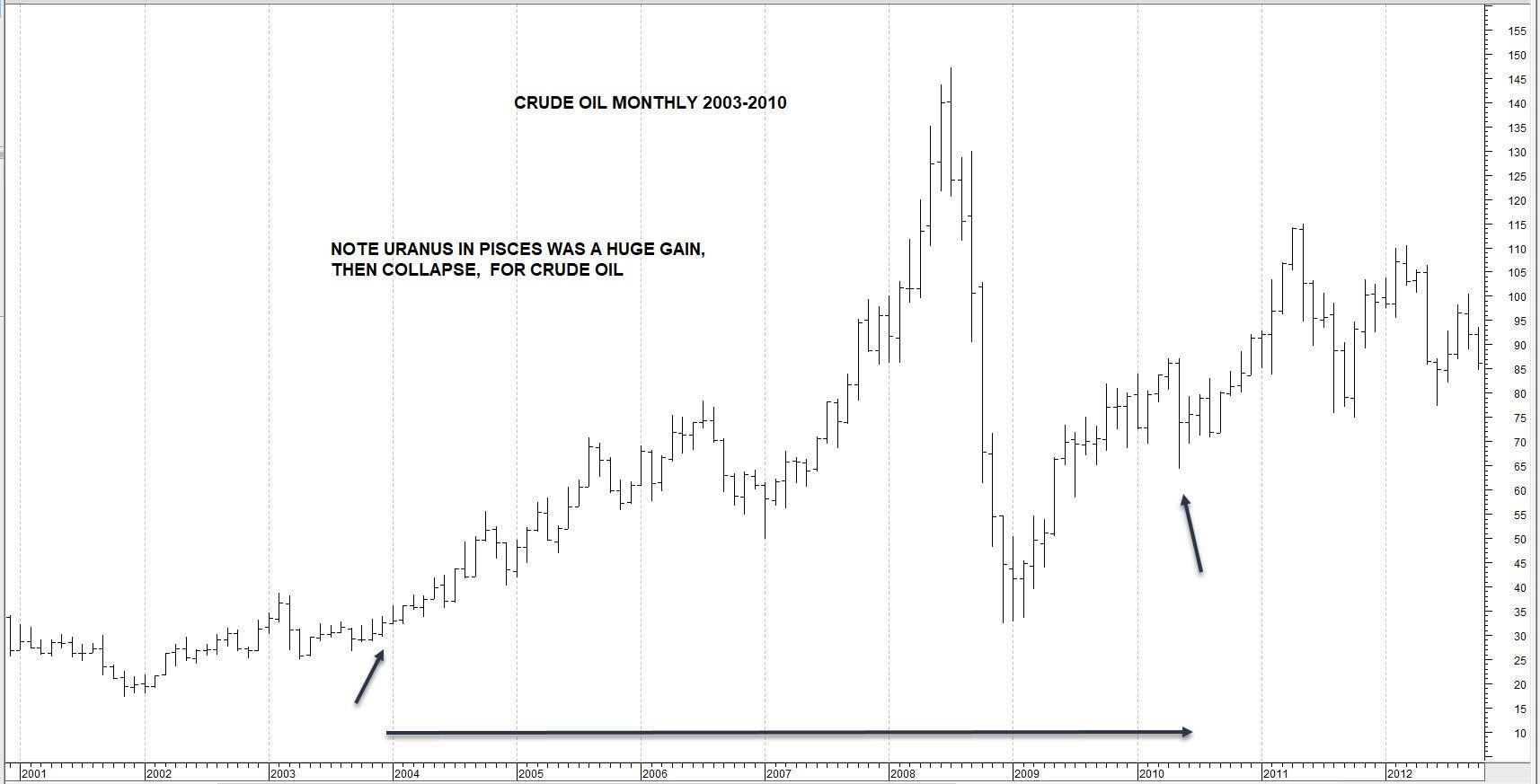
The same pattern can be observed when Uranus next moved into Pisces. The uninterrupted portion of that transit was in force December 30, 2003 through May 28, 2010. Pisces rules crude oil. In December 2003, crude oil’s low was $29.66/barrel. By July 2008, it skyrocketed to an all-time high of 147.27, a price appreciation of nearly 400% (similar to the gain in the NASDAQ between the time Uranus fully entered Aquarius, and its peak in price during that transit). However, in the next five months, while Uranus was still in Pisces, crude oil collapsed to 32.48, a loss in value from the peak of 78% - almost the same percent of loss as the NASDAQ’s decline in 2000-2002.
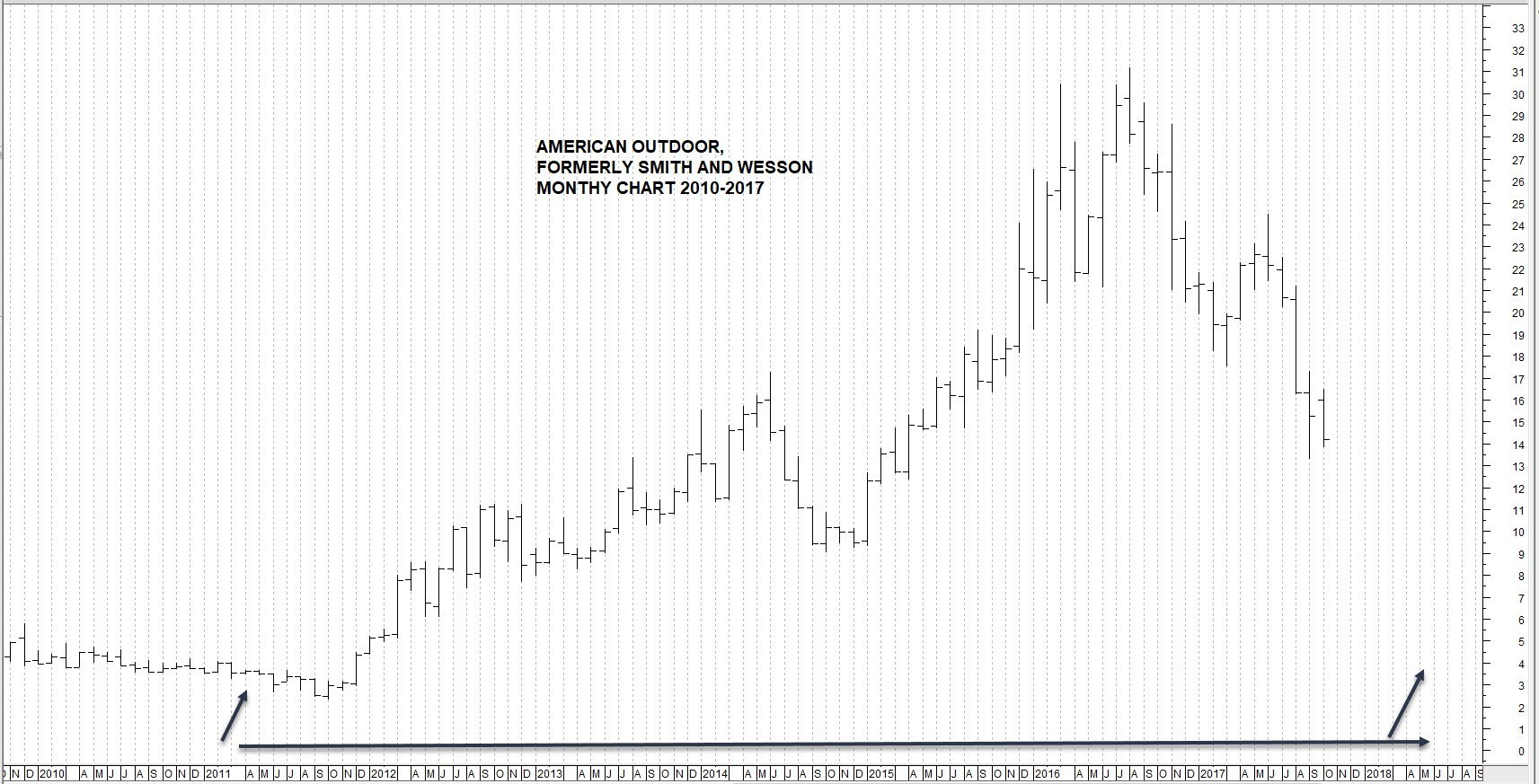
Following its transit of Pisces, Uranus then began its next 7-year journey into Aries. It was fully in Aries as of March 12, 2011, and will continue there until May 15, 2018, when it ingresses for the first of two times into Taurus. One of the main stock sectors that Aries rules is weapons, such as guns. We don’t have a “Guns” sector to draw a chart from, so we will use, as a proxy, the stock American Outdoor (symbol AOBC), formerly Smith and Wesson, a well-known gun manufacturer in the USA.
In March 2011, the low of AOBC was $3.27. It eventually bottomed at 2.29 in October 2011. However, as Uranus in Aries began to assert itself, and many people began to re-arm themselves, the stock soared to a high of 31.19 in August 2016. This represented a gain of 853% while Uranus was in Aries. It is still in Aries as this is being written in October 2017, and the price has fallen to a low of 13.28 as of September 2017, a loss of 57.4%, so far. It could fall lower before finally entering Taurus this year.
This now brings us to the next phase of the greater Uranus cycle, which will be in Taurus. Its first entry into Taurus will happen on May 15, 2018. As in previous instances, its first foray into a new sign does not last long. It retrogrades back into Aries, November 6, 2018 through March 6, 2019. It then re-enters Taurus, where it remains uninterrupted until July 7, 2025, when it makes its first ingress into Gemini. It is thus this period of March 6, 2019 through July 7, 2025, that we anticipate the boom/bust pattern to manifest in sectors of the economy ruled by Taurus. That would involve banks and cattle. That is, we anticipate the price of beef (cattle) and/or the stock price of banks will soar close to - or more than - 400% from March 2019 through the following 3-6 years, and then collapse, losing over 50% of its value, and perhaps close to 80%, prior to July 2025. If that indeed happens, then this information alone will cover your cost for this year’s Forecast Book, and all future editions of the Forecast Book for as long as I shall remain on Earth in this incarnation.
This correlation also fits into our view of what will happen to world banks – central banks – over the course of the next 3-7 years. Uranus is the planet of disruption, revolution, and breaking away from tradition. Whatever has been the “norm” of central banks over the past 84 years is vulnerable to revolutionary change. By association, this could also have a huge impact on currencies, especially the US Dollar, which has served as the world standard currency since 1944, shortly after Uranus last passed through Taurus (and was in a square aspect with Saturn). This subject will be discussed in greater detail in the pages that follow, but the projection is that banks will thrive for the next couple of years, and then run into a wall.
The banking rules/laws will change as Uranus will be in Taurus, and especially after Saturn enters in Aquarius after March 22, 2020, square to one another. Money could take on a new form, and be used for purposes we cannot conceive of today. The result of this transformation may be good for banking stocks at first, but then the drastic changes are apt to be met with hysteria, as bankers go “bonkers.” They may be unable to adapt to the unintended consequences of their experiments. Or they may develop a malady, known as “greed,” and/or “hoarding,” which afflicts some non-aware Taurus natives, or people engaged in Taurus-ruled enterprises, which doesn’t go well with an inability to adapt to suddenly changing circumstances. Banking stocks soar. Bankers do not get out at the top. Banking stocks then crash, and then the chickens come home to roost, as depositors rush to withdraw their monies.
There is a message here for parents: Mothers, don’t let your children grow up to be bankers. Let them grow up to be cowboys.
Author

Raymond Merriman, CTA
The Merriman Market Analyst
Raymond A. Merriman is the President of the Merriman Market Analyst, Inc and founder of the Merriman Market Timing Academy.